« Arab Spring Against Terrorism: Issues and Perspectives » : différence entre les versions
Aucun résumé des modifications |
Aucun résumé des modifications |
||
| (14 versions intermédiaires par le même utilisateur non affichées) | |||
| Ligne 1 : | Ligne 1 : | ||
{{Infobox Lecture | {{Infobox Lecture | ||
| image = | | image = Olivier roy printemps arabe inside.jpg | ||
| image_caption = | | image_caption = | ||
| faculté = [[Faculté des sciences de la société]] | | faculté = [[Faculté des sciences de la société]] | ||
| Ligne 19 : | Ligne 19 : | ||
* [[Combating terrorism and rebuilding transatlantic relations]] | * [[Combating terrorism and rebuilding transatlantic relations]] | ||
* [[Arab Spring Against Terrorism: Issues and Perspectives]] | * [[Arab Spring Against Terrorism: Issues and Perspectives]] | ||
* [[Homegrown jihadism | * [[Homegrown jihadism: How to prevent terrorist catastrophe?]] | ||
}} | }} | ||
We are going to reflect on the link between Arab Spring and terrorism. Arab Spring may have been a moment of parenthesis for violent action, but today, as we can see in the former liberated countries, we could speak of terrorism against Arab Spring. | |||
What are the possible relations between Arab Spring as a popular and spontaneous movement and the place of terrorism in the Muslim space? The first thing that emerges is a question of justice and equity in order to move towards recognition of the individual in sound political management. What is carried by these revolutions and the order of justice and not at all political violence. The awakening of the peoples appears by a thirst for democracy and to refute any form of violence, whether it be Praetorian or terrorist violence. It is a blocked society that no longer has the capacity to offer its children the capacity to be and become because they are societies with high unemployment rates, societies that have accumulated high inequalities and societies that concern inequalities linked to the social status of individuals. In this popular revolution of the Arab Spring, there is something of the order of authenticity. The idea is that this street democracy should lead to a political democracy. | |||
There would be a direct relationship - from cause to immediate effect - between popular revolution and terrorist question. The revival of the peoples from Tunis to Benghazi, via Cairo, would marginalize terrorism. The thirst for democracy and equality would sound the death knell for all forms of political violence, especially that imported by Al Qaeda. | |||
The second vision states that there is a popular demand for emancipation. Basically, the hypothesis questions whether we are moving towards a democratic transition. This hypothesis is doubtful in itself because democratic transitions are always very slow. A window opens, but the question arises as to whether this window is unlikely to open towards a religious fundamentalism that would be a depite-like counter-reaction to the hypothesis of a political Islam dependent on violence or political action, whether it is a group like Al Qaeda or a state that organizes violence as a mode of functioning. It is a more pessimistic vision, of an evolution towards the opposite of what is necessary to think about the origin. In other words, what if Arab Spring, in the collective disarray of slow and complex democratic transitions, led to the return of religious fundamentalism, to the very source of a political Islam strongly dependent on violence and group or state terrorist action? | |||
These are two antithetical visions that have largely marked the debate on the constitution of the Arab Spring. The Arab Spring could have led to another form of political violence or could have been a formidable machine that would eliminate violent action. The temporality allows us to establish a new political reflection or a new reflection on society. It is the difference with protest that is the opposition's statement, but it is not enough to move on to democracy. Must regulate a set of devices both in society as well as the means of protest to transform protest into construction and exchange. | |||
Arab Spring Spring produces a cascade effect["the Arab Spring's cascading effects"] from Tunisia being a formidable vector of transformation. We also need to look at those who did not have an Arab Spring and we need to look at the factors that led to the absence of an Arab Spring. There is a difficulty in understanding and analysing this phenomenon. In the West, we depend on our referents and our own constructed representations of what democracy is. It has also been very difficult in the West to interpret and understand this phenomenon, but also to integrate it as a fundamental and important factor in the political transition of these countries, showing that political positions have been very complex. | |||
{{Translations | |||
| fr = Le Printemps arabe contre le terrorisme : enjeux et perspectives | |||
| es = Primavera árabe contra el terrorismo: cuestiones y perspectivas | |||
| it = La Primavera araba contro il terrorismo: questioni e prospettive | |||
| de = Arabischer Frühling gegen den Terrorismus: Herausforderungen und Perspektiven | |||
}} | |||
= Arab Spring and Islamist Terrorism: THe Pandora Box Theory = | |||
It is the hypothesis that since there are closed, closed and authoritarian political systems, the problem did not come out of them. From the moment we open the box, problems emerge. First, there is an effect of prism and distancing in the West between our representations of politics and its virtues, modelled on the Athenian City. This representation has led to distance and lack of understanding of the institutional processes that have taken place in the Middle East. The hypothesis on which the West has always functioned is the idea that political modernity in the sense that society can change, evolve, reflect on the integration of society, use democracy as a political system and appear as a virtue of our liberal democracies, but did not appear to the West to be a fashion for Eastern cultures. For a long time, political science and democratic analysis saw Middle Eastern regimes as unable to access democracy. The West values European modernity as a universalist model. In a way, American political science considered that democracy was a monopoly of Western democracies and that one should try or try to transplant it from the countries of the Middle East. The idea is that the link was built between economic development and political development. It is important to implement an economic development model to implement a model of democracy. | |||
== | == Conceptual a priori of the ethnocentric vision of Western political modernity == | ||
[[Fichier:The passing of traditional factory.jpg|200px|vignette|droite|Lerner, Daniel. The Passing of Traditional Society: Modernizing the Middle East. Glencoe, IL: Free, 1958. ]] | [[Fichier:The passing of traditional factory.jpg|200px|vignette|droite|Lerner, Daniel. The Passing of Traditional Society: Modernizing the Middle East. Glencoe, IL: Free, 1958. ]] | ||
Daniel Lerner [1917 | Daniel Lerner [1917 - 1980], Professor at the Massachusetts Institute of Technology [MIT] publishes The passing of traditional society. Modernizing the Middle East, a study of Egypt, Iran, Jordan, Lebanon, Syria and Turkey in 1958. The idea is that since these countries are unable to access political modernity because there is resistance, the power of tribes, because there is corruption and military, political modernization cannot be a modernization that will only come from outside. Modernity can only be Western, since it is the West that possesses the motor of modernity and democracy. It excludes any Arab political modernity eliminating the hypothesis that there may be a process of political modernity in these countries. If it is to be brought from outside, in the theory of modernization, it is brought about by the economic change that will disrupt the functioning of society. Democracy will come through economics through processes that are industrialization, the progressive transfer of industrial technologies, the constitution of new production relationships and the massing of products that bring a kind of universality. | ||
[[Fichier:Cheminee2.jpg|200px|vignette|droite]] | [[Fichier:Cheminee2.jpg|200px|vignette|droite]] | ||
Innovation would be important with urbanization, which is a changing deculturation and transformation of lifestyles that can change mentalities. On the loss of the culture of origin will be able to build a new culture. Media deployment can transform communication. The communication space has proved to be a formidable challenge in accessing information. The Internet is a great tool. Political democracy will emerge from the mobilization of individuals in "universalist" behaviour. | |||
[[Fichier:Jacques Berque.png|150px|vignette|gauche|Jacques Berque.]] | [[Fichier:Jacques Berque.png|150px|vignette|gauche|Jacques Berque.]] | ||
Daniel Lerner's work did not pass into posterity, because it is an ethnocentric and dated vision of American theories of economic and political development and at the same time, emerges the current of "other or second Arab modernity" embodied by the social and cultural anthropology around Arabic speakers. | |||
Jacques Berque [1910 | Jacques Berque [1910 - 1995] went on to say that we must move away from the dominant Western representation in order to question the second modernity that would be an Arab modernity. The modernity we are talking about for humanity is a Western modernity that involves the model of Greek democracy, but also welfare state. It emphasises that we have not understood that the incompatibility between Islam and democracy with forms of grassroots democracy must be called into question. Basically, there are individual expression rights in Islam that are interesting, but do not refer to our democracy as such. Under Mubarak and El Sadat, there were islands and democratic pockets in an authoritarian system. | ||
== | == The vision of the Arab political world as that of fixity == | ||
[[Fichier:Nasser hailing.jpg|200px|vignette|droite]] | [[Fichier:Nasser hailing.jpg|200px|vignette|droite]] | ||
The vision of the Arab political world must be condemned as that of a fixed world. Fixedity is the questioning of Western powers who feel that they are in control of the game and defining others as fixed and unable to evolve. This discourse of fixity goes through the caricature of politicians like Nasser, the interpretation of military power as a praetorian, but also through an interpretation of Islam being reasons why they cannot access democracy. | |||
However, in the context of the Cold War, this vision makes it possible to rely on Praetorian regimes to secure its own area of strategic influence as a bulwark for Soviet influence in North Africa and the Middle East. The fall of the Shah of Iran, the rise of political Islam and the constitution of the Islamic Republic of Iran in 1979 led to a strengthening of links between authoritarian, Praetorian and Arab secularist regimes and the Western powers. Egypt will join Saudi Arabia as a Pivotal states. Libya, described as a terrorist, is respected because the fight against Islamism is the spearhead of its repressive policy. | |||
[[Fichier:Iranian-revolution.jpg|300px|vignette|centré]] | [[Fichier:Iranian-revolution.jpg|300px|vignette|centré]] | ||
== | == The immense paradox of the West == | ||
By representing democracy as the only Western model, there is a schizophrenic vision of being dual. On the one hand, after decolonisation, on the other hand, in some ways decolonisation is refused and the movement for these peoples is refused, and in Western realpolitik, the most fixist regimes, which are the military regimes opposed to any form of civil liberties that make it possible to imagine that they will create political stability that will serve the Western powers, are supported. It is no longer a question of fighting these regimes, but only of trying to change their policies as much as possible in order to give them a kind of respectability on the international scene. This explains the internal problems of these states and the great frustration of those people who cannot access democracy. | |||
Between 1990 and 1991, the Arab countries of Saudi Arabia, Egypt and Syria were engaged in the international coalition and gained respectability. On 11 September 2011, the anti-terrorism policy is the second high point of convergence between Arab and Western authoritarian regimes. Libya was a regime denounced in the 1970s as a suppo of terrorism. It is a State that has been at the heart of terrorist violence and a State that becomes honourable from the moment terrorism unfolds and can fight terrorism. | |||
== Vision | == Vision of the Arab political world through the spectrum of "survival strategies" == | ||
[[Fichier:Energief.jpg|150px|vignette|droite]] | [[Fichier:Energief.jpg|150px|vignette|droite]] | ||
[[Fichier:Printemps arabe manifestation.jpg|150px|vignette|droite]] | [[Fichier:Printemps arabe manifestation.jpg|150px|vignette|droite]] | ||
From the 1970s and 1980s, these countries entered survival strategies. The survival strategy is that they're stuck. These are States that find themselves in a position where they feed on large incomes, so this does not translate into social equity, spatial and territorial equity and social justice, while these States are put under pressure by Western globalisation. As long as they are rigid Praetorian states that Western countries accommodate themselves with, their state economies are put at risk, which introduces competition from territories on a global scale. These countries are caught between authoritarian rule, the impossibility of democracy and the disintegration of their state. Somewhere, they are obliged to open up to the market economy, which leads to a melting of the public sectors guaranteeing the bureaucracy of the Praetorian regimes and to the undermining of the simple forms of the social state, which leads to dissatisfaction of the middle classes and the popular classes, as well as to an Islamist protest vote and the seizure of public space. | |||
== | == Strategies deployed around the 1990s - 2000 == | ||
These diets will turn into the paradox of trying to survive. Surviving is not living. Make concessions to the "Arab street" through liberal institutional reforms that make it possible to validate the hypothesis of a political transition towards democratic and egalitarian pluralism. All these regimes find themselves in a position where they have to make concessions, but this is only a "concession of opportunity" in order to make people believe that we are going to get to a better human, social and political situation, but in reality, we are letting go of those who are not going to question the government. The foundations of governments in the concessions of opportunity do not touch on the essence of what is demanded by the populations, such as the end of clientelism and the overhaul of the bureaucratic structure or the closure of civil liberties and the right of association, as well as censorship and the control of expression, as well as the exceptional measures against individuals. Survival strategies as in Morocco in 2004 and 2005 show the desire for liberalization. The constitutional reform announced by the young king is abandoned. The hope of a constitutionalist monarchy is fading. | |||
[[Fichier:Photo 8558706.jpg|200px|vignette|droite]] | [[Fichier:Photo 8558706.jpg|200px|vignette|droite]] | ||
| Ligne 86 : | Ligne 93 : | ||
[[Fichier:983211 3 f6c9 michele-alliot-marie-lors-de-la-seance-de.jpg|200px|vignette|droite|Michèle Alliot-Marie]] | [[Fichier:983211 3 f6c9 michele-alliot-marie-lors-de-la-seance-de.jpg|200px|vignette|droite|Michèle Alliot-Marie]] | ||
Gradually, all these offered elements can not lead to anything being partial and at that time the political regimes will be closed. This explains the passage to Arabic Spring. There is a reformed authoritarianism that does not aim to achieve democracy. If there is a challenge to the reformed authoritarianism, there will be no opening towards democracy leading to a mobilization of the street, which will adorn itself with the finery of Islam in order to build itself. Since the state has defeated itself, promises reforms that it will not undertake, these regimes will be closed down by turning to Islam. These simplistic analytical schemes reinforce the paradigm of the ontological incompatibility between Islam and democracy. There is a reversal that questions whether the challenge of "reformed authoritarianism" would not reflect an inability to assume a democratic process under construction and whether the spontaneous takeover of the street would not cover the spectre of a conservative revolution of a political Islamism. | |||
These analyses make it possible to highlight the incomprehension of the Western chancelleries of these events. However, the research had shown the political impasse of survival strategies that went right into the wall because they did not engage in reform. The demand and aspiration for change were perceived as a subversion action without a political and cultural dimension. Interior Minister Michèle Alliot-Marie, in France, has proposed to the National Assembly the use of the French gendarmerie to protect the Ben Ali regime. | |||
= | = Arab Spring and Al-Qaida's "marginalization" of the Arab Spring = | ||
It is necessary to recall some fundamental elements of the terrorist movement." Al Qaeda "means" base "for some," rule "for others." Al-qâ' ida al sulba "has as its translation" solid base "which would be one of the oldest expressions to designate the city of Medina. It is a term that existed before the attacks of 11 September 2001. The true origin can be found in 1979 in the crucible of the Afghanistan war led by Islamist activists against the Soviet armed support to the communist regime threatened by the civil war. | |||
[[Fichier:L'armée rouge dans les montagnes afghane en 83.jpg|300px|vignette|centré]] | [[Fichier:L'armée rouge dans les montagnes afghane en 83.jpg|300px|vignette|centré]] | ||
It is an anti-imperialist strategic reflection that draws on the models of Nasserian pan-Arabism and Palestinian armed struggle, despite its rejection of their socialist and secular dimension. Abdallah Azzam is the thread running between "Palestinian jihad" and "Afghan jihad". In 1984, he published "La Défense des territoires musulmans" (The Defense of Muslim territories) which emphasizes the collective obligation of jihad and the individual obligation[fard' ayn] for all Muslims in the world. Together with Bin Laden, he founded the first training camp for "Arabs" in Afghanistan, but in 1989 was assassinated in an attack. | |||
[[Fichier:111936162 dfb7748133.jpg|200px|vignette|gauche]] | [[Fichier:111936162 dfb7748133.jpg|200px|vignette|gauche]] | ||
These movements have always sought to build a territorial base explaining the war in Afghanistan, but also what is happening in Africa today. There is a fundamental reference to the territory in relation to the rules and norms that Islam instituted in the field of theology and its political philosophy. All these movements always have the need to manufacture territory because the manufacture of territory is a fabrication of legitimacy and legitimacy of the struggle. In the Qur' an, the interpretation of the earth describes the earth as symbolic, but also as material. The spiritual destiny of Islam is made through the construction of the dâr al-Islam[God's house]. In the culture of radical Islam, there is always the idea of the caliphate, which is a territorial institutional system governed by the Koranic law, which is Shariah. We are in the fact that radical Islam thinks itself well within a territorial geopolitical logic by referring to the political and military struggles of Mohammed in the Arabian peninsula. The discourse is global, but it wants rooting. The question of the caliphate is a return to the rivalry of the divine caliphate, but which is retained on the territory in order to concretely build the caliphate on the land that makes the battle we want to fight. There is a world between imagination and reality with the development of dâr al-harb which is the world of war and dâr al-suth or dâr al-ahd which is the world of reconciliation or covenant in order to allow a life together in an act of individual and collective faith which is the umma. | |||
In 1928 Hassan Al-Banna founded the Muslim Brotherhood Association in parallel with the disappearance of the Ottoman caliphate in Istanbul, abolished by Atatürk in 1924. Hassan Al-Banna's theses are close to those of al-Qaeda, because the struggle for a unified vicariate of Islam is also seen as a struggle from the inside out, but also against traitors and corrupted by Westernization. the principle that a land that was once conquered by Islam must reintegrate the dâr Al-Islam is adopted late. This involves the construction of an imaginary caliphate, the sum of all the caliphates that make it possible to envision the reign of Islam. | |||
== | == Geopolitical symbol of insubordinate Afghanistan == | ||
The Soviet withdrawal from Afghanistan and the disappearance of Azzam set Bin Laden free from the domino strategy, based on the assumption of victory in Afghanistan. In 1989, he created al-qaida al-ma' lûmat, a light structure to keep track of missing fighters, provide information to families and centralize data on Arab volunteer fighters. | |||
Bin Laden leaves Afghanistan for Sudan where he finds refuge to carry the sword against Saudi Arabia and Yemen. This parenthesis of nearly four years[1992-1996] offers him the means to perfect his notion of a territorialized operational base. From this sanctuary under the protection of the Sudanese authorities, he organizes the supply of arms to the Afghan front, the collection of funds and fighters, and launches with the bin Laden group in the launching of infrastructure works your bridges, highways, airports and residential complexes. We reach the second circle of Al-Qaida's struggle. Chased out of Sudan at the request of the Americans, he joined Afghanistan in 1996. | |||
[[Fichier:Oussama ben laden-228x300.jpg|200px|vignette|gauche]] | [[Fichier:Oussama ben laden-228x300.jpg|200px|vignette|gauche]] | ||
It was from the mountains of Hindu Kush in Afghanistan on August 23,1996, that he sent his message urging his "Muslim brothers" to free from the yoke of the U. S. military presence "the occupation of the land of the two sanctuaries, the home of the house of Islam and the cradle of prophecy since the death of the Prophet and the source of the divine message where the holy Kaaba is located. The definition of struggle on the historic lands of the "Two Holy Places" of the original Islam covers a kind of defense of the "legendary topography" of the collective spiritual memory of the holy places and lands of Islam, while compelled to that of the Gospels already described. Besides Mecca and Kaaba, Medina and the Prophet's tomb, it obviously includes Jerusalem, the Al-Aqsa Mosque and the Dome of the Rock. | |||
The February 23, 1998 call for the creation of the World Islamic Front for Jihad against Jews and Crusaders marks the definitive overcoming of Abdallah Azzam's geopolitical strategy. This third spatial circle of conflict cannot be interpreted as a rupture in the very organisation of the struggle. The constitution of global jihad requires more than ever before the constitution of a "territorial base" that Bin Laden seeks to develop together with the Taliban government in Afghanistan. With his first experience of the war against Soviet troops, his experience in Sudan as a public works contractor and organizer of the jihadist mobilization, he aspires to make his host country the Jihadistan necessary to continue the struggle. He says so, only the Taliban's Afghanistan is an Islamic country. The swift collapse of this regime under the blows of the international coalition marks the end of its territorialized terrorist enterprise. | |||
== The Fall of the Taliban Regime == | |||
[[Fichier:Apghantaliban.jpg|200px|vignette|droite]] | [[Fichier:Apghantaliban.jpg|200px|vignette|droite]] | ||
== | The export of the struggle by Arab fighters on an open front poses as a major difficulty to reveal the emerging contradictions between local conflicts and a globalized fight. In the case of Chechnya, even if the violence techniques of Wahhabi internationalist jihadism take precedence over guerrilla forms, this hardly covers a rapprochement between Chechen Islamists and Arab fighters' jihadist Islamism. In the name of the issues of Chechnya's national liberation, the former reject the eschatological dimension of a deterritorialised jihadism that makes this territory one more front among others. Internationalist jihadism is perceived as seeking less to work for Chechnya's independence than to maintain an additional frontline zone to fuel the ideal of permanent conflict. As in the proven cases of Palestine with Fatah, but also Hamas and Iraq with the Sunni movements, Al-Qaida has encountered complex political realities on the ground, making it particularly difficult and uncertain to accept its planetary jihad. | ||
== A double distancing: from Al Qaeda towards the Arab revolution and the acquired distancing from Al Qaeda == | |||
[[Fichier:Mohamed bouazizi.jpg|200px|vignette|droite|Mohamed Bouazizi © cjb22 - 2011]] | [[Fichier:Mohamed bouazizi.jpg|200px|vignette|droite|Mohamed Bouazizi © cjb22 - 2011]] | ||
On the side of Al Qaeda, at the time of Arab Spring, there is an existential claim. There will be a devastating effect of the narrowness of the claim. The uprising that is emerging from Tunis poses several problems for Al-Qaida. This is happening in Tunisia, which is not the noble space of Al-Qaida's political struggle. Tunisia is a peripheral space in relation to the fundamental stakes of Al Qaeda that does not fall under its immediate political geostrategy. It is a peripheral space that is not an Al Qaeda history and cultural tradition. On the other hand, it is not the place of all the great ideological movements of the "nahda" which is the rebirth, namely the anti-colonialist struggle, pan-Arabism or Islamism that comes from the Mashrek and not from the Maghreb. This movement does not occur in the immediate geostrategic environment. | |||
The triggering event, read a posteriori, is part of a purely secular political dimension and far from the political consciousness of radical Islam. The immolation of the young Mohammed Bouazizi is not preceded by any political claim, but an act of injustice that takes place in a demand for social and political equity that goes beyond the aspirations of radical Islam. There is simply a call for greater tolerance and respect for individuals in a society that considered the Maghreb as one of the most advanced societies. It's not something Al Qaeda is interested in. There is a greater demand for democratic development and a shift towards a more social political model that reinforces the Western model of representative democracy. | |||
The street will be stormed by young people and the political issue is not at the centre. Al Qaeda does not expect a movement to leave the streets. Al Qaeda thinks through an ideological head that is Bin Laden, through a top-down thinking that is something that is built naturally by an implementation on the territory. Al-Qaida does not believe in a popular movement capable of lifting the revolutionary mass. In this case, it is very far from the Marxist-Leninist revolutionary concept, which is the thought of revolution and mass consciousness that allows revolution in the context of anti-imperialist struggle. Al Qaeda doesn't believe in Arab Spring. The ideology of terror used on the ground by Al Qaeda to provoke a return to a rigid political Islam differs from street protests, even if it sometimes involves violence. | |||
[[Fichier:1609139 3 2987 la-contestation-prend-rapidement-la-forme-d-un.jpg|200px|vignette|droite|REUTERS/AMR ABDALLAH DALSH]] | [[Fichier:1609139 3 2987 la-contestation-prend-rapidement-la-forme-d-un.jpg|200px|vignette|droite|REUTERS/AMR ABDALLAH DALSH]] | ||
| Ligne 133 : | Ligne 142 : | ||
[[Fichier:Tunisie-revolution-femme.jpg|200px|vignette|droite]] | [[Fichier:Tunisie-revolution-femme.jpg|200px|vignette|droite]] | ||
Youth has no reference in society to the establishment of a caliphate or the destruction of the State of Israel. There are no reminders and references to the motives behind al-Qaida's struggles, nor in religious terms - no link with the establishment of a religious caliphate - nor in geopolitical terms - no reference to the liberation of the lands of the prophet al-Islam or the destruction of the State of Israel. The Arab Spring is a demand for a better standard of living and access to more democratic freedoms than Al Qaeda's theological ambitions can satisfy. | |||
On the side of the demonstrators, this is what some have called "the youth of misery" in a context of aggravated crisis. Basically, these young people take a look at the attractiveness of the West as a role model. It is a youth disappointed by political liberalization proclaimed, but never achieved, by unprecedented corruption and by the renunciation of any major political and social reform by the elites in a context of economic crisis amplified by the effects of the great international crisis of 2008. | |||
== | == "Generation tweeter" vs. Al Qaida Nebula Network == | ||
[[Fichier:Most-powerful-photos-of-201118.jpg|200px|vignette|droite]] | [[Fichier:Most-powerful-photos-of-201118.jpg|200px|vignette|droite]] | ||
The concept of "tweeter generation" is the appropriation of the Internet system, but not for the same subversive purposes. The use of social networks has enabled them to mobilize open-mindedly for democratic renewal. That is what authoritarian states did not want. The control of information in an authoritarian regime depends on the control of means of communication. The Arab street youth cannot recognize themselves in the violence of al-Qaida because it is an apocalyptic image of change and becoming. Youth wants more freedom with no interest in finding themselves in the Al Qaeda model. | |||
Young people are in fact the spearheads of contestation based on a triple demand: | |||
# | #the construction of a genuine democratic space leading to freedom of expression and political plurality; | ||
# | #the elaboration of an economic and social policy aimed at the poor, which can help protect against the spread of the precariousness of globalized liberalism; | ||
# | #And as a corollary, distancing oneself from the American hegemony felt to be particularly present and omnipotent over the Arab States since the implementation of anti-terrorist and military and economic control policies after 11 September 2001. | ||
== | == Al Qaeda's fight is outdated and above all historicized == | ||
Al Qaeda's fight seems to them to be outdated and above all historicized, that is to say, in a very particular context of the end of the Cold War and the Soviet occupation in Afghanistan. But in no way can it make sense after the attacks of 2001 and the return of unilateralist power on the international scene, which has been worked out by the desire for a new multilateralism in favour of emerging powers. | |||
<gallery> | <gallery mode="packed"> | ||
Fichier:wtc attentat blow up.jpg | Fichier:wtc attentat blow up.jpg | ||
Fichier:binladen.jpg | Fichier:binladen.jpg | ||
</gallery> | </gallery> | ||
= | = Al Qaeda and the Arab Spring: attempts to return = | ||
But the question that deserves to be asked can be asked in the following form: Would Al-Qaida have been the only conservative force that has been overtaken? How to explain the slow recovery. | |||
== | == Muslim Brotherhood in Egypt == | ||
[[Fichier:250624 un-egyptien-vote-lors-des-elections-legislatives-a-minya-au-sud-du-caire-le-3-janvier-2012.jpg|200px|vignette|droite|afp.com/Khaled Desouki]] | [[Fichier:250624 un-egyptien-vote-lors-des-elections-legislatives-a-minya-au-sud-du-caire-le-3-janvier-2012.jpg|200px|vignette|droite|afp.com/Khaled Desouki]] | ||
On the first point, it is important to remember that the Muslim Brotherhood in Egypt has also been so wait-and-see as to think that repression would have the force of law. It's a movement they don't understand. They are also suspicious of "angry youth" movements that can also lead to uncontrollable forms of rebellion. But the Muslim Brotherhood is a political force in its own right which has entered into a "logic of coalition and therefore of consultation". | |||
Obviously, it is the very distance from the terrain of the struggles - the local establishment for the Muslim Brotherhood - and the distancing of the imaginary from the struggle for California that can partly explain Al-Qaida's wait-and-see attitude and its inability to evolve in terms of political ideas and representations, whereas it is presented as particularly flexible and adapted to the armed struggle. It should also be remembered that the Muslim Brotherhood is a consumer of the Internet less by Facebook or Twitter judged to be unsafe than by Ikhwan Book, an essential complement to Ikhwanweb, the official site of the Muslim Brotherhood. | |||
The first to intervene is the AQMI, who is the first to make a press release with the "Tunisian brothers" on January 13,2011. On 8 February, the Iraqi branch of Al Qaeda challenged the Egyptian revolts. One hypothesis is that Al-Qaida was basically afraid of losing the regimes he was fighting. If there is a change in these regimes, perhaps even Al-Qaida's struggle is no longer legitimate. On May 1st, Bin Laden will describe Arab Spring as a rare historical opportunity because "the sun of revolution has risen in the Maghreb: the light of revolution came from Tunisia. She brought calm to the country and made people happy. It states that "the rebels free of all countries must retain the initiative and be suspicious of dialogue". Bin Laden supports revolutions, but warns against recuperation because the real objective goes beyond the constitution of the caliphate, which must lead to the uprising of the umma according to a triple logic of liberation from the regimes in place[1], the law of men[2] and Western domination[3]. Al-Qaida's effort to recuperate the Arab Spring is aimed at turning its uprisings towards a service to God which is the only possible form of freedom. Bin Laden points out that "Free rebels in all countries must keep the initiative and be suspicious of dialogue". | |||
== Al-Qaida priorities as defined by Ayman Al-Zawahiri at the beginning of June 2011 == | |||
[[Fichier:Ayman-Al-Zawahiri-numero-1-dAl-Qaida.jpg|200px|vignette|droite|Ayman-Al-Zawahiri]] | [[Fichier:Ayman-Al-Zawahiri-numero-1-dAl-Qaida.jpg|200px|vignette|droite|Ayman-Al-Zawahiri]] | ||
Ayman Al-Zawahiri, barely appointed to succeed him at the head of the movement, announced in early June 2011 the continuation of Jihad in the absolute continuity of Bin Laden. Priorities include the liberation of Palestine, the destruction of the State of Israel, the continued struggle in Afghanistan and jihad against the United States. If it shows its support for the uprising of the Muslim peoples, it is in so far as it remains the initial stage necessary for the implementation of the real desired change, which will only be achieved with the return of the Ummah to Sharia law. And to appeal logically also to the rapprochement between young Arab youths and Islamist groups. | |||
== | For its part, the AQIM tries to make the link between the Arab spring and Al-Qaida by asserting after the death of their leader, that "the events that shake the Arab world are only one fruit among the fruits that jihad has harvested and in which the sheikh - Osama bin Laden - has played a leading role". | ||
== The Fall of the Gaddafi regime: a breath of fresh air == | |||
As long as the Arab Spring was internalized by societies, Al-Qaida had no argument. The fall of the Khadafi regime, programmed by the Western powers, creates a breeding ground for Al-Qaida. The West is designated as the ideological stakeholder of this revolution. If the West is behind the revolution, it means that the revolution is at the service of the West. A discourse appears on a threat of Arab Spring hijacked by the West. From the moment Libya plunges into civil war, Al-Qaida will send its men there. These are several factors to the ideological relegitimization for Al Qaeda with a Western coalition led by France which first Western involvement since the beginning of the Arab Spring or the Western support to the Libyan rebellion of the National Transitional Council which is a favourable ideological ground. On 24 October 2011, the president of CNT Libyan Moustapha Abdljalil announced that Sharia law would be the basis of Libyan legislation. | |||
[[Fichier:Libye-de-la-liberation-a-la-charia article landscape pm v8.jpg|300px|vignette|centré|© Esam Al-Fetori / Reuters]] | [[Fichier:Libye-de-la-liberation-a-la-charia article landscape pm v8.jpg|300px|vignette|centré|© Esam Al-Fetori / Reuters]] | ||
== | == The Syrian dossier: second stage == | ||
[[Fichier:Terroristes syrie.jpg|200px|vignette|droite]] | [[Fichier:Terroristes syrie.jpg|200px|vignette|droite]] | ||
The challenge is to overthrow the anti-Islamic regime because it is secular and that is why we must fight in Syria. The second step has now been taken with the Syrian dossier. What is shown in the video posted on jihadist forums on 12 February 2012 where Ayman Al-Zawahiri shows his support for the Syrian protest. While it recommends that Muslims in Turkey, Jordan and Lebanon support the rebellion and overthrow the current regime, which it describes as anti-Islamist, pernicious and cancerous, it reaffirms the need not to be dependent on the West and Turkey, which have had contracts, agreements and shares with that regime for decades and which have only begun to abandon them when they have had contracts, agreements and shares with it. He added:"Depend only on Allah and count on your sacrifices, your resilience and firmness. The conclusion is once again clear. He recommended that the Syrian rebellion establish a "state that defends the Muslim countries, seeks to liberate the Golan Heights and constitutes its jihad to the point of hoisting the banner of victory over the usurped hills of Jerusalem. | |||
The first reinforcement is Libya, opening conveniently Syria which is in close proximity to Israel. What the Libyan land did not offer now seems to be working in Syria. The extension of the state of siege by President Bashar al-Asad, the violence of repression against demonstrators, but also the impossibility of an international position of the major powers by the paralysis of the Russian and Chinese double veto in the United Nations Security Council seem to favour the arrival of al-Qaida on the ground. | |||
== | == Clusters of facts that seem to favour the arrival of Al Qaeda on the ground == | ||
There are clusters of converging troubling facts that seem to be attesting to this in the eyes of experts. They can be cited here: First, at the beginning of February, the Syrian People's Victory Front was created, a jihadist organization under the responsibility of a certain Abu Muhammad Al-Golani who advocates the struggle against Westerners, Turks, Americans and Iran to save the oppressed Syrian people. Then was assassinated on 10 February 2012 in Damascus the Alawite and Baasist Brigadier General Issa Al-Khawli, following the modus operandi of targeted Al-Qaida assassinations. Finally, according to the U. S. intelligence director, the two attacks on 23 December 2011 and the car bombing of 6 January 2012 in Damascus and the double or tripe car bombing on 10 February 2012 in Aleppo against the siege of military intelligence and the headquarters of the security forces "are typical of the attacks committed by Al-Qaida". | |||
<gallery> | <gallery mode="packed"> | ||
Fichier:Aleppo-004.jpg | Fichier:Aleppo-004.jpg | ||
Fichier:Capture d’écran 2014-07-18 à 15.19.24.png|Photo AFP / Louai BESHARA | Fichier:Capture d’écran 2014-07-18 à 15.19.24.png|Photo AFP / Louai BESHARA | ||
</gallery> | </gallery> | ||
Syria would become Al-Qaida's new front in the Middle East, as President Bashar al-Asad denounced it. From a western point of view, the West today can no longer rush the Syrian problem, because alongside the rebellion supported by the West, entire brigades of international jihadists have arrived. | |||
= Conclusion = | = Conclusion = | ||
The analysis of the relations between Arab Spring and terrorism harbours many difficulties because it is dependent on Western representations which attribute to the Middle East an almost pathological impossibility to be able to access democracy on the model of the Islamic revolution of Ayatollah Khomeiny. There is an implicit reference to the conservative model of the revolution in the Arab world within the framework of Algeria in January 1992 and the Islamic Salvation Front. | |||
[[Fichier:Ennahda-supporters.jpg|200px|vignette|droite]] | [[Fichier:Ennahda-supporters.jpg|200px|vignette|droite]] | ||
The political victories of Islamist parties in democratic elections in Tunisia and the Muslim Brotherhood's victory in Egypt have led the West to fear a process of rapid closure of Arab Spring by the emergence of a new political Islamism. The question is what would be the reality of this new democratic power vis-à-vis radical Islam? Islamist parties were not sure that this would lead to political violence. Somewhere, the Islamic parties in power could be a brake on the development of Islamist terrorism. In Egypt, the Muslim Brotherhood was a structuring social force capable of countering the military forces of the Supreme Armed Forces Council. Young people reveal an interventional tension between young people committed to freedom and more conservative adults. The Arab autumn, which would almost naturally follow him, would paradoxically justify the closure of the ongoing democratic process, as it was carried out in the framework of Algeria in January 1992 with the Islamic Salvation Front. | |||
[[Fichier:Tunisie-constitution.jpg|200px|vignette|gauche]] | [[Fichier:Tunisie-constitution.jpg|200px|vignette|gauche]] | ||
Based on the assumption that the emergence of Islamist parties within the framework of the parliamentarism being established in Tunisia and Egypt would not ipso facto lead to political violence and an absolute Islamist regime. Let us recall first of all that the Islamists derive their legitimacy from the revolution itself; that they represent, as in the case of Egypt, the only structuring political force - unlike the Justice Party close to El-Baradei, which is highly divided - capable of countering the military forces of the Supreme Council of the Armed Forces[CSFA]. As political parties, the Ennahda movement as well as that of the Justice and Freedom Party of the Muslim Brotherhood are subject to strong generational tensions between young people thirsting for freedom and more conservative adults. The reference to the restoration of Sharia law must be contextualized according to cultures. The Shariah close to Roman law in the case of the Ennaba movement is not comparable to that of the Muslim Brotherhood, which is also not that of Afghanistan. | |||
[[fichier:photo_hamideddine_bouali-2.jpg|200px|vignette|droite|photo:Hamideddine Bouali]] | [[fichier:photo_hamideddine_bouali-2.jpg|200px|vignette|droite|photo:Hamideddine Bouali]] | ||
It is also important to be aware of the gaps that exist between Islamic parties in the heart of the Arab Spring and Al-Qaida movement. Each of them is first expressed in a logic of the nation-state. Far from claiming, as in 1927, the creation of a caliphate on all Muslim lands, the Muslim Brotherhood has long since claimed recognition in Egyptian political life. Opposed to the Salafist party Al-Nur, the Freedom and Justice Party tries to associate itself within the People's Assembly with the al-Wassat and Wafd parties to become a governing party. Let us recall that it was this structural positioning for more than twenty years, which had provoked against him the fiercest opposition of Al-Qaida accusing him of betraying Islam. The relationship between Arab Spring and terrorism thus becomes meaningful in a more global context of the weakening of the Al-Qaida movement linked in part to the partial successes of Western counterterrorism. But in the same way that Arab Spring initially meant Al-Qaida's weaknesses, it is also the major event - via the Libyan and now Syrian example - that can also relegate their actual violence. | |||
= Annexes = | = Annexes = | ||
| Ligne 219 : | Ligne 232 : | ||
*Malet, David. Foreign Fighters: Transnational Identity in Civil Conflicts | *Malet, David. Foreign Fighters: Transnational Identity in Civil Conflicts | ||
= | = References = | ||
<references/> | <references /> | ||
[[Category:science | [[Category:political science]] | ||
[[Category:relations | [[Category:international relations]] | ||
[[Category:Rémi Baudoui]] | [[Category:Rémi Baudoui]] | ||
[[Category: | [[Category:security]] | ||
[[Category: | [[Category:terrorism]] | ||
[[Category:2011]] | [[Category:2011]] | ||
[[Category:2013]] | [[Category:2013]] | ||
| Ligne 232 : | Ligne 245 : | ||
[[Category:2015]] | [[Category:2015]] | ||
[[Category:2016]] | [[Category:2016]] | ||
[[Category:2017]] | |||
[[Category:2018]] | |||
Version actuelle datée du 16 février 2018 à 17:40

| Faculté | Faculté des sciences de la société |
|---|---|
| Département | Département de science politique et relations internationales |
| Professeur(s) | Rémi Baudoui[1] (2011 - ) |
| Enregistrement | 2014, 2015 |
| Cours | Terrorism and international relations |
Lectures
- Terrorism or terrorisms? Some epistemological considerations
- National security and counter-terrorism: the example of Latin America
- Internationalisation of struggles and emergence of international terrorism
- International relations and the fight against international terrorism
- The United States and the New International Order
- Middle East Geopolitics
- September 11, 2001 ruptures
- Al-Qaida and the "geopolitics of radical terrorism"
- Combating terrorism and rebuilding transatlantic relations
- Arab Spring Against Terrorism: Issues and Perspectives
- Homegrown jihadism: How to prevent terrorist catastrophe?
We are going to reflect on the link between Arab Spring and terrorism. Arab Spring may have been a moment of parenthesis for violent action, but today, as we can see in the former liberated countries, we could speak of terrorism against Arab Spring.
What are the possible relations between Arab Spring as a popular and spontaneous movement and the place of terrorism in the Muslim space? The first thing that emerges is a question of justice and equity in order to move towards recognition of the individual in sound political management. What is carried by these revolutions and the order of justice and not at all political violence. The awakening of the peoples appears by a thirst for democracy and to refute any form of violence, whether it be Praetorian or terrorist violence. It is a blocked society that no longer has the capacity to offer its children the capacity to be and become because they are societies with high unemployment rates, societies that have accumulated high inequalities and societies that concern inequalities linked to the social status of individuals. In this popular revolution of the Arab Spring, there is something of the order of authenticity. The idea is that this street democracy should lead to a political democracy.
There would be a direct relationship - from cause to immediate effect - between popular revolution and terrorist question. The revival of the peoples from Tunis to Benghazi, via Cairo, would marginalize terrorism. The thirst for democracy and equality would sound the death knell for all forms of political violence, especially that imported by Al Qaeda.
The second vision states that there is a popular demand for emancipation. Basically, the hypothesis questions whether we are moving towards a democratic transition. This hypothesis is doubtful in itself because democratic transitions are always very slow. A window opens, but the question arises as to whether this window is unlikely to open towards a religious fundamentalism that would be a depite-like counter-reaction to the hypothesis of a political Islam dependent on violence or political action, whether it is a group like Al Qaeda or a state that organizes violence as a mode of functioning. It is a more pessimistic vision, of an evolution towards the opposite of what is necessary to think about the origin. In other words, what if Arab Spring, in the collective disarray of slow and complex democratic transitions, led to the return of religious fundamentalism, to the very source of a political Islam strongly dependent on violence and group or state terrorist action?
These are two antithetical visions that have largely marked the debate on the constitution of the Arab Spring. The Arab Spring could have led to another form of political violence or could have been a formidable machine that would eliminate violent action. The temporality allows us to establish a new political reflection or a new reflection on society. It is the difference with protest that is the opposition's statement, but it is not enough to move on to democracy. Must regulate a set of devices both in society as well as the means of protest to transform protest into construction and exchange.
Arab Spring Spring produces a cascade effect["the Arab Spring's cascading effects"] from Tunisia being a formidable vector of transformation. We also need to look at those who did not have an Arab Spring and we need to look at the factors that led to the absence of an Arab Spring. There is a difficulty in understanding and analysing this phenomenon. In the West, we depend on our referents and our own constructed representations of what democracy is. It has also been very difficult in the West to interpret and understand this phenomenon, but also to integrate it as a fundamental and important factor in the political transition of these countries, showing that political positions have been very complex.
Arab Spring and Islamist Terrorism: THe Pandora Box Theory[modifier | modifier le wikicode]
It is the hypothesis that since there are closed, closed and authoritarian political systems, the problem did not come out of them. From the moment we open the box, problems emerge. First, there is an effect of prism and distancing in the West between our representations of politics and its virtues, modelled on the Athenian City. This representation has led to distance and lack of understanding of the institutional processes that have taken place in the Middle East. The hypothesis on which the West has always functioned is the idea that political modernity in the sense that society can change, evolve, reflect on the integration of society, use democracy as a political system and appear as a virtue of our liberal democracies, but did not appear to the West to be a fashion for Eastern cultures. For a long time, political science and democratic analysis saw Middle Eastern regimes as unable to access democracy. The West values European modernity as a universalist model. In a way, American political science considered that democracy was a monopoly of Western democracies and that one should try or try to transplant it from the countries of the Middle East. The idea is that the link was built between economic development and political development. It is important to implement an economic development model to implement a model of democracy.
Conceptual a priori of the ethnocentric vision of Western political modernity[modifier | modifier le wikicode]

Daniel Lerner [1917 - 1980], Professor at the Massachusetts Institute of Technology [MIT] publishes The passing of traditional society. Modernizing the Middle East, a study of Egypt, Iran, Jordan, Lebanon, Syria and Turkey in 1958. The idea is that since these countries are unable to access political modernity because there is resistance, the power of tribes, because there is corruption and military, political modernization cannot be a modernization that will only come from outside. Modernity can only be Western, since it is the West that possesses the motor of modernity and democracy. It excludes any Arab political modernity eliminating the hypothesis that there may be a process of political modernity in these countries. If it is to be brought from outside, in the theory of modernization, it is brought about by the economic change that will disrupt the functioning of society. Democracy will come through economics through processes that are industrialization, the progressive transfer of industrial technologies, the constitution of new production relationships and the massing of products that bring a kind of universality.

Innovation would be important with urbanization, which is a changing deculturation and transformation of lifestyles that can change mentalities. On the loss of the culture of origin will be able to build a new culture. Media deployment can transform communication. The communication space has proved to be a formidable challenge in accessing information. The Internet is a great tool. Political democracy will emerge from the mobilization of individuals in "universalist" behaviour.

Daniel Lerner's work did not pass into posterity, because it is an ethnocentric and dated vision of American theories of economic and political development and at the same time, emerges the current of "other or second Arab modernity" embodied by the social and cultural anthropology around Arabic speakers.
Jacques Berque [1910 - 1995] went on to say that we must move away from the dominant Western representation in order to question the second modernity that would be an Arab modernity. The modernity we are talking about for humanity is a Western modernity that involves the model of Greek democracy, but also welfare state. It emphasises that we have not understood that the incompatibility between Islam and democracy with forms of grassroots democracy must be called into question. Basically, there are individual expression rights in Islam that are interesting, but do not refer to our democracy as such. Under Mubarak and El Sadat, there were islands and democratic pockets in an authoritarian system.
The vision of the Arab political world as that of fixity[modifier | modifier le wikicode]

The vision of the Arab political world must be condemned as that of a fixed world. Fixedity is the questioning of Western powers who feel that they are in control of the game and defining others as fixed and unable to evolve. This discourse of fixity goes through the caricature of politicians like Nasser, the interpretation of military power as a praetorian, but also through an interpretation of Islam being reasons why they cannot access democracy.
However, in the context of the Cold War, this vision makes it possible to rely on Praetorian regimes to secure its own area of strategic influence as a bulwark for Soviet influence in North Africa and the Middle East. The fall of the Shah of Iran, the rise of political Islam and the constitution of the Islamic Republic of Iran in 1979 led to a strengthening of links between authoritarian, Praetorian and Arab secularist regimes and the Western powers. Egypt will join Saudi Arabia as a Pivotal states. Libya, described as a terrorist, is respected because the fight against Islamism is the spearhead of its repressive policy.

The immense paradox of the West[modifier | modifier le wikicode]
By representing democracy as the only Western model, there is a schizophrenic vision of being dual. On the one hand, after decolonisation, on the other hand, in some ways decolonisation is refused and the movement for these peoples is refused, and in Western realpolitik, the most fixist regimes, which are the military regimes opposed to any form of civil liberties that make it possible to imagine that they will create political stability that will serve the Western powers, are supported. It is no longer a question of fighting these regimes, but only of trying to change their policies as much as possible in order to give them a kind of respectability on the international scene. This explains the internal problems of these states and the great frustration of those people who cannot access democracy.
Between 1990 and 1991, the Arab countries of Saudi Arabia, Egypt and Syria were engaged in the international coalition and gained respectability. On 11 September 2011, the anti-terrorism policy is the second high point of convergence between Arab and Western authoritarian regimes. Libya was a regime denounced in the 1970s as a suppo of terrorism. It is a State that has been at the heart of terrorist violence and a State that becomes honourable from the moment terrorism unfolds and can fight terrorism.
Vision of the Arab political world through the spectrum of "survival strategies"[modifier | modifier le wikicode]


From the 1970s and 1980s, these countries entered survival strategies. The survival strategy is that they're stuck. These are States that find themselves in a position where they feed on large incomes, so this does not translate into social equity, spatial and territorial equity and social justice, while these States are put under pressure by Western globalisation. As long as they are rigid Praetorian states that Western countries accommodate themselves with, their state economies are put at risk, which introduces competition from territories on a global scale. These countries are caught between authoritarian rule, the impossibility of democracy and the disintegration of their state. Somewhere, they are obliged to open up to the market economy, which leads to a melting of the public sectors guaranteeing the bureaucracy of the Praetorian regimes and to the undermining of the simple forms of the social state, which leads to dissatisfaction of the middle classes and the popular classes, as well as to an Islamist protest vote and the seizure of public space.
Strategies deployed around the 1990s - 2000[modifier | modifier le wikicode]
These diets will turn into the paradox of trying to survive. Surviving is not living. Make concessions to the "Arab street" through liberal institutional reforms that make it possible to validate the hypothesis of a political transition towards democratic and egalitarian pluralism. All these regimes find themselves in a position where they have to make concessions, but this is only a "concession of opportunity" in order to make people believe that we are going to get to a better human, social and political situation, but in reality, we are letting go of those who are not going to question the government. The foundations of governments in the concessions of opportunity do not touch on the essence of what is demanded by the populations, such as the end of clientelism and the overhaul of the bureaucratic structure or the closure of civil liberties and the right of association, as well as censorship and the control of expression, as well as the exceptional measures against individuals. Survival strategies as in Morocco in 2004 and 2005 show the desire for liberalization. The constitutional reform announced by the young king is abandoned. The hope of a constitutionalist monarchy is fading.


Gradually, all these offered elements can not lead to anything being partial and at that time the political regimes will be closed. This explains the passage to Arabic Spring. There is a reformed authoritarianism that does not aim to achieve democracy. If there is a challenge to the reformed authoritarianism, there will be no opening towards democracy leading to a mobilization of the street, which will adorn itself with the finery of Islam in order to build itself. Since the state has defeated itself, promises reforms that it will not undertake, these regimes will be closed down by turning to Islam. These simplistic analytical schemes reinforce the paradigm of the ontological incompatibility between Islam and democracy. There is a reversal that questions whether the challenge of "reformed authoritarianism" would not reflect an inability to assume a democratic process under construction and whether the spontaneous takeover of the street would not cover the spectre of a conservative revolution of a political Islamism.
These analyses make it possible to highlight the incomprehension of the Western chancelleries of these events. However, the research had shown the political impasse of survival strategies that went right into the wall because they did not engage in reform. The demand and aspiration for change were perceived as a subversion action without a political and cultural dimension. Interior Minister Michèle Alliot-Marie, in France, has proposed to the National Assembly the use of the French gendarmerie to protect the Ben Ali regime.
Arab Spring and Al-Qaida's "marginalization" of the Arab Spring[modifier | modifier le wikicode]
It is necessary to recall some fundamental elements of the terrorist movement." Al Qaeda "means" base "for some," rule "for others." Al-qâ' ida al sulba "has as its translation" solid base "which would be one of the oldest expressions to designate the city of Medina. It is a term that existed before the attacks of 11 September 2001. The true origin can be found in 1979 in the crucible of the Afghanistan war led by Islamist activists against the Soviet armed support to the communist regime threatened by the civil war.

It is an anti-imperialist strategic reflection that draws on the models of Nasserian pan-Arabism and Palestinian armed struggle, despite its rejection of their socialist and secular dimension. Abdallah Azzam is the thread running between "Palestinian jihad" and "Afghan jihad". In 1984, he published "La Défense des territoires musulmans" (The Defense of Muslim territories) which emphasizes the collective obligation of jihad and the individual obligation[fard' ayn] for all Muslims in the world. Together with Bin Laden, he founded the first training camp for "Arabs" in Afghanistan, but in 1989 was assassinated in an attack.

These movements have always sought to build a territorial base explaining the war in Afghanistan, but also what is happening in Africa today. There is a fundamental reference to the territory in relation to the rules and norms that Islam instituted in the field of theology and its political philosophy. All these movements always have the need to manufacture territory because the manufacture of territory is a fabrication of legitimacy and legitimacy of the struggle. In the Qur' an, the interpretation of the earth describes the earth as symbolic, but also as material. The spiritual destiny of Islam is made through the construction of the dâr al-Islam[God's house]. In the culture of radical Islam, there is always the idea of the caliphate, which is a territorial institutional system governed by the Koranic law, which is Shariah. We are in the fact that radical Islam thinks itself well within a territorial geopolitical logic by referring to the political and military struggles of Mohammed in the Arabian peninsula. The discourse is global, but it wants rooting. The question of the caliphate is a return to the rivalry of the divine caliphate, but which is retained on the territory in order to concretely build the caliphate on the land that makes the battle we want to fight. There is a world between imagination and reality with the development of dâr al-harb which is the world of war and dâr al-suth or dâr al-ahd which is the world of reconciliation or covenant in order to allow a life together in an act of individual and collective faith which is the umma.
In 1928 Hassan Al-Banna founded the Muslim Brotherhood Association in parallel with the disappearance of the Ottoman caliphate in Istanbul, abolished by Atatürk in 1924. Hassan Al-Banna's theses are close to those of al-Qaeda, because the struggle for a unified vicariate of Islam is also seen as a struggle from the inside out, but also against traitors and corrupted by Westernization. the principle that a land that was once conquered by Islam must reintegrate the dâr Al-Islam is adopted late. This involves the construction of an imaginary caliphate, the sum of all the caliphates that make it possible to envision the reign of Islam.
Geopolitical symbol of insubordinate Afghanistan[modifier | modifier le wikicode]
The Soviet withdrawal from Afghanistan and the disappearance of Azzam set Bin Laden free from the domino strategy, based on the assumption of victory in Afghanistan. In 1989, he created al-qaida al-ma' lûmat, a light structure to keep track of missing fighters, provide information to families and centralize data on Arab volunteer fighters.
Bin Laden leaves Afghanistan for Sudan where he finds refuge to carry the sword against Saudi Arabia and Yemen. This parenthesis of nearly four years[1992-1996] offers him the means to perfect his notion of a territorialized operational base. From this sanctuary under the protection of the Sudanese authorities, he organizes the supply of arms to the Afghan front, the collection of funds and fighters, and launches with the bin Laden group in the launching of infrastructure works your bridges, highways, airports and residential complexes. We reach the second circle of Al-Qaida's struggle. Chased out of Sudan at the request of the Americans, he joined Afghanistan in 1996.

It was from the mountains of Hindu Kush in Afghanistan on August 23,1996, that he sent his message urging his "Muslim brothers" to free from the yoke of the U. S. military presence "the occupation of the land of the two sanctuaries, the home of the house of Islam and the cradle of prophecy since the death of the Prophet and the source of the divine message where the holy Kaaba is located. The definition of struggle on the historic lands of the "Two Holy Places" of the original Islam covers a kind of defense of the "legendary topography" of the collective spiritual memory of the holy places and lands of Islam, while compelled to that of the Gospels already described. Besides Mecca and Kaaba, Medina and the Prophet's tomb, it obviously includes Jerusalem, the Al-Aqsa Mosque and the Dome of the Rock.
The February 23, 1998 call for the creation of the World Islamic Front for Jihad against Jews and Crusaders marks the definitive overcoming of Abdallah Azzam's geopolitical strategy. This third spatial circle of conflict cannot be interpreted as a rupture in the very organisation of the struggle. The constitution of global jihad requires more than ever before the constitution of a "territorial base" that Bin Laden seeks to develop together with the Taliban government in Afghanistan. With his first experience of the war against Soviet troops, his experience in Sudan as a public works contractor and organizer of the jihadist mobilization, he aspires to make his host country the Jihadistan necessary to continue the struggle. He says so, only the Taliban's Afghanistan is an Islamic country. The swift collapse of this regime under the blows of the international coalition marks the end of its territorialized terrorist enterprise.
The Fall of the Taliban Regime[modifier | modifier le wikicode]

The export of the struggle by Arab fighters on an open front poses as a major difficulty to reveal the emerging contradictions between local conflicts and a globalized fight. In the case of Chechnya, even if the violence techniques of Wahhabi internationalist jihadism take precedence over guerrilla forms, this hardly covers a rapprochement between Chechen Islamists and Arab fighters' jihadist Islamism. In the name of the issues of Chechnya's national liberation, the former reject the eschatological dimension of a deterritorialised jihadism that makes this territory one more front among others. Internationalist jihadism is perceived as seeking less to work for Chechnya's independence than to maintain an additional frontline zone to fuel the ideal of permanent conflict. As in the proven cases of Palestine with Fatah, but also Hamas and Iraq with the Sunni movements, Al-Qaida has encountered complex political realities on the ground, making it particularly difficult and uncertain to accept its planetary jihad.
A double distancing: from Al Qaeda towards the Arab revolution and the acquired distancing from Al Qaeda[modifier | modifier le wikicode]

On the side of Al Qaeda, at the time of Arab Spring, there is an existential claim. There will be a devastating effect of the narrowness of the claim. The uprising that is emerging from Tunis poses several problems for Al-Qaida. This is happening in Tunisia, which is not the noble space of Al-Qaida's political struggle. Tunisia is a peripheral space in relation to the fundamental stakes of Al Qaeda that does not fall under its immediate political geostrategy. It is a peripheral space that is not an Al Qaeda history and cultural tradition. On the other hand, it is not the place of all the great ideological movements of the "nahda" which is the rebirth, namely the anti-colonialist struggle, pan-Arabism or Islamism that comes from the Mashrek and not from the Maghreb. This movement does not occur in the immediate geostrategic environment.
The triggering event, read a posteriori, is part of a purely secular political dimension and far from the political consciousness of radical Islam. The immolation of the young Mohammed Bouazizi is not preceded by any political claim, but an act of injustice that takes place in a demand for social and political equity that goes beyond the aspirations of radical Islam. There is simply a call for greater tolerance and respect for individuals in a society that considered the Maghreb as one of the most advanced societies. It's not something Al Qaeda is interested in. There is a greater demand for democratic development and a shift towards a more social political model that reinforces the Western model of representative democracy.
The street will be stormed by young people and the political issue is not at the centre. Al Qaeda does not expect a movement to leave the streets. Al Qaeda thinks through an ideological head that is Bin Laden, through a top-down thinking that is something that is built naturally by an implementation on the territory. Al-Qaida does not believe in a popular movement capable of lifting the revolutionary mass. In this case, it is very far from the Marxist-Leninist revolutionary concept, which is the thought of revolution and mass consciousness that allows revolution in the context of anti-imperialist struggle. Al Qaeda doesn't believe in Arab Spring. The ideology of terror used on the ground by Al Qaeda to provoke a return to a rigid political Islam differs from street protests, even if it sometimes involves violence.


Youth has no reference in society to the establishment of a caliphate or the destruction of the State of Israel. There are no reminders and references to the motives behind al-Qaida's struggles, nor in religious terms - no link with the establishment of a religious caliphate - nor in geopolitical terms - no reference to the liberation of the lands of the prophet al-Islam or the destruction of the State of Israel. The Arab Spring is a demand for a better standard of living and access to more democratic freedoms than Al Qaeda's theological ambitions can satisfy.
On the side of the demonstrators, this is what some have called "the youth of misery" in a context of aggravated crisis. Basically, these young people take a look at the attractiveness of the West as a role model. It is a youth disappointed by political liberalization proclaimed, but never achieved, by unprecedented corruption and by the renunciation of any major political and social reform by the elites in a context of economic crisis amplified by the effects of the great international crisis of 2008.
"Generation tweeter" vs. Al Qaida Nebula Network[modifier | modifier le wikicode]

The concept of "tweeter generation" is the appropriation of the Internet system, but not for the same subversive purposes. The use of social networks has enabled them to mobilize open-mindedly for democratic renewal. That is what authoritarian states did not want. The control of information in an authoritarian regime depends on the control of means of communication. The Arab street youth cannot recognize themselves in the violence of al-Qaida because it is an apocalyptic image of change and becoming. Youth wants more freedom with no interest in finding themselves in the Al Qaeda model.
Young people are in fact the spearheads of contestation based on a triple demand:
- the construction of a genuine democratic space leading to freedom of expression and political plurality;
- the elaboration of an economic and social policy aimed at the poor, which can help protect against the spread of the precariousness of globalized liberalism;
- And as a corollary, distancing oneself from the American hegemony felt to be particularly present and omnipotent over the Arab States since the implementation of anti-terrorist and military and economic control policies after 11 September 2001.
Al Qaeda's fight is outdated and above all historicized[modifier | modifier le wikicode]
Al Qaeda's fight seems to them to be outdated and above all historicized, that is to say, in a very particular context of the end of the Cold War and the Soviet occupation in Afghanistan. But in no way can it make sense after the attacks of 2001 and the return of unilateralist power on the international scene, which has been worked out by the desire for a new multilateralism in favour of emerging powers.


Al Qaeda and the Arab Spring: attempts to return[modifier | modifier le wikicode]
But the question that deserves to be asked can be asked in the following form: Would Al-Qaida have been the only conservative force that has been overtaken? How to explain the slow recovery.
Muslim Brotherhood in Egypt[modifier | modifier le wikicode]

On the first point, it is important to remember that the Muslim Brotherhood in Egypt has also been so wait-and-see as to think that repression would have the force of law. It's a movement they don't understand. They are also suspicious of "angry youth" movements that can also lead to uncontrollable forms of rebellion. But the Muslim Brotherhood is a political force in its own right which has entered into a "logic of coalition and therefore of consultation".
Obviously, it is the very distance from the terrain of the struggles - the local establishment for the Muslim Brotherhood - and the distancing of the imaginary from the struggle for California that can partly explain Al-Qaida's wait-and-see attitude and its inability to evolve in terms of political ideas and representations, whereas it is presented as particularly flexible and adapted to the armed struggle. It should also be remembered that the Muslim Brotherhood is a consumer of the Internet less by Facebook or Twitter judged to be unsafe than by Ikhwan Book, an essential complement to Ikhwanweb, the official site of the Muslim Brotherhood.
The first to intervene is the AQMI, who is the first to make a press release with the "Tunisian brothers" on January 13,2011. On 8 February, the Iraqi branch of Al Qaeda challenged the Egyptian revolts. One hypothesis is that Al-Qaida was basically afraid of losing the regimes he was fighting. If there is a change in these regimes, perhaps even Al-Qaida's struggle is no longer legitimate. On May 1st, Bin Laden will describe Arab Spring as a rare historical opportunity because "the sun of revolution has risen in the Maghreb: the light of revolution came from Tunisia. She brought calm to the country and made people happy. It states that "the rebels free of all countries must retain the initiative and be suspicious of dialogue". Bin Laden supports revolutions, but warns against recuperation because the real objective goes beyond the constitution of the caliphate, which must lead to the uprising of the umma according to a triple logic of liberation from the regimes in place[1], the law of men[2] and Western domination[3]. Al-Qaida's effort to recuperate the Arab Spring is aimed at turning its uprisings towards a service to God which is the only possible form of freedom. Bin Laden points out that "Free rebels in all countries must keep the initiative and be suspicious of dialogue".
Al-Qaida priorities as defined by Ayman Al-Zawahiri at the beginning of June 2011[modifier | modifier le wikicode]

Ayman Al-Zawahiri, barely appointed to succeed him at the head of the movement, announced in early June 2011 the continuation of Jihad in the absolute continuity of Bin Laden. Priorities include the liberation of Palestine, the destruction of the State of Israel, the continued struggle in Afghanistan and jihad against the United States. If it shows its support for the uprising of the Muslim peoples, it is in so far as it remains the initial stage necessary for the implementation of the real desired change, which will only be achieved with the return of the Ummah to Sharia law. And to appeal logically also to the rapprochement between young Arab youths and Islamist groups.
For its part, the AQIM tries to make the link between the Arab spring and Al-Qaida by asserting after the death of their leader, that "the events that shake the Arab world are only one fruit among the fruits that jihad has harvested and in which the sheikh - Osama bin Laden - has played a leading role".
The Fall of the Gaddafi regime: a breath of fresh air[modifier | modifier le wikicode]
As long as the Arab Spring was internalized by societies, Al-Qaida had no argument. The fall of the Khadafi regime, programmed by the Western powers, creates a breeding ground for Al-Qaida. The West is designated as the ideological stakeholder of this revolution. If the West is behind the revolution, it means that the revolution is at the service of the West. A discourse appears on a threat of Arab Spring hijacked by the West. From the moment Libya plunges into civil war, Al-Qaida will send its men there. These are several factors to the ideological relegitimization for Al Qaeda with a Western coalition led by France which first Western involvement since the beginning of the Arab Spring or the Western support to the Libyan rebellion of the National Transitional Council which is a favourable ideological ground. On 24 October 2011, the president of CNT Libyan Moustapha Abdljalil announced that Sharia law would be the basis of Libyan legislation.

The Syrian dossier: second stage[modifier | modifier le wikicode]

The challenge is to overthrow the anti-Islamic regime because it is secular and that is why we must fight in Syria. The second step has now been taken with the Syrian dossier. What is shown in the video posted on jihadist forums on 12 February 2012 where Ayman Al-Zawahiri shows his support for the Syrian protest. While it recommends that Muslims in Turkey, Jordan and Lebanon support the rebellion and overthrow the current regime, which it describes as anti-Islamist, pernicious and cancerous, it reaffirms the need not to be dependent on the West and Turkey, which have had contracts, agreements and shares with that regime for decades and which have only begun to abandon them when they have had contracts, agreements and shares with it. He added:"Depend only on Allah and count on your sacrifices, your resilience and firmness. The conclusion is once again clear. He recommended that the Syrian rebellion establish a "state that defends the Muslim countries, seeks to liberate the Golan Heights and constitutes its jihad to the point of hoisting the banner of victory over the usurped hills of Jerusalem.
The first reinforcement is Libya, opening conveniently Syria which is in close proximity to Israel. What the Libyan land did not offer now seems to be working in Syria. The extension of the state of siege by President Bashar al-Asad, the violence of repression against demonstrators, but also the impossibility of an international position of the major powers by the paralysis of the Russian and Chinese double veto in the United Nations Security Council seem to favour the arrival of al-Qaida on the ground.
Clusters of facts that seem to favour the arrival of Al Qaeda on the ground[modifier | modifier le wikicode]
There are clusters of converging troubling facts that seem to be attesting to this in the eyes of experts. They can be cited here: First, at the beginning of February, the Syrian People's Victory Front was created, a jihadist organization under the responsibility of a certain Abu Muhammad Al-Golani who advocates the struggle against Westerners, Turks, Americans and Iran to save the oppressed Syrian people. Then was assassinated on 10 February 2012 in Damascus the Alawite and Baasist Brigadier General Issa Al-Khawli, following the modus operandi of targeted Al-Qaida assassinations. Finally, according to the U. S. intelligence director, the two attacks on 23 December 2011 and the car bombing of 6 January 2012 in Damascus and the double or tripe car bombing on 10 February 2012 in Aleppo against the siege of military intelligence and the headquarters of the security forces "are typical of the attacks committed by Al-Qaida".
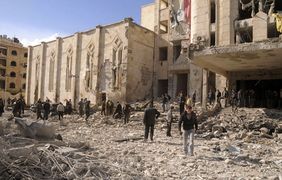

Photo AFP / Louai BESHARA


Syria would become Al-Qaida's new front in the Middle East, as President Bashar al-Asad denounced it. From a western point of view, the West today can no longer rush the Syrian problem, because alongside the rebellion supported by the West, entire brigades of international jihadists have arrived.
Conclusion[modifier | modifier le wikicode]
The analysis of the relations between Arab Spring and terrorism harbours many difficulties because it is dependent on Western representations which attribute to the Middle East an almost pathological impossibility to be able to access democracy on the model of the Islamic revolution of Ayatollah Khomeiny. There is an implicit reference to the conservative model of the revolution in the Arab world within the framework of Algeria in January 1992 and the Islamic Salvation Front.

The political victories of Islamist parties in democratic elections in Tunisia and the Muslim Brotherhood's victory in Egypt have led the West to fear a process of rapid closure of Arab Spring by the emergence of a new political Islamism. The question is what would be the reality of this new democratic power vis-à-vis radical Islam? Islamist parties were not sure that this would lead to political violence. Somewhere, the Islamic parties in power could be a brake on the development of Islamist terrorism. In Egypt, the Muslim Brotherhood was a structuring social force capable of countering the military forces of the Supreme Armed Forces Council. Young people reveal an interventional tension between young people committed to freedom and more conservative adults. The Arab autumn, which would almost naturally follow him, would paradoxically justify the closure of the ongoing democratic process, as it was carried out in the framework of Algeria in January 1992 with the Islamic Salvation Front.

Based on the assumption that the emergence of Islamist parties within the framework of the parliamentarism being established in Tunisia and Egypt would not ipso facto lead to political violence and an absolute Islamist regime. Let us recall first of all that the Islamists derive their legitimacy from the revolution itself; that they represent, as in the case of Egypt, the only structuring political force - unlike the Justice Party close to El-Baradei, which is highly divided - capable of countering the military forces of the Supreme Council of the Armed Forces[CSFA]. As political parties, the Ennahda movement as well as that of the Justice and Freedom Party of the Muslim Brotherhood are subject to strong generational tensions between young people thirsting for freedom and more conservative adults. The reference to the restoration of Sharia law must be contextualized according to cultures. The Shariah close to Roman law in the case of the Ennaba movement is not comparable to that of the Muslim Brotherhood, which is also not that of Afghanistan.

It is also important to be aware of the gaps that exist between Islamic parties in the heart of the Arab Spring and Al-Qaida movement. Each of them is first expressed in a logic of the nation-state. Far from claiming, as in 1927, the creation of a caliphate on all Muslim lands, the Muslim Brotherhood has long since claimed recognition in Egyptian political life. Opposed to the Salafist party Al-Nur, the Freedom and Justice Party tries to associate itself within the People's Assembly with the al-Wassat and Wafd parties to become a governing party. Let us recall that it was this structural positioning for more than twenty years, which had provoked against him the fiercest opposition of Al-Qaida accusing him of betraying Islam. The relationship between Arab Spring and terrorism thus becomes meaningful in a more global context of the weakening of the Al-Qaida movement linked in part to the partial successes of Western counterterrorism. But in the same way that Arab Spring initially meant Al-Qaida's weaknesses, it is also the major event - via the Libyan and now Syrian example - that can also relegate their actual violence.
Annexes[modifier | modifier le wikicode]
- Foreign Policy,. (2015). Al Qaeda Boss Zawahiri Pledges Allegiance to New Taliban Leader. Retrieved 13 August 2015, from https://foreignpolicy.com/2015/08/13/al-qaeda-boss-zawahiri-pledges-allegiance-to-new-taliban-leader
- Malet, David. Foreign Fighters: Transnational Identity in Civil Conflicts