The Civil Rights Movement in the United States
Based on a lecture by Aline Helg[1][2][3][4][5][6][7]
The Americas on the eve of independence ● The independence of the United States ● The U.S. Constitution and Early 19th Century Society ● The Haitian Revolution and its Impact in the Americas ● The independence of Latin American nations ● Latin America around 1850: societies, economies, policies ● The Northern and Southern United States circa 1850: immigration and slavery ● The American Civil War and Reconstruction: 1861 - 1877 ● The (re)United States: 1877 - 1900 ● Regimes of Order and Progress in Latin America: 1875 - 1910 ● The Mexican Revolution: 1910 - 1940 ● American society in the 1920s ● The Great Depression and the New Deal: 1929 - 1940 ● From Big Stick Policy to Good Neighbor Policy ● Coups d'état and Latin American populisms ● The United States and World War II ● Latin America during the Second World War ● US Post-War Society: Cold War and the Society of Plenty ● The Cold War in Latin America and the Cuban Revolution ● The Civil Rights Movement in the United States
The civil rights movement in the United States marked an era of profound transformation in the American social and political fabric, fighting hard to dismantle racial segregation and abolish systematic discrimination against African-Americans. At the heart of this mid-20th century social revolution were determined young people, particularly daring students, who played a pivotal role in orchestrating and joining peaceful sit-ins, Freedom Rides and other forms of non-violent resistance. Their unwavering commitment not only captured the nation's attention but also ignited a wave of solidarity, inspiring people from all walks of life to get involved in the quest for equity.
Iconic figures such as the Reverend Martin Luther King Jr, who was himself young when he first became involved, embodied the spirit and resilience of the movement. Under their inspirational leadership, historic legislative advances were made, including the passage of the Civil Rights Act of 1964 and the Voting Rights Act of 1965, marking essential milestones towards a more just society.
The memory of Martin Luther King Jr, whose birth is commemorated every 15 January, lives on beyond his achievements. Federal Martin Luther King Jr. Day, established by President Ronald Reagan in 1983 and celebrated for the first time in January 1986, not only honours the legacy of this visionary leader but also embodies a call to action. Observed on the third Monday in January, the day encourages citizens to embrace community spirit and perpetuate King's legacy through civic service and acts of kindness, reaffirming the collective commitment to the ideals of peace and equality for which he fought so passionately.
Speech delivered on 28 August 1963 before the Lincoln Memorial in Washington, D.C., is widely regarded as one of the greatest and most influential speeches of the 20th century.[8] According to US Congressman John Lewis, who also spoke that day on behalf of the Student Nonviolent Coordinating Committee. "By speaking as he did, he educated, he inspired, he guided not just the people who were there, but people all over America and generations to come.[9]
During the annual commemorations of Martin Luther King Jr. Day, the echoes of King's vibrant words ring out with particular resonance, particularly when his historic "I Have a Dream" speech is recalled. Delivered to a crowd of people at the March on Washington for Jobs and Freedom in 1963, this speech has become emblematic of the fight for social justice. On this day of reflection and recognition, King's oratorical legacy is celebrated not only for its rhetorical power but also for its call to action in favour of equality and human dignity. King's words continue to galvanise communities around the values of diversity and respect for minority rights, while commemorating significant advances in the struggle for civil rights. However, beyond the tribute, his speeches are a poignant reminder of the need for continued commitment. They encourage introspection about the challenges of today in the quest to realise King's vision of a society without barriers of race, class or creed. The lessons of his speeches are universal and timeless, advocating a world where hope overcomes hatred, love triumphs over fear, and reconciliation breaks the chains of oppression. Martin Luther King's speeches remain etched in America's cultural heritage, inspiring new generations to continue the march towards a more inclusive and loving society. Today, as we strive to build bridges of understanding and equity, King's voice still resonates, urging us to remain steadfast in our commitment to justice and social harmony.
The "I Have a Dream" speech delivered by Martin Luther King Jr. on the steps of the Lincoln Memorial on 28 August 1963, during the March on Washington, remains one of the most powerful calls for social justice in modern history. In this eloquent message, King highlighted the deep scars of America - the abuses of segregation, the insidious obstacles to equal rights at work and at the ballot box, and the heavy burden of racial inequality weighing on the lives of African-Americans. King painted a stark picture of the America of his time, a nation riddled with glaring contradictions between its ideals of freedom and the reality of racial oppression. But instead of sinking into despair, King raised his voice in a vibrant symphony of optimism, weaving a prophetic vision of a transformed America. He not only spoke of dreams, he summoned the collective imagination to envision a renewed brotherhood where every man, woman and child would be measured by their shared humanity rather than arbitrary criteria of race or colour. The moral force of this speech lay in the audacity of a dream that transcended the boundaries established by history and unjust laws. King issued a resounding call to build a future where black and white children could hold hands as brothers and sisters, where the bells of freedom would ring in every corner of the land, and where justice would flow like waters and righteousness like an endless stream. It was not just the clarity of his message that captivated, but the passion with which he delivered it, a passion that continues to resonate just as strongly today. The 'I Have a Dream' speech encapsulated the dualism of the black American experience - the pain of the past and the hope of the future.
The resonance of Martin Luther King Jr's "I Have a Dream" speech undoubtedly served as a catalyst for the civil rights movement, galvanising public opinion and strengthening the resolve of activists. King's eloquence and the strength of the movement accelerated legislative change, pushing the federal government to act with greater urgency against institutionalised racial injustice. The passage of the Civil Rights Act of 1964 represented a crucial milestone in this struggle, embodying a radical shift in national policy towards segregation and discrimination. With its wide-ranging provisions, the Act dismantled the legal basis for segregation in public places and imposed equal access to employment, setting a new standard for civil rights in America. It also gave the federal government the power and authority to counter segregationist systems, particularly in the South. Complementing this legislation, the Voting Rights Act of 1965 was a decisive step forward in the democratisation of America. By ending discriminatory tactics such as literacy tests and other barriers that prevented African-Americans from voting, the Act fundamentally transformed the political landscape, opening the door to more equitable representation and participation. These two laws, the result of the relentless and often dangerous activism of civil rights campaigners, brought many of the movement's aspirations to fruition. They embodied the courage, perseverance and faith in humanity that were expressed in the streets, on the courthouse steps and in prison cells. The legacy of these laws, along with the efforts of figures like Martin Luther King Jr. and many others, marks a turning point in American history. Not only did they pave the way for formal equality before the law for African Americans, but they also laid the foundations for an ongoing national dialogue on justice, fairness and human rights.
The 14th and 15th Amendments were essential constitutional milestones in the long struggle for racial equality in the United States. Adopted during the Reconstruction era, they sought to redefine citizenship and civil rights at a time when America was recovering from the deep divisions of the Civil War. The 14th Amendment established a fundamental principle of equality before the law, designed to protect the rights of citizens, including freed former slaves. It introduced key citizenship clauses, the Equal Protection Clause and the Due Process Clause, which formed the basis of important legal decisions over the following centuries. The 15th Amendment followed, explicitly prohibiting racial discrimination in the exercise of the right to vote. This was a significant effort to include African Americans in American political life and to secure their right to participate in the governance of the country. Despite these constitutional protections, the reality was far from reflecting the proclaimed principles of equality. Practices such as Jim Crow laws, literacy tests, head taxes and grandfather clauses were designed to circumvent these amendments, de facto perpetuating the discrimination and exclusion of African-Americans from political and social life. The civil rights movement of the mid-20th century was a direct response to the failure of the states to live up to the promises of the 14th and 15th amendments. The legislation of the 1960s, specifically the Civil Rights Act of 1964 and the Voting Rights Act of 1965, were passed to systematically address the shortcomings and to force the enforcement of these constitutional rights. These laws not only strengthened legal protections for African Americans but also created mechanisms for federal enforcement, ensuring that the promises of the 14th and 15th Amendments could become a reality for all citizens. So while the amendments laid the theoretical groundwork for racial equality, it was the efforts of the civil rights movement and the resulting legislation that ultimately translated these principles into concrete action and real change.
It is true that the history of the United States is marked by profound contradictions between the ideals of freedom and equality set out in its founding documents and the realities of slavery, segregation and racial discrimination. The abolition of slavery with the 13th Amendment in 1865 marked a crucial step, but the end of slavery did not put an end to the inequality and oppression of African-Americans. Indeed, after the Civil War, systems of discrimination, such as Jim Crow laws in the South, were established to maintain strict separation and inequality between the races, going against the spirit of the 14th and 15th amendments. Redlining, mass incarceration and other policies also had a disproportionate impact on African-American communities, leading to long-term disparities in wealth, education, health and access to housing. However, it is important to note that racial segregation and discrimination were and are far from unique to the United States. Other countries in the Americas, such as Brazil and the Caribbean nations, also have a long history of racial discrimination and struggles for equality, although these systems did not always take the form of codified segregation laws as they did in the United States. Apartheid in South Africa is another example of an institutionalised system of racial discrimination and legal segregation that lasted until the mid-1990s.
Actors for change
The civil rights movement in the United States has a long history, dating back well before the iconic events of the 1950s and 1960s. Its roots lie in earlier struggles against slavery, post-Civil War reconstruction efforts, and ongoing resistance to Jim Crow laws and other institutionalised forms of racism. After the Civil War and the passage of the 13th, 14th and 15th Amendments, African Americans continued to fight for their rights and status as full citizens. During the early 20th century, leaders such as Booker T. Washington and W.E.B. Du Bois took different approaches to promoting the advancement of black Americans. Du Bois' organisation, the National Association for the Advancement of Colored People (NAACP), founded in 1909, played a central role in the struggle for civil rights by using the legal system to challenge discriminatory laws and by conducting public awareness campaigns. The civil rights era of the 1950s and 1960s saw a series of non-violent direct actions, such as the Montgomery Bus Boycott in 1955, initiated by Rosa Parks and led by the young Martin Luther King Jr, who emerged as one of the movement's leading figures. Lunch counter sit-ins, protest marches, Freedom Rides and numerous other acts of civil disobedience put pressure on the federal government and brought international attention to the cause of civil rights. Organisations such as the Student Nonviolent Coordinating Committee (SNCC) and the Congress of Racial Equality (CORE) played an important role in organising young activists and implementing mass protest strategies. Their efforts, and those of many others, led to the passage of key legislation such as the Civil Rights Act of 1964 and the Voting Rights Act of 1965, which marked a turning point in the struggle for equal civil rights for African Americans.
The struggle for black freedom in the United States was waged through a series of strategic and peaceful actions, guided by the principles of non-violence and civil disobedience. Inspired by the teachings of Mahatma Gandhi and led by figures such as Martin Luther King Jr. and Rosa Parks, civil rights activists adopted a variety of tactics to challenge segregation and injustice. The Montgomery Bus Boycott was one of the first large-scale actions in which the black community stopped using public transport to protest against segregation laws. This prolonged boycott succeeded in exerting economic pressure that eventually led to the integration of buses in this city. At the same time, courageous sit-ins were organised in places traditionally reserved for whites, where African-Americans, often joined by white allies, sat down and refused to leave until they were either served or arrested, drawing national attention to the daily injustice of segregation. Peace marches also played a central role, with landmark moments such as the March on Washington, which saw King's iconic "I Have a Dream" speech become a symbol of the struggle for equality. Similarly, the Freedom Rides, where activists of different races travelled together through the South to challenge segregation laws on interstate transport, showed the strength of interracial solidarity and the determination to defy segregationist norms. In addition to these public protests, the struggle was also taken to court. Lawyers like Thurgood Marshall fought segregation through the court system, leading to landmark decisions like Brown v. Board of Education, which declared segregation in public schools unconstitutional. In addition, voter registration work and political education were essential, particularly in the Deep South where discriminatory laws and practices hindered the right of African-Americans to vote. All of these efforts helped create a powerful national movement that not only raised public awareness of inequalities, but also put irresistible pressure on the federal government to act, ultimately leading to the passage of key civil rights legislation. The recognition of the rights of African Americans in the 1960s was no accident, but the result of decades of resistance, determination and commitment to the struggle for equality and justice.
The political landscape of the United States in the 1960s underwent significant transformations that were crucial to the advancement of civil rights. Initially, President John F. Kennedy was reluctant to commit fully to civil rights reform, concerned about the reactions of the deeply segregated South and the political calculations involved in retaining Southern support for the Democratic Party. However, the changing dynamics of the civil rights movement, accentuated by high-profile events such as the unrest in Birmingham, Alabama, where non-violent demonstrators, including children, were violently confronted by police, captured national and international attention. These shocking images, broadcast on television stations across the country, helped to raise public awareness and generate growing support for the cause of civil rights. Faced with this pressure and the calls for justice and equality, Kennedy was forced to act. In a landmark speech in June 1963, he called for new civil rights legislation that would establish equal protection under the law for all Americans, regardless of the colour of their skin. He presented Congress with a series of legislative proposals that laid the groundwork for the Civil Rights Act of 1964. After Kennedy's assassination in November 1963, his successor, President Lyndon B. Johnson, made civil rights a priority of his administration. Johnson, using his experience and influence in Congress, skilfully manoeuvred the passage of the Civil Rights Act of 1964, which prohibited discrimination on the basis of race, colour, religion, sex or national origin, and ended segregation in public places, and the Voting Rights Act of 1965, which prohibited discriminatory practices in voting procedures. These laws marked a significant break with the United States' discriminatory past and constituted official recognition of the civil rights of African-Americans, achieved through a combination of popular protest and political action at the highest level of government. These legislative changes were the culmination of a long and difficult struggle and marked a turning point in the history of civil rights in the United States.
The mid-1960s in the United States was a period of unprecedented change and social ferment, characterised by a wave of questioning of established norms and a collective struggle for a more inclusive and equitable society. At the heart of this transformation was the counterculture, a movement largely driven by young people who rejected the traditional values of American society. The counterculture advocated individual freedom, self-expression and experimentation, often in opposition to the Vietnam War, social inequality and racial discrimination. The feminist movement, gaining in visibility and influence, was also a crucial element of this period. With the publication of iconic works such as Betty Friedan's "The Mystified Woman", women began to openly challenge traditional gender roles, demanding equal rights and personal autonomy, goals that paralleled those of the civil rights movement. At the same time, the anti-war movement intensified, fuelled by growing opposition to US military involvement in Vietnam. Millions of people, particularly students, took part in demonstrations and acts of civil disobedience, creating a united front of dissent against government policies. These social movements were interconnected, with participants often engaged in several causes simultaneously, creating a network of solidarity that crossed the boundaries of individual movements. The civil rights movement benefited from this solidarity, as it shared a common goal with other movements: the transformation of society into a fairer place for all its members. Thus, in this climate of widespread activism, the civil rights movement was able to find fertile ground in which to flourish and pursue its goals of ending segregation and achieving racial equality. The various social struggles of the time were mutually reinforcing, each victory providing impetus for the others, and together they helped to redefine the political, social and cultural landscape of the United States.
The impact of the Civil Rights Movement went beyond the borders of the United States, drawing international attention to issues of social justice and racial inequality. In the context of the Cold War, the image of the United States was closely scrutinised and the struggle for civil rights became a critical point in the international discourse on human rights. America presented itself as the leader of the free world, a model of democracy and freedom, but images of police brutality and severe racial discrimination against African-Americans were in flagrant contradiction with this image. This put pressure on successive US governments to address these issues not only for domestic moral and legal reasons, but also to maintain their credibility on the world stage. In addition, the civil rights movement has served as a source of inspiration and example for other liberation and social justice movements around the world. The non-violent civil disobedience tactics and eloquent speeches of leaders like Martin Luther King Jr. have resonated with those fighting oppression and discrimination in other countries. For example, the strategies and ideals of the Civil Rights Movement have influenced anti-apartheid movements in South Africa and civil rights struggles in Europe and elsewhere. In this way, the recognition of the rights of African-Americans and the progress made in the 1960s were not simply the result of an internal movement, but also reflected a global dialogue on human rights and dignity. The progress made in the United States strengthened the global civil rights movement and helped promote an international consciousness around equality and justice for all.
African-Americans in the South
The return of the African-American veterans of the Second World War marked a decisive turning point in the civil rights movement in the United States. These men and women had fought for freedom and justice abroad, often demonstrating bravery and skill in very difficult circumstances, only to return to a country where they were treated as second-class citizens, denied civil rights and subjected to racial segregation and discrimination. This stark contrast between the ideals they had fought for and the reality they faced on their return fuelled a strong resolve and commitment to change. Many of these veterans became key leaders and activists in the civil rights movement, building on the leadership and organisational skills they had acquired in the military. They were less willing to tolerate injustice and more willing to organise and demand their rights. In addition, their service provided a powerful refutation of racist stereotypes. Their courage and sacrifice proved that they deserved respect and full citizenship, highlighting the contradictions of American society. The situation of African-American veterans was often cited in arguments against segregation and for equal rights, adding a moral urgency to the struggle for social change. Their influence was felt in mass demonstrations, actions of civil disobedience and legal challenges to Jim Crow laws. Their determination helped inspire a movement that eventually led to major legislative changes, such as the Civil Rights Act of 1964 and the Voting Rights Act of 1965, marking a significant step forward in the quest for racial equality in the United States.
African Americans have drawn inspiration and strength from struggles for freedom and equality around the world. In the mid-twentieth century, the rise of the decolonisation movements in Africa and Asia offered striking parallels with their own struggles for civil and social rights. Victories against colonial and imperial oppression reinforced the belief that change was possible, even in the face of seemingly insurmountable obstacles. Back in the United States, African-Americans organised themselves in a more structured way to oppose segregation and discrimination. Organisations such as the National Association for the Advancement of Colored People (NAACP) and the Southern Christian Leadership Conference (SCLC) played central roles in coordinating resistance efforts. Figures such as Rosa Parks, whose refusal to give up her seat on a bus in Montgomery, Alabama, sparked the famous Montgomery Bus Boycott, and young activists who initiated the Greensboro sit-ins, demonstrated the effectiveness of non-violent civil disobedience. These actions were often orchestrated to draw national and international attention to injustices. Sit-ins, protest marches, Freedom Rides and other forms of peaceful protest and demonstration have shown impressive solidarity and determination to achieve equality. They have also often provoked a violent reaction from the authorities and from white citizens' groups, which has drawn even more public attention and increased the pressure for change. The success of these efforts was marked not only by the passage of legislation such as the Civil Rights Act and the Voting Rights Act, but also by a gradual shift in the public perception of racial justice and civil rights. These changes were a testament to the power of collective organisation and non-violent protest, and continue to inspire social movements to this day.
The individual and collective courage of African Americans in the South was an undeniable force for change in the civil rights movement. Often risking their lives, they confronted an institutionally racist system. Their persistence in demanding dignity and equality served as a catalyst for legislative reform and considerable social change. The struggle for civil rights in the South was characterised by heroic acts of ordinary people who took part in boycotts, marches, sit-ins and other forms of peaceful protest. Images of peaceful demonstrators facing police violence, mass arrests, and even acts of terrorism perpetrated by citizens and local authorities have outraged many people in the United States and around the world. Events such as the bombing of the 16th Street Baptist Church in Birmingham, Alabama, where four young African-American girls were killed, highlighted the cruelty and injustice of systemic racism. The actions of African-American activists have highlighted the gap between the ideals of freedom and equality advocated by the United States and the reality experienced by a large part of its population. Increased media and international attention put pressure on politicians to act, ultimately leading to the passage of important legislation to guarantee civil rights. This activism also inspired other marginalised groups, both in the US and abroad, to fight for their rights, showing that change was possible through determination and solidarity. The legacy of these efforts lies in the continuing struggles for equality and justice for all, a quest that continues to shape today's dialogues and policies around race, justice and equality.
The bravery and commitment of African Americans in the South was fundamental to the success of the Civil Rights Movement. It was their refusal to give in to systemic oppression, their determination to fight for equality and their willingness to sacrifice that fuelled the progress made. Despite the constant danger, these men and women marched, spoke, resisted and sometimes even gave their lives for the cause of justice. Their struggle has had a ripple effect, not only in the communities directly affected by segregation and discrimination, but across the country and around the world. They inspired a generation of civil rights activists and laid the foundations for the struggles for equality that continue today. The impact of their struggle goes far beyond legislative advances. It helped shape the national consciousness, educate the public about the realities of discrimination and profoundly transform American culture and values. Their legacy lives on not only in the laws and policies they helped to change, but also in the spirit of resistance and the quest for justice that continues to guide contemporary social movements.
The Supreme Court
The Supreme Court of the United States has had a profound and lasting impact on the development of civil rights and equality in the country. Its jurisprudence has spanned several eras, marking significant turning points in American history. For example, the landmark 1954 decision in Brown v. Board of Education overturned the doctrine of "separate but equal" and declared racial segregation in public schools unconstitutional. This laid the groundwork for a series of civil rights reforms. Later, in 1967, the Court issued another landmark decision in Loving v. Virginia, ending laws that prohibited interracial marriage. The Court has continued to shape the civil rights landscape with decisions such as Roe v. Wade in 1973, which established the right to abortion, although this decision was subsequently overturned in 2022. In a more contemporary context, the Court affirmed gay rights in 2015 with Obergefell v. Hodges, guaranteeing the right to marry for same-sex couples, a decision that marked a major step forward for LGBTQ+ equal rights. However, it is important to note that the Supreme Court has not always followed a linear progressive trajectory. While some decisions have clearly pushed society in a more inclusive direction, others have reflected a more cautious or conservative approach, particularly in the years leading up to the civil rights era and, more recently, with the rollback of certain protections. Shelby County v. Holder in 2013, for example, eroded certain provisions of the 1965 Voting Rights Act, reflecting a shift in the Court's policy. The Court's trajectory often reflects the deep ideological divisions that characterise American society. Thus, while it has sometimes acted as a catalyst for progressive reform, the Court has also acted as a mirror for conservative forces, highlighting the complexity of its role in the history of civil rights in the United States.
In the mid-twentieth century, the United States was at a critical juncture in terms of civil rights. The Supreme Court played an essential role in this area, making decisions that reshaped American society. Among the most important decisions was Brown v. Board of Education in 1954, in which the Court ruled that segregation in public schools was unconstitutional, contradicting the doctrine of "separate but equal" established in Plessy v. Ferguson in 1896. This Supreme Court decision marked a decisive moment, triggering resistance but also inspiring a movement towards greater and fairer integration in educational establishments. It meant that segregating pupils on the basis of race deprived black children of equal opportunities, which was in conflict with the US Constitution, in particular the 14th Amendment, which guarantees equal protection of the laws to all citizens. By declaring school segregation unconstitutional, the Supreme Court sent a clear message against the Jim Crow laws that maintained segregation in other spheres of public life. It also motivated civil rights activists and was followed by other court rulings and legislation that continued to fight racial discrimination and promote equal rights for all Americans, laying the groundwork for future social change.
The 1960s was a pivotal time for the United States in terms of civil justice and equality. The US Supreme Court, acting as the guardian of constitutional rights, took decisive steps to eliminate discrimination and promote equality. Among the notable cases, Heart of Atlanta Motel, Inc. v. United States was particularly significant. In this case, the Court ruled that Congress had the power under the Commerce Clause of the Constitution to prohibit racial discrimination in private establishments such as hotels and restaurants, which affected interstate commerce. This meant that the Civil Rights Act of 1964 was not just a moral ideal but a legal obligation that businesses had to abide by or face prosecution and punishment. In upholding this law, the Court held that racial discrimination in public spaces was not only a matter of social justice but also an impediment to commerce and the national economy. The decision therefore had a profound impact, extending civil rights protections beyond education and into commerce and public services. It affirmed the role of the federal government in protecting the rights of citizens and helped to dismantle the vestiges of legal segregation. Along with other similar rulings, the Court set a precedent for strengthening civil rights and paved the way for a more inclusive and just America.
The decisions of the US Supreme Court during the 1950s and 1960s laid the foundations for a lasting legal framework for civil rights. The rulings made during this period dismantled many discriminatory laws and practices, and redefined the understanding of constitutional rights in the United States. These rulings were not limited to racial issues, but also addressed other areas of discrimination and inequality. For example, after Brown v. Board of Education, other decisions followed, reinforcing the nation's commitment to equal treatment in various sectors of society. Loving v. Virginia in 1967 put an end to laws prohibiting interracial marriage, underlining the importance of protecting equality in the personal and private spheres. Over the years, the Court has continued to play a crucial role in interpreting the Constitution, often in response to social movements and evolving standards of justice. Whether by refining the rights of the accused, extending protections against discrimination, or addressing new legal issues related to technology and privacy, the Supreme Court has demonstrated its ability and willingness to adapt constitutional law to contemporary realities. The Supreme Court's power to determine the constitutionality of laws and practices has made it a central arena for civil rights debates. Its decisions, while they cannot by themselves eliminate all forms of discrimination or prejudice, set legal standards that shape public policy and influence culture and attitudes. The precedents it sets continue to resonate, illustrating how the law can be used as a tool for social change and progress.
Domestic and international context
Internal structural changes
The Great Migration is a key element in the history of America and the civil rights movement. This mass migration of African Americans, which took place in two major waves between 1916 and 1970, transformed the demography, culture and politics of cities in the North and West of the United States. Fleeing the institutionalised discrimination and limited economic opportunities of the South, African Americans settled in new areas where they hoped to find greater equality of rights and better living conditions. However, discrimination and segregation often followed them into these new urban environments, although in different forms to those in the South. In the cities of the North and West, African-Americans were often confined to overcrowded and run-down neighbourhoods, subjected to discriminatory employment practices and confronted with new forms of racial segregation. Despite these challenges, the Great Migration had profoundly positive effects for the civil rights movement. By moving a significant portion of the African-American population out of the South, where the majority of Jim Crow laws were in force, it enabled African-Americans to make their voices heard in areas where they could exercise their right to vote with fewer obstacles. This migration also led to the creation of robust urban black communities with their own institutions, businesses and political organisations, which provided a basis for activism and change. Moreover, the concentration of African-Americans in major urban centres has changed the political dynamic, giving black voters a new electoral clout and pushing civil rights issues up the national political agenda. The race riots that broke out in several cities in the mid-20th century also drew attention to racial inequalities and spurred political leaders to action. The experience of African-Americans during the Second World War, where they served their country in the hope of proving their equal citizenship, also fuelled the desire for social justice and equality after the war. The contrast between the struggle for freedom abroad and discrimination at home was too stark to ignore, and many began to clamour for the rights they had fought for.
The Great Migration undeniably played a pivotal role in reshaping the political and social landscape of the United States. In moving north and west, African Americans not only sought economic opportunities and an escape from the racial oppression of the South, but also imported and spread ideas of resistance and emancipation that germinated in the new urban centres. The establishment of black communities in major cities created networks of mutual support and organisation that were crucial to the civil rights movement. From churches to neighbourhood organisations, African-American institutions provided platforms for mobilisation, education and political resistance. Black newspapers and other forms of community media enabled a wider dissemination of ideas and information, helping to raise awareness of the civil rights cause and challenge the dominant narrative. Political empowerment was a direct consequence of migration. In the cities of the North and West, African-Americans gained the right to vote without the oppressive legal barriers present in the South, such as voter testing and poll taxes. This new voting bloc could not be ignored by politicians, making the issues of the black community more relevant on the national political stage. Federal legislation, such as the Civil Rights Act and the Voting Rights Act, were legal responses to the demands of the civil rights movement, but also recognitions of the growing importance of the black electorate. Political leaders, aware of the need to respond to the demands of this increasingly influential segment of the electorate, were spurred into action. Moreover, African American struggles for justice and equality took place against the backdrop of the Cold War, when the United States was keen to demonstrate its moral superiority over the Soviet Union by making progress on issues of human rights and democracy.
Although the Great Migration offered African Americans a relative escape from Jim Crow legal segregation in the South, it did not mark the end of their struggle against discrimination. In the North and West, African Americans faced a new set of challenges and obstacles, such as de facto segregation in residential neighbourhoods and schools, inequalities in employment, and institutional and structural racism. Despite these barriers, the Northern and Western regions offered slightly more favourable environments for the pursuit of civil rights due to less restrictive laws and greater political openness. In these regions, African-Americans were able to accumulate a measure of economic and political power. Jobs in industry and the public service were more accessible, although often the lowest paid and most precarious. Nevertheless, this enabled the formation of a black middle class and the development of black institutions, including churches and businesses, which played a central role in the civil rights movement. The growth of the African-American population in northern cities also changed the political dynamic, forcing politicians to pay attention to the needs and desires of these newly arrived voters. With the right to vote more widely available, African-Americans were able to exert a direct influence on elections and public policy, a reality that helped make the issue of civil rights a major national political issue. The diversity of the African-American community, with its different experiences and perspectives, enriched the civil rights movement. It allowed the emergence of new leaders and organisations that used a variety of strategies and tactics to fight racial discrimination. African-American activism in the North and West was often more radical and direct than in the South, with groups such as the Nation of Islam and later the Black Panther Party advocating a more militant approach to self-defence and black liberation.
The modernisation of the South, often referred to as the 'New South', marked a period of profound economic and social change in the region. Industrialisation and modernisation fostered a climate of economic openness and, as a result, contributed to some relaxation of the rigid social structures of the Jim Crow era. The arrival of white migrants in the Sun Belt, a region stretching across the south-east and south-west of the United States, also played a role in this transition. These newcomers, often from other parts of the United States or from other countries, were not always linked to the segregationist traditions of the South and brought with them different perspectives on race and society. This mix gradually led to a questioning of segregationist attitudes, as the new arrivals did not have the same attachment to the old norms of Southern society. Increased economic mobility, particularly through the emergence of employment opportunities outside the agricultural sector, enabled people of all races to rise above their original socio-economic status. This mobility created a more diverse middle class, including African-Americans, who claimed their right to a fair share of American prosperity. Culture and the mass media also had a considerable impact. With television and radio broadcasting ideas and values across regional boundaries, Southerners were exposed to social norms and perspectives that challenged the foundations of segregation. The media also played a crucial role in broadcasting images of the protests of the Civil Rights Movement, often showing peaceful demonstrators confronted with brutal violence. These images shocked many people and generated national and international sympathy for the cause of civil rights.
The progress made by the civil rights movement was met with significant resistance. In some parts of the South, this resistance took the form of violence and intimidation, and even after the passage of major federal legislation, civil rights laws were often unevenly applied or openly defied by local and state powers. Defenders of segregation, often supported by local politicians and authority figures, used legal and illegal means to maintain the status quo, including Jim Crow laws, literacy tests and other barriers to voting, violence perpetrated by individuals or the police, and fear and propaganda campaigns. However, despite these challenges, the civil rights movement persisted thanks to the determination and courage of its members and a judicious strategy that combined local action with national pressure. Activists used lawsuits, boycotts, marches, sit-ins and a wide range of political and community activities to challenge and ultimately dismantle the system of segregation. The progress made during this period significantly transformed American society and had a lasting effect on the country's cultural norms and policies. Although the road to equality and justice remains a work in progress, the victories of the civil rights movement remain pivotal moments in the history of the United States, reminding us of the power of citizen mobilisation in the face of injustice.
During the 1960s, a pivotal period in the United States and the rest of the world, the civil rights movement was strongly influenced by the tensions of the Cold War. The need for the United States to position itself as a champion of individual freedoms on the international stage highlighted the internal contradictions linked to racial segregation and discrimination. This external pressure pushed the government to pay attention to demands for equality and to seriously consider reforms. Developments in the mass media also played a key role in raising public awareness of the issues surrounding the civil rights movement. With images of the violent repression of civil rights demonstrators broadcast on a large scale, national and international awareness developed, generating empathy and support for the struggle for equality. At the same time, the Black Power movement gained momentum, promoting a more direct and often more militant approach to the fight against racial injustice. Leaders such as Malcolm X brought a different and complementary perspective to the non-violence advocated by figures such as Martin Luther King Jr, enriching the discourse on civil rights. At the same time, the anti-war movement, particularly against the Vietnam War, nurtured a spirit of protest that spread among young people, including in the African-American community. The disproportionate impact of conscription on young black men linked the issues of the civil rights movement to a broader critique of American foreign policy. These various elements converged to create an atmosphere conducive to activism and increased the pressure on American leaders to act. They also served to highlight the gap between the democratic ideals professed by the United States and the reality experienced by its African-American citizens, which helped to speed up the adoption of legislative and social measures aimed at reducing this gap.
The Cold War and decolonisation
The civil rights movement in the United States took place at a time of significant global upheaval, including decolonisation and independence movements in Asia, Africa and the Caribbean. The contradictions between American democratic ideals and racial segregation were increasingly scrutinised by a rapidly changing international community. The period was marked by a global call for greater equality and national sovereignty, and the United States' commitment to freedom and democracy was judged by its treatment of racial minorities on its own soil. In the context of the Cold War, US efforts to spread its influence and ideology were often contrasted with domestic social realities. Images of violence against civil rights demonstrators and gross inequality travelled around the world, casting doubt on the sincerity of American claims to be the leader of the free world. As a result, the civil rights struggle in the United States became an integral part of the global political scene, symbolising the fight for equality and justice around the world. The influence of the civil rights movement extended far beyond American borders, inspiring and energising other social movements across the globe. As the colonies won their independence, African-Americans fought for their civil rights, creating a synergy for global change. The legislative and social advances made in the United States, such as the Civil Rights Act and the Voting Rights Act, became emblematic examples of the progress possible towards a more inclusive and equitable society, resonating with the aspirations of those under the yoke of oppressive systems around the world.
Gunnar Myrdal's An American Dilemma: The Negro Problem and Modern Democracy marked a turning point in the understanding and recognition of the deep racial dissonance within American society. Published in 1944, this text offered an exhaustive analysis of racial discrimination and segregation as phenomena contrary to the fundamental principles of American democracy. It highlighted the way in which the marginalisation of African-Americans hindered the country's quest for true liberal democracy. Myrdal's book came at a crucial time, during the Second World War, when the United States was engaged in a struggle against the forces of oppression and totalitarianism, while at the same time having to confront its own internal contradictions when it came to human rights. This work challenged intellectuals, legislators and the general public, prompting many to re-examine and question the persistence of racial inequality and segregation in a nation that held itself up as a model of freedom and democracy. The resonance of "An American Dilemma" in the United States and abroad helped build a moral and political consensus for change. The civil rights movement of the 1950s and 1960s, which developed in response to this climate of heightened awareness, saw the emergence of leading figures such as Martin Luther King Jr. and organisations like the NAACP, the Southern Christian Leadership Conference (SCLC) and the Student Nonviolent Coordinating Committee (SNCC). Their relentless struggle, often at the risk of their lives, led to major legislative advances, including the Civil Rights Act of 1964 and the Voting Rights Act of 1965, which dismantled legal segregation and extended equal civil rights. It was against this backdrop that activism flourished, not only as a political and social movement, but also as a powerful force for cultural transformation, ushering in a new era of recognition and inclusion for African-Americans and serving as an example to civil rights movements around the world.

The Soldier Voting Act of 1942 was an important milestone in the evolution of civil rights in the United States, mainly because it recognised the injustice of denying soldiers, who risked their lives to defend democratic ideals abroad, the right to vote at home. This was all the more significant for African-American soldiers who were fighting for freedom abroad while facing segregation and discrimination at home. Indeed, the propaganda of the Axis powers highlighted the internal contradictions of American society with regard to race and democracy, and the introduction of the Soldier Voting Act was a step towards alleviating these contradictions. However, although the Act made it easier for soldiers serving overseas to vote, it did not remove the barriers to voting that existed for African-Americans in the United States, particularly in the South, where segregation and discrimination were institutionalised. The civil rights movement of the 1950s and 1960s built on these foundations, continuing the fight for equal rights for all citizens. Activists organised boycotts, sit-ins, marches and campaigns of civil disobedience to draw national and international attention to racial injustice. Under pressure from these actions and the geopolitical context of the Cold War, which required the United States to reinforce its image as a defender of freedom and democracy, significant legislative changes were made. The Civil Rights Act of 1964 and the Voting Rights Act of 1965 are two of the most significant achievements of this era. The Civil Rights Act prohibited discrimination on the basis of race, colour, religion, sex or national origin, and ended segregation in schools, workplaces and public facilities. The Voting Rights Act eliminated voter testing and poll taxes that were used to prevent African Americans from voting, guaranteeing federal protection for minority voting rights. These laws marked a decisive turning point in guaranteeing the rights and freedoms of African-Americans, legally dismantling structures of segregation and paving the way for a more inclusive and egalitarian society.r freedom and democracy, and many hoped that the sacrifices they had made would be recognised by the granting of equal civil rights and freedoms at home. The reality, however, was very different. Despite the existence of legislation such as the Soldier Voting Act, which in theory was supposed to give soldiers the right to vote in elections, the reality was very different.
The end of the Second World War marked a crucial moment for the civil rights movement in the United States. African-American soldiers were returning from a war in which they had fought to protect the soldiers' right to vote, but African-Americans still faced heavy barriers when they tried to register to vote, particularly in the Southern states. Tactics used to deter them included literacy tests and poll taxes, which were legal methods, but also threats, violence and even murder, which were illegal and brutal means. White supremacist violence was a terrifying and pervasive tool to maintain the status quo of segregation and white supremacy. Despite this, the African-American community mobilised with growing determination. Leaders such as A. Philip Randolph and others had already organised resistance efforts, and the movement began to take shape around figures such as Martin Luther King Jr, Rosa Parks and organisations like the National Association for the Advancement of Colored People (NAACP). The civil rights movement engaged in a series of non-violent campaigns, including the famous Montgomery bus boycotts, sit-ins in segregationist restaurants, Freedom Rides, and the March on Washington. These events, often broadcast on national television, raised awareness of the civil rights cause among the American and international public and put considerable pressure on politicians to act. The courageous activism of African-Americans, political pressure and international moral outrage eventually led to major legislative advances. The involvement of African-American war veterans in this movement was a key factor, showing a stark contrast between the ideals they had fought for abroad and the reality at home. It also served as a poignant reminder that democracy at home requires active vigilance and participation to be fully realised.

The period of McCarthyism in the United States in the 1940s and 1950s was marked by an anti-Communist witch-hunt that affected all strata of society. Led by figures such as Senator Joseph McCarthy and FBI Director J. Edgar Hoover, the US government launched a series of investigations and prosecutions against people suspected of communist activities or considered threats to national security. J. Edgar Hoover, in particular, was notorious for his ruthless approach to those he considered subversive. Under his leadership, the FBI investigated individuals and groups linked to the civil rights movement. The suspicion was that communism sought to exploit racial inequalities in the United States to cause unrest and undermine the American government. As a result, many leaders and supporters of the civil rights movement found themselves under surveillance, their actions scrutinised for links to communism. Accusations of communism were often used to discredit the claims of civil rights activists, painting them as anti-American and subversive. This put a damper on some aspects of the movement, as leaders had to act with caution to avoid being accused of communist links, which could have led to serious legal and social consequences. Passport confiscation was another method used to limit the civil rights activist movement, preventing activists from travelling abroad where they could gather international support or embarrass the US government by revealing the extent of racial discrimination and segregation. However, despite the pressure and intimidation, the civil rights movement persevered. Leaders such as Martin Luther King Jr, who were initially suspected by the FBI of having communist links, continued to campaign for equality and justice. Their hard work and determination eventually contributed to major legislative changes in the 1960s, including the Civil Rights Act and the Voting Rights Act, although activists continued to face surveillance and charges for many years.
The establishment of the United Nations (UN) headquarters in New York in 1949 came at a time of profound transformation in international relations. The post-Second World War era saw the emergence of the United States as a decisive superpower and self-proclaimed defender of the values of freedom and democracy. However, the persistence of racial segregation and discrimination in the United States represented a glaring contradiction between these ideals and the reality experienced by African-Americans. The UN quickly became a stage where the decolonised countries of Africa and Asia could voice their concerns and seek support for their causes. For the United States, this meant increasing pressure to bring its domestic policies into line with its international human rights commitments. African and Asian delegates to the UN and leaders of newly independent nations used this platform to criticise segregation policies and encourage the US to adopt measures to end racial discrimination. In the context of the Cold War, the Soviet Union also exploited the American race issue to criticise the United States and attempt to gain influence among non-aligned nations. The irony of a nation preaching freedom and democracy while tolerating segregation and discrimination in its midst could not be ignored. This put the United States in a position where it not only had to fight Communist influence but also prove its commitment to human rights. Faced with this international pressure and ongoing struggles at home, the United States was forced to take concrete action. Under the administrations of presidents such as Harry S. Truman, who initiated the desegregation of the army in 1948, and later with Lyndon B. Johnson, who enacted the Civil Rights Act of 1964 and the Voting Rights Act of 1965, the country began to align its practices with its proclaimed principles.
The international image of the United States was severely tarnished by the realities of the segregation and racial discrimination that persisted, particularly in the southern states. This contrasted starkly with the image the country sought to project as a world leader in freedom and democracy.
Segregation in the Southern States was not confined to its citizens; it also extended to foreign visitors, including dignitaries and diplomats from newly decolonised African and Asian countries. The latter, often from countries that had fought for independence from the European colonial powers, were particularly sensitive to issues of sovereignty and human rights. Their direct experience of racial discrimination in the United States not only affected them personally but also had diplomatic repercussions, as it provided ammunition for the Soviet Union in its propaganda efforts. At the height of the Cold War, the Soviets were quick to point out these contradictions, using segregation and racial discrimination as examples of American hypocrisy. They used these facts to discredit the United States and reduce its influence, particularly among non-aligned nations seeking their own way between the capitalist Western bloc and the communist Eastern bloc. Although international pressure on human rights issues began to mount, it was not yet sufficient to compel the US government to make immediate and radical changes in the South. However, these international tensions increased sensitivity to racial issues and ultimately contributed to a heightened awareness among political elites and the American public at large. This dynamic played a role in creating a climate more conducive to the civil rights reforms of the 1960s. Even so, it took a relentless struggle by civil rights activists, mass demonstrations and a series of legal and legislative acts for the US government to formally end segregation and take significant steps to protect the rights of African-American citizens. The Civil Rights Act of 1964 and the Voting Rights Act of 1965 are key examples, ending legal segregation and ensuring the protection of voting rights. These changes marked a crucial evolution not only in American society but also in the way the United States was perceived on the world stage.
The first stages of the struggle: from 1955 to 1960

The year 1954 represented a decisive turning point in the history of civil rights in the United States, marked by the Supreme Court's decision in Brown v. Board of Education of Topeka. Under Chief Justice Earl Warren, the Court took a progressive turn and began to attack the institution of racial segregation, which had until then been supported by the legal precedent of "separate but equal" established in the 1896 case of Plessy v. Ferguson. In the unanimous decision of Brown v. Board of Education, the Court declared that segregation in public schools was unconstitutional because it violated the Equal Protection Clause of the Constitution, enshrined in the 14th Amendment. This decision marked the official end of the "separate but equal" doctrine and was the first major step towards desegregation in all areas of public life. The verdict was a major blow to the system of segregation in the South and had a signalling effect on the civil rights movement, spurring action and inspiring a generation of activists. However, the decision also provoked strong resistance in parts of the South, where politicians such as Alabama Governor George Wallace pledged to maintain segregation. The Brown decision also reinforced the role of the Supreme Court as an arbiter of constitutional rights, demonstrating that the judiciary could be an agent of social change. This precedent led to numerous other Court decisions that progressively eroded the legal structure of racial discrimination and strengthened civil rights in the United States.
The Supreme Court's landmark decision in Brown v Board of Education was handed down in 1954, not 1955. This decision marked the beginning of deliberations about how to implement desegregation in schools, leading to a second decision in 1955, often referred to as Brown II, where the Court ordered that desegregation of public schools be done "with all deliberate speed". The NAACP, led by Thurgood Marshall, who would later become the first African-American Supreme Court Justice, played a central role in orchestrating and arguing the Brown case. They challenged the validity of the "separate but equal" doctrine that had been established by Plessy v Ferguson in 1896, which held that laws establishing separate schools for black and white students were constitutional as long as the schools were equivalent. Brown v. Board of Education was actually a collection of five cases under one umbrella because they all challenged racial segregation in public schools. The Supreme Court concluded that segregation in public schools was unconstitutional because it violated the Equal Protection Clause of the Fourteenth Amendment, stating that segregation by its nature created inequality and had a detrimental effect on African-American children. This decision had a profound impact not only on the education system but on American society as a whole. It gave considerable impetus to the civil rights movement and set a legal precedent for other challenges to discriminatory laws and practices.

Earl Warren was appointed Chief Justice of the US Supreme Court in 1953, and it was under his leadership that the Court delivered its groundbreaking verdict in Brown v. Board of Education on 17 May 1954. Warren played a key role in this decision by persuading all the Supreme Court Justices to reach a unanimous consensus in order to present a united front against segregation in public education. Brown v. Board of Education was a landmark decision in the civil rights movement because it declared that segregation in public schools was unconstitutional, overturning the "separate but equal" doctrine established by Plessy v. Ferguson in 1896. This decision marked an important milestone in the fight against Jim Crow laws and paved the way for further advances in civil rights. Earl Warren, as Chief Justice, continued to advocate progressive civil rights rulings, and his court is often credited with decisions that profoundly altered social and legal norms in the United States, particularly in the areas of civil rights, criminal justice, and the power of state and federal governments.
Brown v. Board of Education established that racial segregation in public schools was unconstitutional. However, the original 1954 decision did not include specific guidelines for implementing school integration. This led to the 1955 companion decision, known as Brown II, in which the Court ordered that desegregation be done "with all deliberate speed". NAACP lawyers, including Thurgood Marshall, presented compelling evidence that segregation by law produced inherent inequalities and harmed African-American children, both emotionally and educationally. The argument focused on the psychological damage that segregation inflicted on black children, drawing in part on the research of social psychologists such as Kenneth and Mamie Clark and their doll study, which demonstrated the effect of segregation on the self-esteem of African-American children. The Court's decision served as a catalyst for further change and encouraged civil rights activists to continue the fight against other forms of institutionalised segregation and discrimination. Despite this, many schools, particularly in the Southern states, resisted integration, leading to further legal and social conflict in the decades that followed.
The US Supreme Court, under Chief Justice Earl Warren, issued a series of groundbreaking decisions that had a lasting impact on American society, particularly in the 1950s and 1960s. The landmark decision of Brown v. Board of Education in 1954 was a watershed, declaring racial segregation in public schools unconstitutional and overturning the "separate but equal" doctrine that had been in place since Plessy v. Ferguson in 1896. Beyond Brown, the Court also strengthened the rights of the defence through landmark decisions such as Mapp v Ohio in 1961, which barred the use in court of evidence obtained in violation of the Fourth Amendment. In 1963, in Gideon v. Wainwright, the Court affirmed the right of defendants to a lawyer, even if they did not have the means to pay for one, thus guaranteeing a fair defence for all in the American legal system. In addition, Miranda v Arizona in 1966 introduced what are now known as "Miranda rights", requiring suspects to be informed of their rights, including the right to remain silent and the right to legal assistance. And in Loving v. Virginia in 1967, the Court struck down laws against interracial marriage, holding that such prohibitions violated the Equal Protection Clause of the Fourteenth Amendment. Another area where the Warren Court has exerted considerable influence has been electoral reapportionment, most notably with the 1964 Reynolds v. Sims decision, which helped establish the principle of "one person, one vote", asserting that all citizens should have equal weight in electoral processes. These decisions collectively strengthened civil rights and individual liberties and encouraged a more inclusive vision of the US Constitution. The Warren Court's jurisprudence not only transformed the laws but also reflected and catalysed the social changes of the time, placing the Court at the heart of debates on equality and justice in the United States.
Earl Warren, as Chief Justice of the Supreme Court of the United States from 1953 to 1969, presided over an unprecedented period of judicial reform that extended civil rights and liberties to diverse and previously marginalised groups. His Court worked to dismantle legal systems and social practices that perpetuated discrimination and inequality. Under his leadership, the Court has made bold interpretations of the Constitution, extending the protections of the Equal Protection Clause of the Fourteenth Amendment far beyond issues of race and segregation. On women's rights, for example, the Warren Court laid the groundwork for future decisions that would recognise gender equality as an essential constitutional principle. Native Americans also benefited from this period of progressive jurisprudence. In several cases, the Court recognised and reinforced the sovereignty of indigenous nations, and required the federal government to respect treaties and agreements made with indigenous peoples. For Latin Americans, the Court has addressed issues of discrimination, particularly in employment and education, and has recognised the importance of protecting the civil rights of all ethnic groups. The rights of people living in poverty have also been strengthened by rulings that have challenged discrimination based on wealth, particularly in relation to access to criminal justice, such as the requirement for indigent defendants to have a lawyer. Finally, although the vast majority of legal advances concerning disability rights occurred after Warren's tenure, the Court's decisions during that time created a legal context conducive to the emergence of more inclusive legislation. The Warren Court is often celebrated for expanding the reach of the Constitution to include those who had been neglected or excluded by previous policies and practices, laying the groundwork for the civil rights, women's rights and other social justice movements that gained momentum in the 1970s and beyond.
The decisions of the US Supreme Court in the years following the landmark Brown v. Board of Education decision in 1954 marked decisive turning points in the fight against segregation and discrimination. This ruling declared racial segregation in public schools unconstitutional, thereby challenging the doctrine of "separate but equal" established by Plessy v. Ferguson in 1896. However, while these court decisions were fundamental, it is important to note that the end of legal segregation did not materialise immediately after Brown. There was significant resistance, particularly in the southern states, where segregation was deeply rooted in society. School integration was often accompanied by violence and opposition, requiring federal intervention, including the use of national guards to protect African-American students trying to enter schools previously reserved for whites. In addition, the Warren Court continued its work, issuing rulings that extended civil rights beyond the classroom. In areas such as the right to vote, access to public spaces, and the rights of those accused of crimes, the Court gradually removed legal barriers to equality. This included decisions such as Heart of Atlanta Motel v. United States, which upheld the constitutionality of the Civil Rights Act of 1964, prohibiting discrimination in public places on the basis of race, colour, religion or national origin. At the same time, legislative advances such as the Civil Rights Act of 1964 and the Voting Rights Act of 1965, which were adopted largely in response to the civil rights movement, were also decisive in ending institutionalised segregation and guaranteeing voting rights.
The Supreme Court's decision in Brown v. Board of Education was indeed a watershed moment in the history of civil rights in the United States. The official end to segregated schools sent a powerful message across the country that institutionalised inequality was unacceptable and unconstitutional. However, the implementation of this decision met with considerable resistance, particularly in the southern states. State and local governments often tried to circumvent or delay the implementation of desegregation. In the face of this resistance, the federal government had to intervene on several occasions to ensure that the constitutional rights of African-American citizens were respected. An emblematic example of this federal intervention is the Little Rock incident in 1957, when President Eisenhower sent the 101st Airborne Division of the US Army to escort and protect nine African-American students, known as the "Little Rock Nine", who were entering Little Rock Central High School from the hostile crowd that was trying to prevent them from entering. In addition, the FBI and other federal agencies were mobilised to monitor civil rights violations and protect activists. The period following Brown's decision was marked by a series of legislation and government measures aimed at ensuring equal rights for all Americans, including the Civil Rights Act of 1964 and the Voting Rights Act of 1965. These measures were essential to eliminate discriminatory laws and practices in education, employment, housing, voting and access to public services. The impact of Brown's decision and subsequent federal actions extended far beyond the classroom, galvanising the civil rights movement and inspiring a generation of activists to fight for a more just and equal society. It also set a precedent for the use of federal power to protect civil rights, a principle that remains central to debates about social justice and equality to this day.
The virulent opposition to desegregation and civil rights led to a period of tumult and violence in American history. White supremacists and supporters of segregation often resorted to acts of domestic terrorism, such as the bombing of homes and schools attended or supported by African-Americans, in an attempt to roll back advances in social justice. Intimidation and violence against African-Americans were strategies used to maintain fear and discourage efforts at integration. Leading figures such as civil rights activist Medgar Evers were murdered, and tragic events such as the bombing of the 16th Street Baptist Church in Birmingham, Alabama, where four African-American girls were killed, became symbols of the struggle for equality and the brutality of resistance. The federal government, after initially hesitating, was pushed to act more firmly, especially after the violent events attracted national and international attention. Legislation such as the Civil Rights Act of 1964 and the Voting Rights Act of 1965 were passed to guarantee the rights of African-Americans, and President Johnson used the National Guard and other branches of the armed forces to protect citizens and enforce the laws. Nevertheless, even with the presence of federal troops and new laws, the transition to full and equal integration has been slow and fraught with challenges. Many African-Americans and their allies continued to face discrimination and violence, even when exercising such fundamental activities as voting, education and access to public services. The courage it took to confront this resistance and persevere in demanding equality was a testament to the resilience and determination of the civil rights movement.

Rosa Parks' act of civil disobedience became a powerful symbol of the fight against racial segregation and of the entire civil rights movement in the United States. By refusing to give up her seat to a white passenger on the bus that day in Montgomery, she not only challenged segregation but inspired an entire community to stand up for their rights. Her arrest for breaking segregation laws catalysed the Montgomery Bus Boycott, which demanded that African-Americans be treated fairly on the public transport system. The boycott, which lasted 381 days, not only highlighted the economic strength and unity of the African-American community, but also demonstrated the effectiveness of non-violent protest, a tactic that would become a cornerstone of the strategies of Martin Luther King Jr. and other civil rights leaders. The decision by Rosa Parks, who was an experienced NAACP activist, was a deliberate choice to oppose injustice. She was already well aware of the struggles for civil rights and had been involved in many efforts to improve the condition of African-Americans in the segregated South. The impact of her action was immense. The boycott led to a federal court case, Browder v. Gayle, which eventually resulted in a Supreme Court decision declaring segregation on public buses unconstitutional. This was a major victory for the civil rights movement and highlighted the possibility of legal and social success through solidarity and non-violence. Rosa Parks and Martin Luther King Jr. became emblematic figures of resistance against discriminatory laws and for equal rights. Their courage and determination galvanised the movement, leading to profound legislative and social changes that would continue to unfold throughout the 1960s and beyond.
Rosa Parks was much more than a seamstress; she was a seasoned activist, aware of racial injustices and determined to do something about them. Her role in the NAACP (National Association for the Advancement of Colored People) had prepared her to become a key player in the fight against segregation. On 1 December 1955, when she refused to give up her seat on the bus, she acted with full awareness of defying a discriminatory system and its potential consequences. The Montgomery bus boycott that followed her arrest was not simply a spontaneous movement; it was an action organised and supported by the black community, with the active participation of thousands of people. African-Americans in Montgomery chose to walk or find alternative means of transport rather than submit to a segregated public transport system. This collective determination exerted significant economic pressure on the city of Montgomery, which depended heavily on revenue from African-American passengers. The boycott was a resounding success, culminating in the Supreme Court's decision in Browder v Gayle, which declared segregated public buses unconstitutional. The integration of public transport in Montgomery became an example of a significant victory in the wider civil rights movement and demonstrated the power of non-violence and peaceful protest as tools for social change. Rosa Parks thus went down in history as "the mother of the civil rights movement", honoured and celebrated for her courage and essential role in the fight for equality.

The incident at Little Rock Central High School in 1957 is one of the most dramatic and emblematic confrontations of the civil rights era. The "Little Rock Nine" were a group of nine African-American students who enrolled at Little Rock Central High School, a school hitherto reserved exclusively for whites. Their attempt to enter the school was fiercely resisted not only by some local white residents but also by the then Governor of Arkansas, Orval Faubus. Faubus, an advocate of segregation, ordered the Arkansas National Guard to block the entry of African-American students, citing public safety concerns but clearly intending to support segregationist policies. This has led to disturbing scenes of young black students being harassed and threatened by angry mobs as they simply try to get to school. Faced with such a violation of civil rights and the international outrage it provoked, President Dwight D. Eisenhower felt compelled to intervene. He federalized the Arkansas National Guard and sent members of the army's 101st Airborne Division to protect the Little Rock Nine and enforce the federal integration order. The images of the American soldiers escorting the African-American students into the school through a hostile crowd were broadcast around the world, becoming a powerful symbol of the struggle for civil rights in the United States. This event highlighted the deep-rooted racial tensions in American society and highlighted the gap between the democratic values advocated by the United States and the reality of discrimination and segregation. In addition, the incident provided the Soviet Union with a propaganda opportunity during the Cold War, allowing it to criticise the United States for its racial inequality while diverting attention from its own repressive actions in Eastern Europe. For Soviet leaders, the troubles in Little Rock served as an example of the weaknesses and contradictions within American society, which they were eager to exploit in their ideological and geopolitical rivalry with the West.
The Civil Rights Movement in the United States, which gained momentum in the 1950s and 1960s, was a defining period in the country's history. The movement was characterised by a series of non-violent protests and demonstrations aimed at challenging institutionalised racial segregation and promoting equal rights for African Americans. The Greensboro sit-ins of 1960 have become emblematic of this era of non-violent protest. During these sit-ins, four African-American students from North Carolina Agricultural and Technical State University sat down at the whites-only counter at Woolworth's in Greensboro, North Carolina, and demanded to be served. When they were refused service because of segregation laws, they refused to leave their seats. Over the next few days, dozens and then hundreds of other students, black and white, joined the sit-ins, which quickly spread to other institutions across the South. Participants in the sit-ins often faced hostile reactions, ranging from verbal intimidation to physical violence, and many were arrested. However, the determination of the demonstrators and their commitment to non-violence drew national and international attention to the injustices of segregation. The courageous actions of these demonstrators have put pressure on business owners, legislators and public officials to change discriminatory laws and policies. The sit-ins also inspired other forms of non-violent protest, such as Freedom Rides, voting rights marches, and other peaceful demonstrations that were key tactics of the Civil Rights Movement. The combined efforts of protesters, civil leaders like Martin Luther King Jr. and many others led to major legislative changes, including the passage of the Civil Rights Act of 1964, which banned racial discrimination in public places and jobs, and the Voting Rights Act of 1965, which aimed to remove barriers to voting for African Americans. The actions of the activists of the Civil Rights Movement therefore not only led to important legislative changes, but also raised public awareness and debate on racial issues in the United States, which have had repercussions on American society to this day.
The presidency of John F. Kennedy from January 1961
John F. Kennedy, en tant que président, a porté une grande attention à la politique étrangère, en particulier à la suite de la montée des tensions de la Guerre froide avec l'Union soviétique. Des événements tels que la crise des missiles de Cuba en 1962, la construction du mur de Berlin, et l'escalade de l'engagement américain au Vietnam ont marqué sa présidence. Cependant, la pression du mouvement des droits civiques a progressivement forcé Kennedy à s'engager davantage sur les questions de ségrégation raciale. Au début de sa présidence, il a pris des mesures prudentes, telles que la nomination de juges progressistes et l'usage de son pouvoir exécutif pour soutenir des droits civils limités via des décrets, en partie parce qu'il devait ménager les politiciens démocrates des États du Sud, dont il avait besoin pour faire passer son agenda législatif. Malgré une approche initialement timide, les événements l'ont poussé à agir plus résolument. La confrontation avec le gouverneur de l'Alabama George Wallace sur la question de l'intégration de l'Université de l'Alabama, et les manifestations violentes à Birmingham, où la police a utilisé des chiens et des canons à eau contre les manifestants, ont capté l'attention du public et ont accru les appels à une action présidentielle. En réponse, Kennedy a présenté une législation complète sur les droits civiques en 1963, qui est devenue l'ébauche de ce qui sera plus tard le Civil Rights Act de 1964, adopté après son assassinat. Le 11 juin 1963, dans un discours télévisé à la nation, Kennedy a appelé à une nouvelle législation qui garantirait l'égalité pour tous les Américains, indépendamment de leur race, et a déclaré que la question des droits civiques était aussi vieille que la Constitution elle-même et qu'elle était maintenant « aussi pressante que jamais ».
Les Freedom Rides de 1961 étaient une initiative audacieuse qui a testé la volonté du gouvernement fédéral d'enforcer la décision de la Cour suprême interdisant la ségrégation dans les installations de transport inter-États. Organisées par le CORE et rapidement rejointes par des membres du Student Nonviolent Coordinating Committee (SNCC), les Freedom Rides avaient pour but de défier ouvertement les pratiques ségrégationnistes dans le Sud profond, où les lois Jim Crow étaient toujours appliquées avec vigueur malgré la législation fédérale. L'administration Kennedy était dans une situation délicate avec les Freedom Rides. Elle se concentrait sur de nombreux enjeux internationaux et souhaitait éviter une crise nationale qui pourrait affaiblir l'image des États-Unis pendant la Guerre froide. La violence qui a éclaté contre les Freedom Riders, avec des bus incendiés et des passagers battus, a attiré l'attention internationale et a mis la pression sur le gouvernement fédéral pour qu'il intervienne. Le procureur général Robert F. Kennedy, frère du président, a finalement pris des mesures pour protéger les Freedom Riders, en envoyant des maréchaux fédéraux et en pressant l'Interstate Commerce Commission (ICC) de mettre en œuvre des réglementations plus strictes interdisant la ségrégation dans les installations de transport inter-États. Bien que réticente au début à cause des implications politiques, l'administration Kennedy a finalement pris position en faveur des droits civiques à travers son intervention dans les Freedom Rides. Cet épisode a contribué à solidifier la nécessité de législation fédérale plus ferme en matière de droits civiques, ce qui a finalement mené à la passage du Civil Rights Act de 1964.
L'incident des Freedom Rides a mis en lumière les lacunes de la politique du gouvernement fédéral en matière de droits civiques et la résistance acharnée à l'intégration raciale dans le Sud. La violence subie par les Freedom Riders a suscité une indignation publique nationale et internationale, et a forcé l'administration Kennedy à agir de manière plus décisive. Les images de bus en flammes et de manifestants battus ont poussé le gouvernement fédéral à intervenir. L'administration Kennedy a alors négocié avec les gouverneurs du Sud pour assurer la protection des Freedom Riders et a demandé à l'ICC d'émettre de nouvelles règles interdisant la ségrégation dans les gares routières et ferroviaires. L'engagement croissant de Kennedy envers le mouvement des droits civiques après les Freedom Rides a été une étape importante. Son discours du 11 juin 1963, dans lequel il a déclaré que la question des droits civiques était avant tout une "question morale", a marqué une évolution significative dans sa présidence. Il a envoyé au Congrès une législation complète sur les droits civiques peu de temps après. Le Civil Rights Act de 1964, signé par le président Lyndon B. Johnson après l'assassinat de Kennedy, a marqué une étape historique dans la lutte pour l'égalité des droits aux États-Unis. La loi a servi de catalyseur pour des progrès supplémentaires, y compris le Voting Rights Act de 1965, qui a été conçu pour éliminer les barrières juridiques aux niveaux local et étatique qui empêchaient les Afro-Américains d'exercer leur droit de vote. Ces lois ont formé la pierre angulaire de la protection juridique contre la discrimination raciale et ont grandement contribué à façonner une société plus inclusive.
Les Freedom Rides ont été un point critique dans la lutte contre la ségrégation aux États-Unis. Leur impact s'étendait bien au-delà de la question immédiate des transports publics pour toucher le cœur même de la ségrégation et de la discrimination raciale dans le pays. Les attaques violentes contre les Freedom Riders en Alabama et au Mississippi ont illustré le danger extrême auquel étaient confrontés les militants des droits civiques, surtout dans le Sud profond où le Ku Klux Klan et d'autres groupes ségrégationnistes étaient particulièrement actifs et violents. Ces événements ont mis en évidence le défi auquel le gouvernement fédéral était confronté pour faire respecter ses propres lois et décisions de justice. L'administration Kennedy, initialement réticente à intervenir de façon agressive dans les affaires des États du Sud, a dû reconsidérer sa position à la suite de l'attention médiatique et de la pression internationale. La nécessité de protéger les Freedom Riders et d'assurer la suprématie de la loi fédérale a conduit à une intervention plus directe du gouvernement, y compris l'accompagnement des bus par des agents fédéraux pour garantir la sécurité des passagers. En outre, ces événements ont accentué la pression sur le Congrès pour qu'il agisse, ce qui a contribué à créer un contexte politique favorable à l'adoption de la législation sur les droits civils. Ainsi, les Freedom Rides ont été une étape déterminante dans le mouvement des droits civiques qui a mis en mouvement des changements législatifs significatifs. Le Civil Rights Act de 1964 et le Voting Rights Act de 1965 sont devenus les fondations légales pour une transformation sociale et politique plus large aux États-Unis.
Le cas du Voter Education Project dans le Mississippi
Le Mississippi Freedom Democratic Party (MFDP) et le Mississippi Summer Project, souvent appelé Freedom Summer, sont devenus des éléments cruciaux de la stratégie du mouvement des droits civiques pour affronter et démanteler le système de ségrégation raciale dans le Sud. Le Freedom Summer de 1964 a été particulièrement significatif. Il a été conçu pour s'attaquer aux racines du pouvoir blanc dans le Mississippi, qui était alors l'un des États les plus ségrégués et où le taux d'enregistrement des électeurs noirs était le plus faible. Des centaines de volontaires, pour la plupart des étudiants blancs du Nord, ont rejoint les militants afro-américains du Sud pour travailler sur l'enregistrement des électeurs, l'éducation et la constitution de Freedom Schools qui offraient un enseignement alternatif aux jeunes Noirs. L'objectif était de mettre en lumière la discrimination raciale et de forcer le gouvernement fédéral à intervenir. Le projet a également eu un aspect politique avec la création du MFDP, qui a contesté la légitimité du parti démocrate régulier du Mississippi, exclusivement blanc et ségrégué. Lors de la convention démocrate de 1964, le MFDP a revendiqué ses sièges, affirmant représenter tous les citoyens du Mississippi, pas seulement les blancs. Bien que le MFDP n'ait pas obtenu les sièges, la contestation a attiré une attention nationale importante sur les problèmes de droits civiques et a accru la pression pour le changement. Toutefois, cette campagne a été marquée par une violente répression. Les travailleurs des droits civiques James Chaney, Andrew Goodman et Michael Schwerner ont été assassinés par des membres du Ku Klux Klan en collaboration avec des agents de la police locale. Ces meurtres et la découverte ultérieure de nombreux corps d'autres militants noirs assassinés ont eu un profond impact sur le pays, soulignant la résistance brutale au changement et la nécessité d'une intervention fédérale plus forte. En réponse, et après de nombreuses pressions et manifestations, le président Lyndon B. Johnson a signé le Voting Rights Act en 1965, qui interdisait les pratiques discriminatoires utilisées pour empêcher les Afro-Américains de voter. Cette loi, associée à la Civil Rights Act de 1964, a été l'un des développements les plus significatifs dans la lutte pour l'égalité raciale aux États-Unis.
Le climat de peur et d'intimidation enraciné dans les États du Sud, en particulier dans des endroits comme le Mississippi, était sans doute le plus grand obstacle à l'enregistrement des électeurs afro-américains. Les tests d'aptitude à voter et les autres dispositifs de l'époque Jim Crow étaient expressément conçus pour décourager, dissuader et souvent interdire aux citoyens noirs l'exercice de leur droit de vote.
Le Voter Education Project (VEP) était une initiative importante, fournissant des fonds et un soutien pour les efforts d'enregistrement des électeurs dans le Sud. Cependant, les activistes travaillant pour inscrire les électeurs noirs étaient régulièrement confrontés à de sérieux dangers. L'opposition n'était pas seulement locale; elle venait aussi souvent des autorités étatiques et locales, qui étaient presque entièrement composées de Blancs qui soutenaient les lois de ségrégation. En effet, face à l'opposition violente et aux meurtres, certains au sein du mouvement des droits civiques ont commencé à douter de la non-violence comme stratégie. L'émergence de groupes comme le Black Panther Party et d'autres qui prônaient la défense armée est indicative du sentiment croissant que la non-violence ne suffisait pas pour protéger les communautés noires ou pour garantir leurs droits civils et politiques. Cependant, des leaders comme Martin Luther King Jr. ont maintenu leur engagement envers la non-violence, malgré les provocations et les dangers. Les actes de désobéissance civile, comme les Freedom Rides, les sit-ins et les marches, ont continué, démontrant un courage et une détermination qui ont finalement mené à des avancées législatives significatives. Le Voting Rights Act de 1965, signé par le président Lyndon B. Johnson, a été une réponse directe à ces années de lutte. Il a interdit l'utilisation des tests de littératie et d'autres pratiques discriminatoires qui avaient été utilisées pour empêcher les Afro-Américains de voter. Cette loi a marqué un tournant décisif dans le mouvement des droits civiques, car elle a supprimé de nombreux obstacles à l'enregistrement des électeurs et a ouvert la voie à une participation politique beaucoup plus large des Afro-Américains.
Le Mississippi a été un bastion de la résistance à la déségrégation et à l'extension des droits civiques. Cette résistance était souvent brutale et mortelle. Les activistes des droits civiques qui se sont aventurés dans l'État pour organiser des campagnes d'inscription des électeurs, comme celles associées au Freedom Summer de 1964, se sont souvent retrouvés confrontés à une hostilité violente et systématique. Le Freedom Summer était une initiative particulièrement significative dans laquelle des centaines de volontaires, en grande partie des étudiants blancs du Nord, se sont joints aux activistes afro-américains du Mississippi pour travailler sur l'inscription des électeurs et l'éducation. Ils ont été accueillis par une violence extrême, y compris l'assassinat de trois jeunes militants : James Chaney, Andrew Goodman et Michael Schwerner. Leurs meurtres, ainsi que les attaques incessantes contre d'autres militants, ont attiré l'attention nationale et internationale sur la cause des droits civiques et sur l'intransigeance brutale de certains dans le Sud. Les efforts dans le Mississippi et d'autres États du Sud ont également mis en lumière le besoin d'une protection fédérale accrue des droits civiques, aboutissant finalement à l'adoption du Voting Rights Act de 1965. Le travail des militants a également contribué à un changement de conscience au niveau national, conduisant de plus en plus d'Américains à soutenir la lutte contre les lois Jim Crow et la ségrégation raciale.

Le cas d'Emmett Till est un exemple dévastateur de la brutalité raciale et de l'injustice qui perduraient dans le sud des États-Unis pendant l'ère de la ségrégation. Son assassinat a été l'un des catalyseurs du mouvement des droits civiques et est devenu un symbole puissant de la nécessité urgente de changement. Till n'avait que 14 ans lorsqu'il a été brutalement assassiné alors qu'il rendait visite à des parents à Money, Mississippi. La simple accusation qu'il avait sifflé une femme blanche, Carolyn Bryant, dans un magasin local a suffi à ce que son mari, Roy Bryant, et son demi-frère, J.W. Milam, l'enlèvent au milieu de la nuit. Son corps battu et mutilé a été retrouvé des jours plus tard dans la rivière Tallahatchie, avec du fil barbelé autour du cou et une ventilateur de coton de 32 kg attaché à son corps pour le maintenir submergé dans l'eau. La décision de Mamie Till Mobley, la mère d'Emmett, de tenir des funérailles avec le cercueil ouvert a été un acte de courage et de protestation. Elle voulait que le monde voie ce qu'ils avaient fait à son fils, et les images du corps défiguré d'Emmett ont été publiées dans des magazines et des journaux à travers le pays et le monde, suscitant l'indignation et l'horreur. L'acquittement de Bryant et Milam par un jury entièrement blanc, après un procès entaché de racisme et d'entrave à la justice, a montré au monde l'impunité avec laquelle opérait le racisme dans le sud des États-Unis. Des années plus tard, protégés par la règle du double péril, les hommes ont publiquement admis dans une interview de 1956 pour le magazine "Look" qu'ils avaient tué Till. La mort de Till et le procès qui a suivi ont montré la nécessité d'une législation fédérale protégeant les droits civils et la sécurité des Afro-Américains, et beaucoup citent cette affaire comme un moment décisif qui a stimulé la lutte pour les droits civiques et l'adoption éventuelle du Civil Rights Act de 1964 et du Voting Rights Act de 1965.
L'impact de l'acquittement des assassins d'Emmett Till a été profond et durable. Cela a marqué un moment de conscience collective, où les inégalités et la brutalité du système de justice pénale américain sont devenues impossibles à ignorer pour beaucoup de gens aux États-Unis et ailleurs. Le procès, avec ses témoignages racialement chargés et ses manœuvres juridiques douteuses, a non seulement exposé les failles d'un système judiciaire influencé par la ségrégation raciale, mais a également souligné l'urgence d'une réforme sociale et juridique. La couverture médiatique extensive et les photos choquantes du corps mutilé de Till, diffusées largement, ont attiré l'attention internationale sur la sévérité des conditions des droits civiques pour les Noirs américains. Des figures emblématiques du mouvement des droits civiques, telles que Rosa Parks et Martin Luther King Jr., ont été personnellement touchées par le cas de Till. Rosa Parks a même déclaré qu'elle pensait à Emmett Till lorsqu'elle a refusé de céder sa place dans le bus à Montgomery, Alabama, un acte qui a déclenché le boycott des bus de Montgomery et a été l'un des premiers grands succès du mouvement des droits civiques. Le cas d'Emmett Till a ainsi catalysé l'action collective et a renforcé la détermination des militants pour les droits civiques à se battre pour l'égalité et la justice. Il a également contribué à sensibiliser les Américains blancs modérés et d'autres observateurs internationaux à la réalité du racisme systémique aux États-Unis, ce qui a été crucial pour gagner un soutien plus large pour les changements législatifs qui ont suivi dans les années 1960.
Le SNCC (Student Nonviolent Coordinating Committee) a été formé par des étudiants qui étaient inspirés par les sit-in et autres formes de protestation non violente qui commençaient à émerger dans le Sud des États-Unis. Il a rapidement pris sa place comme l'une des organisations de première ligne dans le combat pour la justice raciale. Le SNCC a adopté la philosophie de la non-violence comme méthode de lutte contre la ségrégation, mais il s'est distingué par son approche plus radicale et son organisation décentralisée, ce qui a permis à des leaders locaux de mener des actions adaptées à leur contexte spécifique. Le travail de terrain pour l'inscription des électeurs, en particulier dans le Mississippi et en Géorgie, a non seulement augmenté le nombre de Noirs inscrits pour voter, mais a également attiré l'attention nationale sur la répression violente à laquelle ils étaient confrontés. Le Freedom Summer de 1964 a été un moment décisif pour le SNCC. Des centaines de volontaires, principalement des étudiants blancs des universités du Nord, ont rejoint les activistes locaux noirs pour mener des campagnes d'inscription des électeurs dans le Mississippi, un État notoire pour ses tactiques d'intimidation et de violence contre les électeurs noirs. La violence contre les militants du SNCC et le meurtre de trois de ses membres - James Chaney, Andrew Goodman et Michael Schwerner - ont choqué la nation et ont contribué à catalyser le soutien pour la législation sur les droits civiques. La loi sur les droits civils de 1964 et la loi sur le droit de vote de 1965 sont des points culminants de l'action du SNCC et d'autres groupes de droits civiques. Ces lois ont aboli la ségrégation légale et les obstacles au vote des Afro-Américains. Cependant, le SNCC a également joué un rôle dans l'évolution du mouvement des droits civiques vers un appel plus large à la justice économique et à l'autodétermination, et dans les années suivantes, certains de ses membres se sont orientés vers des positions plus radicales, y compris le Black Power.
L'impact du Student Nonviolent Coordinating Committee (SNCC) sur le mouvement des droits civiques a été à la fois profond et de longue portée, jouant un rôle pivot dans l'éveil de la conscience politique et la mobilisation pour l'égalité raciale aux États-Unis. L'organisation a adopté une stratégie d'éducation populaire, non seulement en travaillant sur l'inscription des électeurs, mais aussi en cherchant à éduquer les communautés afro-américaines sur leurs droits civiques et sur les moyens de les exercer. Cette approche a contribué à renforcer l'engagement communautaire face à l'oppression systémique et à bâtir un mouvement plus conscient et plus résilient. Le SNCC a également innové dans ses structures internes, en promouvant un modèle de leadership participatif plutôt que hiérarchique, qui a permis à de nombreux jeunes, y compris des femmes comme Fannie Lou Hamer, d'émerger en tant que leaders influents. L'organisation a été un exemple précoce et efficace d'intégration raciale, en unissant des militants de toutes races pour atteindre des objectifs communs. Même si cela a mené à des tensions internes, notamment avec l'émergence du Black Power, les efforts initiaux ont mis en lumière la puissance de l'unité dans la confrontation à l'injustice. Avec le temps, sous des figures de proue telles que Stokely Carmichael, le SNCC a évolué pour embrasser le slogan du Black Power, ce qui a reflété une nouvelle conscience et un appel à l'autodétermination politique et économique pour les Afro-Américains. Cet appel à l'autodétermination a également eu un écho au-delà des frontières des États-Unis, influençant les mouvements anticoloniaux et les luttes pour les droits de l'homme dans le monde entier. L'héritage du SNCC se manifeste dans sa capacité révolutionnaire à combattre l'injustice sociale et raciale, en apportant des changements substantiels dans la société américaine et en inspirant des générations successives de militants. Les enseignements tirés de leur courage et de leur dévouement persistent et continuent d'inspirer les mouvements contemporains qui luttent pour la justice sociale et l'égalité.
Les tests d'aptitude à voter étaient un outil de discrimination raciale flagrante, utilisés principalement dans le Sud pour dénier le droit de vote aux citoyens afro-américains. Ces tests comportaient souvent des questions pièges et des puzzles logiques extrêmement complexes, parfois allant jusqu'à demander d'interpréter des sections spécifiques de la Constitution des États-Unis, des détails que la majorité des citoyens, indépendamment de leur origine, auraient eu du mal à expliquer. Ces mesures, appuyées par des tactiques d'intimidation et des violences physiques, formaient une barrière presque infranchissable pour les électeurs noirs. Malgré l'hostilité et les défis considérables, des groupes comme le Student Nonviolent Coordinating Committee (SNCC) ont mené une lutte acharnée pour l'enregistrement des électeurs afro-américains. Ils ont organisé des ateliers, des séminaires et des campagnes pour éduquer les électeurs sur leurs droits et les aider à passer les tests d'aptitude à voter. Le courage et la persévérance des militants ont été exemplaires, et ils ont souvent risqué leur vie pour inscrire de nouveaux électeurs. La persévérance du SNCC et d'autres organisations militantes a porté ses fruits. L'attention nationale et internationale attirée par leurs efforts, combinée avec le soutien du gouvernement fédéral, a abouti à la promulgation de la loi sur le droit de vote de 1965. Cette législation a marqué un tournant décisif, interdisant l'utilisation des tests d'aptitude à voter et d'autres dispositifs discriminatoires. Avec son adoption, une nouvelle ère s'ouvrait pour la démocratie américaine, garantissant que le droit de vote serait protégé et accessible à tous les citoyens, indépendamment de leur race ou de leur statut économique. Cette victoire législative a été une étape clé dans le long chemin vers la justice raciale et l'égalité en Amérique.
Dans le Mississippi des années 1960, le droit de vote était un privilège loin d'être accessible à tous. En 1960, le nombre de citoyens afro-américains autorisés à voter était dérisoirement bas : à peine 5 % de la population noire disposaient de ce droit fondamental. Cette situation était le résultat direct de décennies de discrimination institutionnelle et de stratégies d'intimidation systématiques mises en place pour décourager et dissuader les inscriptions électorales des Noirs. Le Voter Education Project a été lancé dans ce contexte hostile, s'efforçant d'informer et de soutenir les Afro-Américains dans l'exercice de leur droit de vote. Cependant, les obstacles étaient immenses. Les militants faisaient face à une opposition farouche des ségrégationnistes, qui utilisaient la violence et l'intimidation pour maintenir leur contrôle sur le système politique. Les efforts pour inscrire davantage d'électeurs noirs étaient constamment sabotés, ce qui soulignait le danger et les difficultés inhérentes à la lutte pour l'égalité des droits civiques. Les meurtres de militants, au nombre de 63, ont tragiquement souligné les risques encourus par ceux qui osaient défier l'ordre établi. Ces pertes ont été ressenties profondément dans toute la communauté des droits civiques et au-delà, révélant l'extrême brutalité du racisme institutionnel du Sud. L'administration Kennedy, bien que finalement intervenue pour soutenir le mouvement, fut critiquée pour sa réticence et sa lenteur à répondre efficacement aux violences. Malgré un environnement empreint d'hostilité et de peur, les organisations dédiées aux droits civiques, y compris le Voter Education Project, ont continué à lutter avec acharnement. Leur détermination et leur engagement sans faille ont contribué à sensibiliser le public national à la cause des droits civiques. Ces efforts concertés ont porté leurs fruits lorsque la loi sur le droit de vote de 1965 fut finalement adoptée. Cette législation a marqué un tournant crucial, éliminant les tactiques discriminatoires telles que les tests d'aptitude à voter et les taxes de capitation, qui étaient utilisées pour entraver le vote des Afro-Américains. La loi a ainsi largement contribué à l'expansion du droit de vote aux Afro-Américains et à d'autres minorités, permettant une représentation plus équitable et une participation accrue dans la démocratie américaine.
L'été de 1964, connu sous le nom de Freedom Summer, a représenté un moment charnière dans l'histoire du mouvement des droits civiques américains. Pendant ces mois, des centaines de volontaires, principalement des étudiants venus de tout le pays, ont convergé vers le Mississippi. Leur objectif était clair : enregistrer autant d'électeurs afro-américains que possible et mettre fin à l'exclusion systématique de la vie politique. Mais cet idéal de liberté et d'égalité ne s'est pas concrétisé sans heurts. Les volontaires du Freedom Summer, ainsi que les résidents noirs du Mississippi, ont fait face à des niveaux inimaginables de violence et d'intimidation. Des attentats à la bombe, des incendies criminels, des passages à tabac et même des meurtres étaient des risques quotidiens pour ceux qui osaient remettre en question le statu quo ségrégationniste. Ces actes étaient souvent perpétrés avec la complaisance ou la participation tacite des autorités locales. Malgré ces dangers, les volontaires ont persisté. Leur courage et leur détermination ont non seulement mené à une augmentation significative des inscriptions sur les listes électorales parmi la population afro-américaine, mais ils ont aussi attiré l'attention du pays et du monde entier sur les injustices raciales du Sud des États-Unis. L'impact de leur travail s'est finalement matérialisé dans la législation, avec l'adoption du Voting Rights Act de 1965, une loi conçue pour démanteler les barrières juridiques au vote des citoyens noirs. Le Federal Bureau of Investigation (FBI), sous la direction controversée de J. Edgar Hoover, a joué un rôle complexe pendant cette période. Le FBI avait pour mission d'enquêter sur les violations des droits civiques et de protéger les militants. Toutefois, il est important de noter que la réputation de Hoover et du FBI était ambiguë au sein du mouvement des droits civiques, souvent perçue comme réticente à intervenir de manière significative contre la violence raciste. L'intervention du FBI dans le Mississippi était donc symbolique de l'engagement du gouvernement fédéral à soutenir les droits civiques, mais elle a aussi révélé les limites de l'action gouvernementale face à l'entêtement des structures racistes locales. Ce contexte a démontré que, malgré le pouvoir et l'influence fédérale, les luttes pour l'égalité et la justice devaient continuer à être portées par le courage et l'action collective des citoyens eux-mêmes.
L'affaire des meurtres de la Freedom Summer, également connue sous le nom de meurtres de Mississippi ou meurtres de la Freedom Summer s'est déroulée en juin 1964. Les victimes étaient trois militants des droits civiques : James Chaney, qui était Afro-Américain, et Andrew Goodman et Michael Schwerner, qui étaient blancs. Tous trois travaillaient sur le projet d'inscription des électeurs dans le Mississippi, une initiative centrale de la Freedom Summer. Les trois hommes avaient disparu après avoir été arrêtés par la police locale pour un prétendu excès de vitesse, puis relâchés dans la nuit. Leur disparition a déclenché une opération de recherche à grande échelle. Le FBI, sous pression pour réagir à la violence croissante contre les militants des droits civiques dans le Sud, a lancé une enquête sous le nom de code "MIBURN", pour "Mississippi Burning". En fin de compte, leurs corps ont été retrouvés enterrés dans un barrage en construction. L'enquête a révélé que les trois jeunes hommes avaient été assassinés par des membres du Ku Klux Klan, en complicité avec les forces de l'ordre locales. Cette affaire a choqué le pays et a souligné la brutalité raciale et l'impunité qui régnaient dans le Mississippi. Cela a également intensifié la pression publique sur le gouvernement fédéral pour qu'il protège les droits civiques et garantisse la sécurité des militants. Les meurtres de la Freedom Summer ont été un moment déterminant dans le mouvement des droits civiques, illustrant le coût humain de la lutte pour l'égalité et la justice. Ils ont également contribué à la création du Voting Rights Act de 1965, qui a été une étape majeure pour garantir les droits de vote des Afro-Américains et qui a marqué un tournant dans la lutte contre les lois et les pratiques discriminatoires.
Les événements de la Freedom Summer et les réactions tardives des autorités fédérales, y compris du FBI, face aux crimes violents perpétrés contre les militants des droits civiques ont certainement contribué à une transformation profonde dans certaines parties du mouvement des droits civiques. La frustration face à l'inaction des autorités et la persistance de la violence raciale ont conduit certains membres du mouvement à remettre en question les tactiques de non-violence préconisées par des leaders comme Martin Luther King Jr. L'un des tournants dans cette évolution fut la formation du Black Panther Party en 1966, qui prônait la notion de self-defense armée face à la brutalité policière et l'oppression raciste. Les membres du Black Panther Party estimaient que les Afro-Américains devaient s'organiser et se préparer à se défendre eux-mêmes, car ils ne pouvaient pas compter sur les autorités ou sur la société en général pour les protéger ou pour lutter contre l'injustice. La réponse du FBI aux activités des Panthers et d'autres groupes radicaux a été la mise en place du programme COINTELPRO (Counter Intelligence Program), qui avait pour but de surveiller, d'infiltrer, de discréditer et de perturber les organisations politiques considérées comme subversives. Bien que le programme ait été officiellement destiné à prévenir la violence, il a souvent outrepassé ses limites légales et éthiques, contribuant à semer la discorde et la paranoïa au sein des mouvements de gauche et des organisations des droits civiques. La complexité des années 1960, avec ses nombreux acteurs, ses stratégies divergentes et ses réactions variées face à l'oppression, illustre la tension entre l'idéalisme et le pragmatisme, la non-violence et la self-defense, ainsi que le désir d'intégration et la revendication d'une identité distincte et forte au sein de la communauté afro-américaine.
Les événements tragiques et les images de violence qui se déroulaient dans le Sud des États-Unis, notamment lors de la Freedom Summer et au-delà, ont catalysé l'opinion publique tant nationale qu'internationale. L'exposition médiatique de la brutalité dirigée contre les manifestants pacifiques et le traitement inégal des citoyens Afro-Américains ont contribué à mettre en lumière les contradictions profondes au sein de la société américaine. À l'ère de la Guerre Froide, où les États-Unis étaient engagés dans une lutte idéologique mondiale contre le communisme, l'image du pays en tant que phare de la liberté et des droits de l'homme était ternie par la réalité de la ségrégation et de la discrimination raciale. La pression internationale et la crainte d'une perte de crédibilité sur la scène mondiale ont poussé l'administration Kennedy, et plus tard celle de Johnson, à prendre des mesures plus concrètes pour aborder les problèmes de droits civiques. Cela a conduit à des avancées législatives significatives, comme le Civil Rights Act de 1964 et le Voting Rights Act de 1965, qui visaient à abolir la ségrégation légale et à protéger les droits de vote des minorités. Ces lois ont marqué une étape importante dans la réforme des institutions et des lois pour garantir l'égalité devant la loi pour tous les citoyens américains, quelle que soit leur race. Le Mouvement des droits civiques, avec ses nombreuses manifestations et actes de désobéissance civile, a démontré l'efficacité de l'action collective non-violente pour provoquer le changement social et législatif, un principe qui continue d'influencer les mouvements sociaux jusqu'à aujourd'hui.
Le grand tournant pour John F. Kennedy
President John F. Kennedy's Civil Rights Address on June 11, 1963.[10][11][12]
Le "Children's Crusade" à Birmingham, Alabama, en mai 1963 est un moment de confrontation dramatique entre les jeunes manifestants non violents et les autorités locales a marqué un point de bascule dans l'engagement de l'administration Kennedy envers les droits civiques. Les images de la police utilisant des canons à eau et des chiens contre des enfants et des adolescents ont choqué la nation et le monde entier. La violence à Birmingham et les informations sur la conférence de l'Unité Africaine à Addis-Abeba ont illustré la dissonance entre la posture des États-Unis en tant que défenseur de la liberté et de la démocratie et la réalité de la discrimination raciale et de la violence à l'intérieur de ses propres frontières. Le contraste entre l'aspiration à l'égalité et à l'autodétermination des peuples africains et la lutte des Afro-Américains pour les droits civiques et la dignité humaine a amplifié la pression sur le président Kennedy. En réponse à ces événements, le 11 juin 1963, Kennedy a prononcé un discours où il a déclaré que la question des droits civiques était avant tout une question morale, aussi ancienne que la Constitution et plus fondamentale que toute question économique ou politique. Il a annoncé son intention de déposer une nouvelle loi sur les droits civiques, qui deviendra le Civil Rights Act de 1964 sous l'administration Johnson après l'assassinat de Kennedy.
Le discours prononcé par le président John F. Kennedy le 11 juin 1963 a directement abordé la nation sur la question des droits civiques, déclarant qu'ils constituaient une question morale essentielle pour l'avenir des États-Unis. Ce discours a marqué une étape significative dans l'engagement de son administration à promouvoir l'égalité des droits et à mettre fin à la ségrégation. Kennedy a été motivé à agir en partie par les événements de Birmingham, Alabama, où des manifestations dirigées par le Dr Martin Luther King Jr. et d'autres militants des droits civiques avaient été violemment réprimées par les autorités locales. Les images des jeunes manifestants étant attaqués par des chiens policiers et des canons à eau avaient fait la une des journaux à travers le monde, suscitant l'indignation internationale et exacerbant la Guerre Froide entre les États-Unis et l'Union Soviétique. La couverture médiatique négative par la presse soviétique était une source de grande préoccupation pour le gouvernement américain. Cela a renforcé l'urgence ressentie par Kennedy pour prendre des mesures substantielles et réaffirmer les valeurs de démocratie et de liberté, particulièrement alors que les États-Unis cherchaient à étendre leur influence et à promouvoir leur modèle de gouvernance dans le monde pendant la Guerre Froide. La réponse de Kennedy a pris la forme du Civil Rights Act, qu'il a introduit et qui a finalement été adopté après son assassinat, sous la présidence de Lyndon B. Johnson en 1964. Ce fut une législation historique qui a interdit la discrimination fondée sur la race, la couleur, la religion, le sexe ou l'origine nationale, et a mis fin à la ségrégation inconditionnelle dans les écoles, sur les lieux de travail et dans les installations qui servent le public.
La Marche sur Washington pour l'emploi et la liberté a constitué un moment déterminant dans l'histoire du mouvement des droits civiques aux États-Unis. Elle a réuni des personnes de toutes races et origines pour demander des changements concrets et immédiats en matière de droits civiques et d'opportunités économiques pour les Afro-Américains. L'administration Kennedy avait initialement des réserves concernant la marche, craignant qu'elle ne mène à des violences et n'entrave le processus législatif pour le projet de loi sur les droits civiques. Après des discussions avec les organisateurs, un accord tacite a été conclu pour maintenir le ton de la manifestation positif et constructif. Les organisateurs se sont engagés à collaborer avec la présidence pour assurer une journée pacifique et ordonnée, qui présenterait le mouvement sous un jour favorable à la fois au pays et au monde entier. Le discours de Martin Luther King Jr., "I Have a Dream", est devenu emblématique de la lutte pour l'égalité et la justice sociale. Son éloquence et son appel à la conscience nationale ont marqué les esprits et sont souvent cités comme l'un des moments les plus puissants du XXe siècle. La marche et le discours ont amplifié le soutien populaire au Civil Rights Act, qui était alors en délibération au Congrès. Les images de la marche, diffusées à travers les États-Unis et le monde, ont montré une Amérique unie dans la diversité et la demande de justice. Cet élan a été crucial pour surmonter les nombreux obstacles qui se dressaient sur le chemin de la législation sur les droits civiques, menant finalement à l'adoption du Civil Rights Act de 1964. Ce dernier a marqué une avancée majeure dans la lutte pour mettre fin à la ségrégation légale et la discrimination institutionnalisée aux États-Unis.
Le discours "I Have a Dream" de Martin Luther King Jr. est l'un des discours les plus célèbres et les plus inspirants de l'histoire des États-Unis. Prononcé le 28 août 1963 devant le Lincoln Memorial à Washington D.C., ce discours est devenu un symbole de la lutte pour l'égalité des droits civiques et de la lutte contre la ségrégation raciale. Dans son discours, Martin Luther King n'a pas directement fait de comparaison entre lui-même et Moïse. Cependant, la référence biblique à l'Exode, la libération des Israélites de l'esclavage et le voyage vers la Terre promise sont des thèmes qui résonnent dans le cadre de la lutte pour la liberté et la justice pour les Afro-Américains, et King a souvent utilisé de telles métaphores dans ses paroles et écrits pour symboliser la lutte des droits civiques. Après l'assassinat de John F. Kennedy en novembre 1963, c'est son successeur, Lyndon B. Johnson, qui a repris le flambeau des droits civiques. Johnson, un habile politicien et ancien leader de la majorité au Sénat, a utilisé son influence et sa compréhension du Congrès pour pousser à l'adoption du Civil Rights Act de 1964 et, par la suite, du Voting Rights Act de 1965. Ces lois ont été des réussites législatives majeures qui ont mis fin à la ségrégation officielle et ont œuvré à interdire la discrimination raciale dans le vote, l'éducation, l'emploi et d'autres domaines de la vie publique. La législation sur les droits civiques a marqué une étape importante dans l'histoire des États-Unis, apportant des changements légaux significatifs et ouvrant la voie à une amélioration continue des droits et de la représentation des Afro-Américains et d'autres minorités. Bien que la route vers l'égalité soit toujours en cours, ces lois restent des fondements vitaux sur lesquels les mouvements ultérieurs pour la justice sociale se sont et continuent de se construire.

La foule rassemblée sur le mall vue depuis le Lincoln Memorial.

Un participant à la Marche sur Washington.

Bayard Rustin (left) and Cleveland Robinson (right), organizers of the March, on August 7, 1963.

Civil Rights March on Washington, D.C. (Leaders of the march).
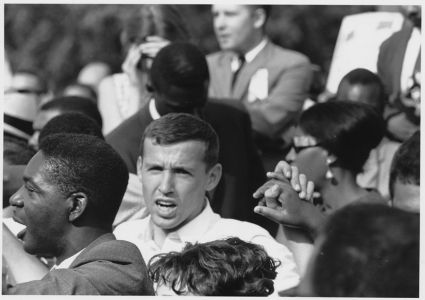
Nearly 250,000 people marched, including 60,000 white participants.

Leaders arrive late and link arms in front of marchers on Constitution Avenue.
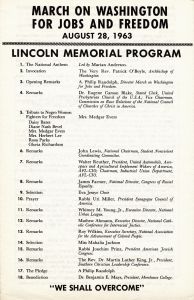
March on Washington for Jobs and Freedom program.

Martin Luther King, Jr. delivering his "I Have a Dream" speech.


_-_NARA_-_542056.jpg)
_-_NARA_-_542070.jpg)


Après 1965 : division du mouvement noir

La lutte pour les droits civiques aux États-Unis a été caractérisée par diverses philosophies et stratégies. Le Civil Rights Act de 1964 a représenté une victoire législative majeure contre la ségrégation et a marqué une avancée significative dans la lutte pour l'égalité des droits civiques. Toutefois, il ne signifiait pas la fin de la lutte pour de nombreux militants. Martin Luther King Jr. et d'autres défenseurs de l'intégration et de la non-violence voyaient la législation comme un pas important vers l'égalité des chances et l'intégration totale, mais ils reconnaissaient que la loi seule ne pouvait pas éliminer les disparités socio-économiques ni les préjugés profondément ancrés dans la société. Ils ont continué à militer pour des changements plus profonds, y compris les droits économiques et l'élimination de toutes les formes de discrimination raciale. D'un autre côté, il y avait ceux dans le mouvement des droits civiques qui étaient plus sceptiques quant à l'intégration au sein de la société blanche, voire carrément en désaccord avec elle. Ces individus et groupes, parfois qualifiés de séparatistes ou nationalistes noirs, prônaient l'autodétermination des Noirs, l'autonomie économique et, dans certains cas, la création d'une nation séparée pour les personnes d'ascendance africaine. Des figures comme Malcolm X et des groupes comme le Nation of Islam, et plus tard le Black Panther Party, ont été associés à cette philosophie. Cette période a été marquée par une intensification du débat sur les meilleures stratégies à suivre pour atteindre l'égalité réelle et la justice sociale. Les années suivantes ont vu l'émergence de mouvements plus radicaux qui se sont éloignés de la stratégie non violente prônée par Martin Luther King Jr., reflétant la frustration croissante face aux lentes améliorations des conditions de vie et au racisme persistant.
L'essor du mouvement Black Power dans les années 1960 a représenté une évolution significative dans la lutte pour les droits civiques aux États-Unis, marquant un passage à des formes d'expression et de revendication plus affirmées et parfois militantes. Ce mouvement a mis l'accent sur la fierté raciale et l'autodétermination, avec des figures comme Stokely Carmichael en tête de file et des groupes comme le Black Panther Party qui incarnait cette nouvelle phase avec une approche qui combinait l'autodéfense armée et des programmes sociaux pour soutenir les communautés noires. Cependant, cette période a également vu un ralentissement du soutien fédéral aux initiatives des droits civiques, malgré les victoires législatives telles que le Civil Rights Act et le Voting Rights Act. Avec l'escalade de la guerre du Vietnam, les priorités politiques ont été redirigées vers des problèmes internationaux, entraînant un déplacement des ressources et de l'attention loin des questions de droits civiques. En parallèle, une réaction conservatrice s'est manifestée, où certains segments de la population blanche ont perçu les avancées des droits civiques comme une menace à leur statut. De plus, après le passage de législation majeure, il y avait une perception répandue que les objectifs législatifs avaient été atteints, malgré la persistance d'inégalités systémiques. Cette saturation législative, combinée à un manque d'engagement continu de la part de certains responsables gouvernementaux et à une opposition politique, a contribué à la diminution du soutien fédéral pour le mouvement. Le développement du mouvement et l'émergence de groupes plus radicaux ont également soulevé des inquiétudes au sein du gouvernement, où des questions de radicalisme et de violence ont parfois entravé le soutien fédéral. Ainsi, la fin des années 1960 et le début des années 1970 ont été caractérisés par un changement dans la dynamique du mouvement des droits civiques. De la lutte pour l'intégration et l'égalité devant la loi, le focus s'est élargi pour inclure le pouvoir, l'autonomie et la réponse aux inégalités systémiques et structurelles qui continuaient d'affecter les communautés noires à travers les États-Unis.

.jpg)
La distinction entre les expériences des Noirs américains dans différentes parties du pays est cruciale pour comprendre les dynamiques du mouvement des droits civiques et les répercussions des législations qui ont été adoptées pendant cette période. La loi sur le droit de vote de 1965 a marqué une avancée majeure en ciblant les pratiques discriminatoires qui avaient historiquement empêché les Noirs du Sud d'exercer leur droit de vote. Cependant, pour les millions de Noirs vivant dans les ghettos urbains du Nord et de l'Ouest, les défis étaient souvent différents et moins liés aux lois officielles sur la ségrégation que ceux du Sud. Au Nord et à l'Ouest, les discriminations étaient davantage ancrées dans les pratiques systémiques de racisme économique, de ségrégation résidentielle et d'inégalités dans l'éducation et l'emploi. Ces problèmes ne pouvaient pas être directement résolus par des lois protégeant les droits de vote. Dans les grandes villes du Nord et de l'Ouest, les ghettos se formaient en grande partie à cause de politiques non officielles et officielles de redlining, de clauses restrictives dans les actes de propriété, et de discriminations à l'embauche qui limitaient les opportunités économiques et sociales pour les Noirs. Ces politiques ont abouti à la création d'environnements urbains défavorisés qui perpétuaient la pauvreté et l'isolement social. Alors que le Civil Rights Act de 1964 et le Voting Rights Act de 1965 ont marqué des victoires légales significatives contre le racisme institutionnalisé, ces lois n'ont pas directement abordé le racisme systémique ou les inégalités économiques profondément enracinées. Par conséquent, malgré les progrès législatifs dans le Sud, de nombreux Noirs dans d'autres régions continuaient à vivre dans des conditions de grande pauvreté et de marginalisation. Le mouvement des droits civiques s'est donc progressivement tourné vers ces questions de justice économique et sociale, menant à des campagnes telles que la Poor People’s Campaign, qui a souligné la nécessité d'élargir la lutte pour inclure les problèmes économiques et de logement. Cela a également conduit à l'émergence d'autres mouvements qui cherchaient à aborder de manière plus directe les conditions de vie dans les ghettos et à renforcer la communauté noire de l'intérieur, ce qui inclut des initiatives de développement économique communautaire et des mouvements d'autodétermination noire.
Les assassinats de figures emblématiques des droits civiques ont profondément marqué la nation et le mouvement dans son ensemble. La mort de Malcolm X en février 1965, suivie par celles de Martin Luther King Jr. et de Robert F. Kennedy en 1968, a représenté des pertes dévastatrices pour des millions d'Américains qui luttaient pour la justice sociale et la fin de la discrimination raciale. Malcolm X, connu pour sa perspective plus militante et ses appels à l'autodétermination noire, avait commencé à influencer la pensée plus radicale du mouvement des droits civiques, surtout après son éloignement de la Nation of Islam et son voyage à La Mecque qui avait modifié sa vision sur la collaboration interraciale et l'unité. Son assassinat a donc été un choc pour les communautés noires et a signifié la perte d'une voix qui prônait à la fois l'autonomie et l'évolution vers un engagement plus direct dans le changement social. L'assassinat de Martin Luther King Jr., le visage le plus connu de la lutte non-violente pour les droits civiques, a eu un impact encore plus profond. Il était vu comme le moralisateur de l'Amérique, utilisant la désobéissance civile et la rhétorique puissante pour amener des changements pacifiques. Sa mort a laissé un vide énorme et a incité à des révoltes dans plus de 100 villes américaines, connues sous le nom d'émeutes du Holy Week Uprising. Robert Kennedy, un autre défenseur des droits civiques et candidat à la présidence, a été assassiné peu après Martin Luther King Jr. Son engagement pour la cause des droits civiques et son appel à l'unité nationale ont suscité l'espoir d'une Amérique plus juste. Avec sa mort, beaucoup ont ressenti la perte d'une possibilité de concrétiser cet espoir. Les assassinats, couplés à la violence endémique et aux émeutes qui ont éclaté dans les ghettos du Nord et de la Californie, ont projeté l'image d'une nation en proie à des conflits internes profonds. Les émeutes ont souvent été déclenchées par des incidents de brutalité policière, des inégalités persistantes et des frustrations accumulées sur des générations. Ces révoltes ont été rencontrées par une répression intense, parfois avec l'intervention de la Garde nationale et des forces militaires. La combinaison des assassinats et des émeutes a contribué à un sentiment d'urgence et de crise nationale. Elle a non seulement exposé les divisions raciales profondément enracinées mais a également souligné la résistance considérable à l'évolution vers une société véritablement égalitaire. Le chaos et l'instabilité de cette période ont marqué un tournant dans l'histoire des États-Unis, posant des défis fondamentaux à la conscience et à l'identité nationales.
La violence et les troubles explosifs qui ont secoué les ghettos du Nord et d'autres zones urbaines à travers les États-Unis dans les années 1960 peuvent être attribués en partie au grand fossé économique et social entre ces quartiers et les zones résidentielles des banlieues plus aisées. Les résidents des ghettos urbains étaient souvent confrontés à un chômage élevé, à des logements insalubres, à une éducation de qualité inférieure, et à une ségrégation de fait qui perdurait même après l'abolition légale de la ségrégation de jure. Ces conditions, combinées à la brutalité policière et à l'exclusion économique systémique, ont créé un terrain fertile pour la frustration et la colère. La proposition d'une solution similaire au plan Marshall est une référence à l'ambitieux programme d'aide financière mis en place par les États-Unis après la Seconde Guerre mondiale pour aider à la reconstruction des pays européens dévastés par la guerre. Un tel plan, lorsqu'il est appliqué aux ghettos américains, suggère la nécessité d'un engagement profond et soutenu en termes d'investissement dans les infrastructures, l'éducation, le logement et les opportunités économiques pour réparer les dommages causés par des décennies de négligence et de discrimination. L'idée serait de mener une politique de reconstruction intérieure qui s'attaque de manière holistique aux racines des inégalités sociales et économiques. Cela inclurait non seulement un financement substantiel mais aussi un changement des politiques pour s'assurer que les communautés marginalisées aient accès aux ressources nécessaires pour prospérer, y compris un accès équitable aux opportunités d'emploi, à l'éducation de qualité, à des logements abordables, à des soins de santé adéquats et à une représentation politique. Ce type d'intervention radicale aurait le potentiel de transformer les communautés en difficulté et de résoudre certains des problèmes systémiques qui conduisent à la violence et aux troubles. Cependant, une telle initiative nécessiterait une volonté politique importante et le soutien du public, ainsi que la collaboration entre les gouvernements locaux et fédéraux, les entreprises privées et les communautés elles-mêmes.
La présidence de Lyndon B. Johnson a été marquée par deux efforts ambitieux qui ont fini par entrer en collision : d'une part, sa "Grande Société" et la guerre contre la pauvreté, qui cherchaient à transformer le paysage social et économique américain, et de l'autre, son escalade de l'engagement militaire américain dans la guerre du Vietnam. Johnson a lancé des programmes nationaux ambitieux, qui comprenaient des initiatives majeures comme Medicare, Medicaid, des réformes de l'éducation et des subventions pour les projets de développement urbain. Ces programmes visaient à éradiquer la pauvreté et la faim et à améliorer l'éducation et les soins de santé pour tous les Américains. Cependant, la guerre du Vietnam commençait à consommer une part croissante des ressources américaines, aussi bien financières qu'humaines. La conscription pour le conflit vietnamien a touché tous les secteurs de la société américaine, mais le poids en tombait de manière disproportionnée sur les jeunes hommes issus de milieux défavorisés, y compris de nombreux Afro-Américains. Cette situation exacerbait la frustration au sein des communautés qui bénéficiaient le moins des programmes de la Grande Société, tout en payant un prix élevé dans un conflit lointain et de plus en plus impopulaire. Le mécontentement n'était pas limité à la communauté noire. En 1968, des jeunes partout dans le monde se levaient contre ce qu'ils percevaient comme des injustices, des rigidités sociales et des politiques autoritaires. Aux États-Unis, cela s'est traduit par des manifestations contre la guerre, des soulèvements dans les ghettos urbains, et une culture de la contestation qui a imprégné la musique, l'art et la littérature de l'époque. Le chaos social et politique de 1968 a contribué à créer un climat qui a favorisé l'élection de Richard Nixon. Nixon a fait campagne en promettant de restaurer l'ordre et de soutenir la "majorité silencieuse" des Américains qui, selon lui, souhaitaient un retour à la stabilité sans les bouleversements sociaux qui avaient caractérisé la fin des années 60. Cette promesse de stabilité, combinée avec une stratégie qui cherchait à tirer parti des divisions raciales et de la réaction contre le mouvement des droits civiques, a finalement contribué à son succès électoral.
L'élection présidentielle de 1968 a révélé les profondes divisions qui persistaient dans la société américaine, en particulier en ce qui concerne la question des droits civiques et de la ségrégation raciale. George Wallace, ancien gouverneur de l'Alabama, s'était fait connaître par son soutien inébranlable à la ségrégation, symbolisé par son infâme proclamation de "ségrégation maintenant, ségrégation demain, ségrégation pour toujours". Sa candidature à la présidence en tant que candidat du Parti indépendant américain a attiré une base significative d'électeurs qui étaient résistants, voire hostiles, aux changements apportés par le mouvement des droits civiques. La campagne de Wallace a trouvé un écho particulièrement fort dans les États du Sud, mais il a également attiré des votes dans d'autres régions du pays, révélant une résistance au progrès des droits civiques qui dépassait les frontières géographiques traditionnelles du Sud profond. En promouvant des politiques ouvertement ségrégationnistes et en jouant sur les peurs et les préjugés de son électorat, Wallace a cherché à capitaliser sur les tensions raciales et sociales de l'époque. Bien que sa candidature n'ait pas été couronnée de succès en termes de victoire électorale, elle a néanmoins secoué le paysage politique américain. Les voix qu'il a rassemblées ont prouvé que les attitudes ségrégationnistes et discriminatoires restaient profondément enracinées chez certains Américains. La campagne de Wallace a mis en évidence la nécessité d'un engagement continu dans la lutte pour l'égalité des droits et la justice sociale, soulignant que l'adoption de lois comme le Civil Rights Act et le Voting Rights Act n'était qu'une étape dans le long processus de changement des attitudes et des structures sociales. L'échec de Wallace a également démontré que, malgré la résistance, l'Amérique évoluait lentement vers une plus grande acceptation des principes de l'égalité et de la justice pour tous. Cela a encouragé les militants des droits civiques à poursuivre leur travail acharné, conscients que chaque action, chaque marche et chaque discours contribuait à la construction d'une nation plus inclusive et plus juste.
Annexes
- >Weiss, Jana (2017). "Remember, Celebrate, and Forget? The Martin Luther King Day and the Pitfalls of Civil Religion", Journal of American Studies
- Martin Luther King Jr. Day of Service official government site
- [King Holiday and Service Act of 1994] at THOMAS
- Remarks on Signing the King Holiday and Service Act of 1994, President William J. Clinton, The American Presidency Project, August 23, 1994
- I Have a Dream: Martin Luther King Jr. and the Future of Multicultural America, James Echols – 2004
- Alexandra Alvarez, "Martin Luther King's 'I Have a Dream': The Speech Event as Metaphor", Journal of Black Studies 18(3); doi:10.1177/002193478801800306.
- Hansen, D, D. (2003). The Dream: Martin Luther King Jr. and the Speech that Inspired a Nation. New York, NY: Harper Collins. p. 58.
- "Jones, Clarence Benjamin (1931– )". Martin Luther King Jr. and the Global Freedom Struggle (Stanford University).
- Horwitz, Morton J. (Winter 1993). "The Warren Court And The Pursuit Of Justice". Washington and Lee Law Review. 50.
- Powe, Jr., Lucas A. (2002). The Warren Court and American Politics. Harvard University Press.
- Swindler, William F. (1970). "The Warren Court: Completion of a Constitutional Revolution" (PDF). Vanderbilt Law Review. 23.
- Driver, Justin (October 2012). "The Constitutional Conservatism of the Warren Court". California Law Review. 100 (5): 1101–1167. JSTOR 23408735.
- Myrdal, Gunnar (1944). An American dilemma: The negro problem and modern democracy. New York: Harper & Bros.
- Inbody, Donald S. The Soldier Vote War, Politics, and the Ballot in America. Palgrave Macmillan US :Imprint: Palgrave Macmillan, 2016.
- Schønheyder, Caroline Therese. “U.S. Policy Debates Concerning the Absentee Voting Rights of Uniformed and Overseas Citizens, 1942-2011.” Thesis / Dissertation ETD, 2011.
- Coleman, Kevin. (2010). The Uniformed and Overseas Citizens Absentee Voting Act: Overview and Issues.
- US Policy Debates Concerning the Absentee Voting Rights, United States. Congress, U.S. Government Printing Office, 1944
- Krenn, Michael L. The African American Voice in U.S. Foreign Policy since World War II. Garland Pub., 1999.
- Maxwell, William J. F.B. Eyes: How J. Edgar Hoover's Ghostreaders Framed African American Literature. Princeton Univ. Press, 2017.
- Executive Order 9981 - On July 26, 1948, President Truman issued Executive Order 9981 establishing equality of treatment and opportunity in the Armed Services. This historic document can be viewed here.
- Jon E. Taylor, Freedom to Serve: Truman, Civil Rights, and Executive Order 9981 (Routledge, 2013)
- Patterson, James T. (2001). Brown v. Board of Education: A Civil Rights Milestone and Its Troubled Legacy. Oxford University Press. ISBN 978-0195156324.
- Abraham, Henry J. (1992). Justices and Presidents: A Political History of Appointments to the Supreme Court (3rd ed.). New York: Oxford University Press. ISBN 978-0-19-506557-2.
- Belknap, Michael (2005). The Supreme Court Under Earl Warren, 1953–1969. The University of South Carolina Press. ISBN 978-1-57003-563-0.
- Cray, Ed (1997). Chief Justice: A Biography of Earl Warren. ISBN 978-0-684-80852-9.
- Powe, Lucas A. (2000). The Warren Court and American Politics. Belknap Press. ISBN 978-0674006836.
- Schwartz, Bernard (1983). Super Chief: Earl Warren and His Supreme Court, A Judicial Biography. New York University Press. ISBN 9780814778265.
- Urofsky, Melvin I. (2001). The Warren Court: Justices, Rulings, and Legacy. ABC-CLIO. ISBN 9781576071601.
- See, e.g., Cumming v. Richmond County Board of Education, Berea College v. Kentucky, Gong Lum v. Rice, Missouri ex rel. Gaines v. Canada, and Sweatt v. Painter
- Aguiar, Marian; Gates, Henry Louis (1999). "Southern Christian Leadership Conference". Africana: the encyclopedia of the African and African American experience. New York: Basic Civitas Books. ISBN 0-465-00071-1.
- Cooksey, Elizabeth B. (December 23, 2004). "Southern Christian Leadership Conference (SCLC)". The new Georgia encyclopedia. Athens, GA: Georgia Humanities Council. OCLC 54400935. Retrieved February 12, 2008.
- Fairclough, Adam. To Redeem the Soul of America: The Southern Christian Leadership Conference and Martin Luther King, Jr. (University of Georgia Press, 2001)
- Garrow, David. Bearing the Cross: Martin Luther King, Jr., and the Southern Christian Leadership Conference (1986); Pulitzer Prize
- Meier, August; Rudwick, Elliott M. (1975). CORE: A Study in the Civil Rights Movement, 1942-1968. University of Illinois Press. ISBN 9780252005671.
- Frazier, Nishani (2017). Harambee City: Congress of Racial Equality in Cleveland and the Rise of Black Power Populism. University of Arkansas Press. ISBN 1682260186.<
- Congress of Racial Equality Official website
- Harambee City: Archival site incorporating documents, maps, audio/visual materials related to CORE's work in black power and black economic development.
- Catsam, Derek (2009). Freedom's Main Line: The Journey of Reconciliation and the Freedom Rides. University Press of Kentucky. ISBN 9780813173108.
- Niven, David (2003). The Politics of Injustice: The Kennedys, the Freedom Rides, and the Electoral Consequences of a Moral Compromise. University of Tennessee Press. ISBN 9781572332126.
- PEDAGOGÍA INTERNACIONAL: CUANDO LA INSTRUCCIÓN CÍVICA SE CONVIERTE EN UN PELIGRO PARA LA VIDA..., R. UEBERSCHLAG - The student, international student magazine.
- Whitby, Kenny J. The Color of Representation: Congressional Behavior and Black Interests. University of Michigan Press, 1997. JSTOR, www.jstor.org/stable/10.3998/mpub.14985.
- The Voter Education Project, King Research & Education Institute ~ Stanford University.
- Voter Education Project, Civil Rights Movement Veterans
- Tyson, Timothy B. (2017). The Blood of Emmett Till, Simon & Schuster. ISBN 978-1-4767-1484-4
- Anderson, Devery S. (2015). Emmett Till: The Murder That Shocked the World and Propelled the Civil Rights Movement. Jackson, MS: University Press of Mississippi, 2015.
- Houck, Davis; Grindy, Matthew (2008). Emmett Till and the Mississippi Press, University Press of Mississippi. ISBN 978-1-934110-15-7
- Whitaker, Hugh Stephen (1963). A Case Study in Southern Justice: The Emmett Till Case. M.A. thesis, Florida State University.
- The original 1955 Jet magazine with Emmett Till's murder story pp. 6–9, and Emmett Till's Legacy 50 Years Later" in Jet, 2005.
- Documents regarding the Emmett Till Case. Dwight D. Eisenhower Presidential Library
- Federal Bureau of Investigation. Prosecutive Report of Investigation Concerning (Emmett Till) Part 1 & Part 2 (PDF).
- Hogan, Wesley C. How Democracy travels: SNCC, Swarthmore students, and the growth of the student movement in the North, 1961–1964.
- Hogan, Wesley C. Many Minds, One Heart: SNCC's Dream for a New America, University of North Carolina Press. 2007.
- Carson, Clayborne (1981). In Struggle, SNCC and the Black Awakening of the 1960s. Harvard University Press.
- Student Nonviolent Coordinating Committee Founded ~ Civil Rights Movement Veterans.
- The Voter Education Project, King Research & Education Institute ~ Stanford University.
- Faubus, Orval Eugene. Down from the Hills. Little Rock: Democrat Printing & Lithographing, 1980. 510 pp. autobiography.
- Anderson, Karen. Little Rock: Race and Resistance at Central High School (2013)
- Baer, Frances Lisa. Resistance to Public School Desegregation: Little Rock, Arkansas, and Beyond (2008) 328 pp. ISBN 978-1-59332-260-1
- Kirk, John A. "Not Quite Black and White: School Desegregation in Arkansas, 1954-1966," Arkansas Historical Quarterly (2011) 70#3 pp 225–257 in JSTOR
- "Civil rights rider keeps fight alive" . Star-News. 30 June 1983. pp. 4A
- Civil Rights Act of 1964 (Pub.L. 88–352 , 78 Stat. 241 , enacted July 2, 1964)*Civil Rights Act Passes in the House ~ Civil Rights Movement Veterans
- "A Case History: The 1964 Civil Rights Act". The Dirksen Congressional Center.
- The Voting Rights Act of 1965: Background and Overview (PDF), Congressional Research Service
- Brown v. Board of Education 347 U.S. 493 (1954)
- Brown v. Board of Education 349 U.S. 294 (1955)
- Bolling v. Sharpe 347 U.S. 497 (1955)
Références
- ↑ Aline Helg - UNIGE
- ↑ Aline Helg - Academia.edu
- ↑ Aline Helg - Wikipedia
- ↑ Aline Helg - Afrocubaweb.com
- ↑ Aline Helg - Researchgate.net
- ↑ Aline Helg - Cairn.info
- ↑ Aline Helg - Google Scholar
- ↑ Stephen Lucas et Martin Medhurst, « "I Have a Dream" Speech Leads Top 100 Speeches of the Century », University of Wisconsin News, University of Wisconsin–Madison, 15 décembre 1999 (lire en ligne).
- ↑ A "Dream" Remembered, NewsHour, 28 août 2003.
- ↑ Goduti Jr., Philip A. (2012). Robert F. Kennedy and the Shaping of Civil Rights, 1960-1964. McFarland. ISBN 9781476600871.
- ↑ Goldzwig, Steven R.; Dionisopolous, George N. (1989). "John F. Kennedy's civil rights discourse: The evolution from "principled bystander" to public advocate". Communication Monographs. Speech Communication Association. 56 (3): 179–198. doi:10.1080/03637758909390259. ISSN 0363-7751.
- ↑ Loevy, Robert D. (1997). The Civil Rights Act of 1964: The Passage of the Law That Ended Racial Segregation (illustrated ed.). SUNY Press. ISBN 9780791433614.