The Civil Rights Movement in the United States
| Faculté | Lettres |
|---|---|
| Département | Département d’histoire générale |
| Professeur(s) | Aline Helg |
| Cours | The United States and Latin America: late 18th and 20th centuries |
Lectures
- The Americas on the eve of independence
- The independence of the United States
- The U.S. Constitution and Early 19th Century Society
- The Haitian Revolution and its Impact in the Americas
- The independence of Latin American nations
- Latin America around 1850: societies, economies, policies
- The Northern and Southern United States circa 1850: immigration and slavery
- The American Civil War and Reconstruction: 1861 - 1877
- The (re)United States: 1877 - 1900
- Regimes of Order and Progress in Latin America: 1875 - 1910
- The Mexican Revolution: 1910 - 1940
- American society in the 1920s
- The Great Depression and the New Deal: 1929 - 1940
- From Big Stick Policy to Good Neighbor Policy
- Coups d'état and Latin American populisms
- The United States and World War II
- Latin America during the Second World War
- US Post-War Society: Cold War and the Society of Plenty
- The Cold War in Latin America and the Cuban Revolution
- The Civil Rights Movement in the United States
Basically, it is a movement in which young people have had an extraordinary role, without them, certainly Civil Rights would not have been granted to African Americans reminding us of the role of youth in history.
Since January 15, 1986, the birthday of Pastor Martin Luther King, born on January 15, 1929, has been celebrated in the United States by a holiday that defines in most cities television and radio broadcasts and commemorations, especially in schools.[1][2][3][4]
Speech delivered on August 28, 1963 to the Lincoln Memorial in Washington, D.C., is widely considered one of the greatest and most influential speeches of the 20th century.[5] According to U.S. Congressman John Lewis, who also spoke that day on behalf of the Coordinating Committee of Non-Violent Students. "By speaking as he did, he educated, he inspired, he guided not just the people who were there, but people across America and generations to come.[6]
During these celebrations, part of King's speech was rebroadcast with tributes to diversity and minority rights in the United States.[7][8][9][10]
This is not the first part of his speech in which he makes a deep and strong criticism of the social and racial inequality of the situation of blacks, but the end of his visionary speech about the American nation that will one day live on from its declaration of independence saying that all men were created equal; he also dreams of the day when his four children will no longer be judged by their colour, but by their character.
Shortly thereafter, Congress outlawed racial discrimination and guaranteed the black vote throughout the United States.
These laws are not new; they merely repeat amendments already passed following the abolition of slavery in 1865; the 14th Amendment guarantees political and civil rights to all and the 15th Amendment prohibits any state from preventing any citizen from voting based on his or her origin.
The United States was the only independent country in the Americas to legally discriminate against some of its citizens on the basis of their "race," while elsewhere other legal subterfuges were often and still sometimes used to discriminate first on the basis of skin color and poverty and now on the basis of poverty in general.
Actors for change
Why were African-American rights suddenly recognized in the mid-1960s? The United States was so powerful that it could have continued to accept segregation in the South.
African-Americans of the South
The first actors are the African Americans themselves, whose prospects broadened considerably after the Second World War.
The Supreme Court
The Supreme Court's policy direction is changing, becoming more progressive.[11][12][13][14]
Domestic and international context
Internal structural changes
In American society, there are structural changes, during the war there was the mechanization of part of the cotton crop which reduced rural employment, accelerating the process of urbanization in the southern states, many tenant farmers, small black and white peasants emigrated to the north, to the north of the United States and the west coast, between 1940 and 1959 there are a total of 3 million black people from the south who "vote with their feet", leaving and immigrating to the north and west in order to be full-fledged citizens.
With this migration they kept family in the South, a process of communication is intensified with the extension of the possibilities of mutual aid between the blacks of the South and the North and the East. This strengthens the electoral weight of blacks in the states of the East Coast and California; later on, politicians will have to deal with the racial issue.
In the South, with the beginning of modernization, this conjunctural change modifies the mentality of a part of the whites, in particular thanks to the white migrants who come to the sun-belt; absolute control over blacks through segregation is now superfluous.
The Cold War and Decolonization
We are in the midst of the Cold War and decolonization, the contradictions between the declared ideal of freedom and democracy that the United States wants to show the world is in complete contradiction with the reality of segregation in the South, which will be used more and more by the detractors of the United States to denounce them as racists and even fascists.
In 1944, Gunnar Myrdal published An American dilemma: The negro problem and modern democracy. [15] In this book, he insists on the contradiction between the democratic discourse of the American government and the practice of segregation and discrimination of blacks in the United States, pointing to it as the Achilles' heel of the United States.

The blacks had already begun to oppose the violation of the 14th and 15th amendments. Black people mobilized to fight fascism and defend democracy were characterized by segregation and discrimination. Axis forces used this argument in their propaganda forcing Congress to pass the Soldier Voting Act.[16][17][18][19]
When black soldiers returned from the war, they tried to register to vote; they were sure that the new legislation would allow them to vote in their home states; the whites often prevented them from doing so through violence.
They still face segregation, yet they will increasingly oppose it and demonstrate openly.

In the years 1948 and 1949 McCarthyism was in full swing, limiting what black Americans could do. The FBI is dominated by Hoover from 1924 to 1972 being obsessed with communist infiltration in the country; for all blacks who ask for civil rights and demand reforms are accused of communism and anti-Americanism; those who criticize racism face confiscation of their passports.[20][21]
McCarthyism dominates Congress and blocks any State Department initiative against segregation, as several State Department officials are accused of anti-American and communist activities. On the other hand, Truman had little interest in the black cause, but he was forced in 1949 to pass an executive order abolishing racial segregation in the U.S. military.[22][23]
The other thing is that in 1949, with the inauguration of the UN headquarters in New York, it will be increasingly difficult for the United States to defend democracy and the free world in the face of the newly decolonized nations of Africa and Asia that will be sitting at the UN.
It will be all the more difficult because representatives will try to travel around the country and will be prevented from having access to the facilities normally available in the States of the South, thereby tarnishing the image of the United States. The USSR will use this segregation as a weapon against the United States.
It is not only the African representatives, but also often those from Asia and the Caribbean. This is something that is beginning to make a bad impression and is creating democratic problems, but international pressure is still too weak to see the US government take action in the South.
The first stages of the fight: from 1955 to 1960

In 1954, things began to change for African Americans; until then the Supreme Court had been dominated by Southerners, suddenly it became more progressive. The role of the Supreme Court is essential for all citizens of the United States.
A minor event had major consequences; in 1955 the Supreme Court began debating Brown v. Board of Education; the National Association for the Advancement of Colored People (NAACP) on behalf of a citizen attacked the separeted but egal doctrine that had been approved by the Supreme Court in 1896.[24]

This is a very important issue, when the judges are debating one of the supreme justices dies; he has to be replaced. Eisenhower appointed Earl Warren, who was an attorney general and a popular governor in California as well as a Republican, a man of his time, and he felt that justice should evolve with the times and not be as marked as it was before.[25][26][27][28][29][30]
NAACP lawyers were able to show that segregated schools lead black children to receive an education that is not equal to, but far below, that received by whites; the Supreme Court ruled that segregated schools were illegal and forced public schools to integrate racially as soon as possible without defining legal degrees.[31]
This decision related to the appointment of Justice Warren will have many effects on other decisions made later, Warren will dominate the Supreme Court from 1954 to 1969; during this period the Supreme Court will make several decisions that reinterpret the U.S. Constitution in favor of the excluded.
He not only defended the equal rights of blacks, but also of women, Indians, Latin Americans, the poor, and the disabled, who gained new rights that guaranteed their freedom and equality.
The Supreme Court's decision making segregation in schools unconstitutional is followed by two decisions that make segregation illegal in federal authorities and public places.
This has enormous significance for black movements, as it obliges the federal state to support this decision everywhere in the territory, the federal state must even provide the army to support the enforcement of these new laws and the FIB must also be the guarantor of the enforcement of these federal laws.
After 1954, many blacks tried to enter public schools, colleges and universities, while others tried to get on public transportation, seeing the white response each time as a wave of violence.

Rosa Parks in Montgomery in 1955 refused to give up her seat on the bus to a white man who was still standing. She was arrested then imprisoned, she is at the origin of the famous boycott of the buses of Montgomery by the blacks during more than one year propelling the young Martin Luther King then 26 years old and the Christian Leadership Conference at the head of the movement for racial equality.[32][33][34][35]
Rosa Parks was not only a modest seamstress, but also an NAACP activist and she knows very well the risk she is taking; for more than a year, blacks will walk to work, eventually forcing integration into public transport.

In 1957, in Arkansas, when Little Rock Middle School had to integrate black students, the segregationist governor refused to let nine black youths enter the school, forcing President Eisenhower to requisition more than 1,000 soldiers to guarantee the integration of the school; images of violence went round the world and provoked a great wave of protests while giving the USSR the opportunity to make people forget its interventions in Eastern Europe.[36][37][38][39]
In North Carolina, seating and boycotts took place against businesses that refused to serve blacks, as in Greensboro in 1960; the activists of these movements resumed the non-violent resistance sought by Gandhi, but were beaten by the population and the police, eventually forcing the establishments to accept blacks.
La présidence de John F. Kennedy dès janvier 1961
Dans ce contexte est élu Kennedy, c’est la politique extérieure notamment de faire face à la politique d’expansion de l’Union soviétique en Asie, en Afrique et à Cuba qui l’intéresse, il est aussi très soucieux de garder le soutien des votes des démocrates des États du Sud, il ne va pas vraiment toucher à la question raciale dans le sud des États-Unis.
Pour garder le soutient des États du Sud, il tente d’empêcher le projet de la Congress of Racial Equality qui a pour projet de faire voyager en bus dans les États du Sud un groupe de blancs et de noirs qu’on appelle les « Freedom Riders » ; le but de ces jeunes était de tester les États du Sud pour voir si l’État fédéral allait faire respecter la ségrégation dans les bus et les gares routières.[40][41][42][43][44][45]
Ce projet a aussi une portée internationale, car la ségrégation le long des routes fédérales affectait aussi les diplomates africains et asiatiques qui voulaient voyager de New York à Washington ; en Alabama et au Mississippi, les Freedom Riders sont brutalement attaqués par des membres du Ku Klux Klan.[46]
Le cas du Voter Education Project dans le Mississippi
Kennedy s’efforce de rediriger ce mouvement vers la préparation des noirs afin de s’enregistrer en tant qu’électeurs : les noirs étaient soumis à des tests « d’aptitude électorale ».[47][48] Cette voie était moins risquée que les Freedom Riders.
Il crée en 1962 le Voter Education Project sous la protection du gouvernement fédéral et du FIB, mais au Mississippi cela montre la limite de l’engagement de Kennedy en faveur des noirs poussant une partie des noirs à renoncer à la non-violence.[49][50]
Le Mississippi est l’un des États les plus pauvres et un bastion de la ségrégation ; les noirs engagés dans lutte pour les droits civiques depuis 1945 sont victimes de licenciements, on les chasse des fermes dans lesquels ils habitent, on les passe à tabac et il y a énormément de meurtres.

Ce qui va commencer à mobiliser l’opinion est le lynchage d’un jeune noir à Chicago qui avait 14 ans, Emmet Till ; sa mère à Chicago a décidé d’autoriser la diffusion par la presse nationale et internationale la photo de son cadavre défiguré.[51][52][53][54][55][56]
Il y eut un procès avec un jury entièrement blanc et par deux fois le jury a acquitté tous les accusés ; en même temps, cela a fait une montée du courage des noirs au Mississippi qui ont commencé à manifester plus directement.[57]
Ce changement va s’accélérer avec l’arrivée de la SNCC (Student Nonviolent Coordinating Committee) qui est une autre organisation de jeunes créée en 1960, mouvement multiracial de jeunes chrétiens.[58][59][60][61]
Les buts de ce mouvement sont non seulement d’enregistrer les noirs dans les bureaux de vote, mais aussi de développer au niveau local des organisations de base qui privilégient les jeunes et les femmes ; les jeunes qui adhèrent au SNCC abandonnent leurs études pour participer au changement social dans les petites villes du Sud, ils représentent l’aile radicale pour le mouvement de représentation des noirs qui poussent la lutte de Martin Luther King vers le centre.
Au Mississippi ils vont faire un travail énorme de recrutement de communautés avec des assemblées afin de mobiliser les gens à lire, à écrire, à prendre leur vie en charge décidant de travailler pour le Voting Education Project de Kennedy ; mais le test d’aptitude électorale fait face.[62]
Au Mississippi, en 1960, il y a seulement 5 % des noirs en position de voter ; lorsqu’ils ne sont pas attaqués, les candidats inscrits sur ces listes d’électeurs sont rejetés, un an après le lancement de cette campagne 63 militants sont assassinés sans que le gouvernement de Kennedy réagisse.
Washington dénonce le manque de réussite du Voting Education Project cessant de lui donner des fonds.
En 1963, lorsqu’un groupe d’étudiants arrive au Mississippi pour encadrer le Voting Education Programm, le FBI commence à protéger les noirs.
Ils décident de jouer le jeu invitant plusieurs centaines d’étudiants du Nord et de l’Est pour forcer le FBI à protéger leur campagne pour le vote au Mississippi. C’est alors que deux volontaires, deux blancs et un noir du Sud disparaissent. Le gouvernement envoie des centaines de policiers et d’agents du FBI afin de les retrouver. Ce n’est que deux mois plus tard que leurs corps sont retrouvés, les deux blancs fusillés et le noir torturé à mort.
Au cours de leur recherche, le FBI a trouvé une quantité de cadavres de noirs sans ouvrir d’enquêtes ; cela augmente le sentiment que les blancs veulent saper le processus d’autodétermination local ; il y a un changement de stratégie et ils vont se passer de la protection des étudiants blancs prenant les armes d’autant plus que le FBI ne réagit pas face aux meurtres dans le Mississippi.
À partir de 1953, la violence du Ku Klux Klan redouble ainsi que celle de la police et des gouverneurs du Sud commençant à être diffusé sur les écrans de télévision rendant de plus en plus difficile la légitimité d’avoir le siège de l’ONU à New York.
Le grand tournant pour John F. Kennedy
President John F. Kennedy's Civil Rights Address on June 11, 1963.[63][64][65]
Kennedy ne se décide à agir qu’en 1963 lorsque la police de l’Alabama réprime une manifestation pour les droits civiques et l’intégration, ce sont surtout des jeunes et des enfants des écoles qui vont manifester ; ces évènements se produisent au moment même où un mouvement pour l’unité africaine a lieu à Addis-Abeba.
La presse soviétique se saisie de cela afin de critiquer les États-Unis et Kennedy fait un discours à la télévision appelant le Congrès à passer une loi-cadre sur les droits civiques.[66][67][68]
En août 1963, l’ensemble du mouvement pour les droits civiques réunis plus de 200 000 personnes pour une marche vers Washington menant à un accord tacite entre Kennedy et les organisateurs qui soit d’éviter les discours radicaux en échange d’une loi-cadre permettant de diffuser des images apaisantes de cette marche.
Une partie du discours visionnaire de Martin Luther King est dans laquelle il se présente dans le rôle de Moïse devant l’ensemble de l’Amérique réconciliée avec elle-même. Après l’assassinat de Kennedy en 1963, Lyndon B Johnson, premier président originaire du sud reprend le flambeau et obtient l’approbation par le Congrès qui garantit le suffrage des noirs ; l’histoire se termine sur un triomphe législatif.

La foule rassemblée sur le mall vue depuis le Lincoln Memorial.

Un participant à la Marche sur Washington.

Bayard Rustin (left) and Cleveland Robinson (right), organizers of the March, on August 7, 1963.

Civil Rights March on Washington, D.C. (Leaders of the march).

Nearly 250,000 people marched, including 60,000 white participants.
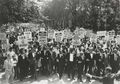
Leaders arrive late and link arms in front of marchers on Constitution Avenue.

March on Washington for Jobs and Freedom program.

Martin Luther King, Jr. delivering his "I Have a Dream" speech.


_-_NARA_-_542056.jpg)
_-_NARA_-_542070.jpg)


Après 1965 : division du mouvement noir

Après 1965, le mouvement noir se divise avec le Civil Right de 1964 qui interdit la ségrégation menant à la création d’une commission visant à contrôler le fait « ségrégationniste » ; c’est une fin en soi pour ceux dont Martin Luther King qui prônent la lutte pour l’égalité concrète, l’égalité socioéconomique et une intégration totale, toutefois une franche veut le séparatisme noir.[69]

.jpg)
Il ne faut pas oublier qu’il y a une énorme différence entre les noirs du Nord, du Sud et de la côte ouest, car le Voting Act de 1965 ne représente une victoire que pour les 11 millions de noirs du Sud, mais non pas pour les 7 millions de noirs qui vivent dans les ghettos.
On entre dans une période d’émeutes dans les ghettos du Nord et de la Californie explosant dans des révoltes violentes caractérisées par le pillage, des incendies, la répression policière et militaire ; ces années sont marquées par une énorme violence et par des meurtres après celui de Kennedy en 1963 par ceux de Malcom X en 1965, ceux de Luther King et de Robert Kennedy en 1968.
C’est le fossé entre les ghettos du Nord et les zones de villas suburbaines qui expliquent l’explosion et la solution qui serait une sorte de plan Marshall.
Johnson lance une politique pour lutter contre la pauvreté, mais en même temps il s’enfonce dans la guerre du Vietnam ou les noirs sont tués de façon disproportionnée. En 1968, des révoltes de jeunes secouent le monde et les États-Unis menant à l’élection de Nixon à la présidence du pays.
Le sud profond réagi encore à toutes ces lois avec la candidature de Wallace qui crée un American Independant Party afin d’avoir un ségrégationniste comme président, mais qui échoue montrant que les mentalités mettent beaucoup de temps à évoluer et qu’il faut continuer à réclamer des droits qui ne sont jamais acquis pour tout le monde.
Annexes
Brown v. Board of Education - les arrêts
- Brown v. Board of Education 347 U.S. 493 (1954)
- Brown v. Board of Education 349 U.S. 294 (1955)
- Bolling v. Sharpe 347 U.S. 497 (1955)
References
- ↑ Weiss, Jana (2017). "Remember, Celebrate, and Forget? The Martin Luther King Day and the Pitfalls of Civil Religion", Journal of American Studies
- ↑ Martin Luther King Jr. Day of Service official government site
- ↑ [King Holiday and Service Act of 1994] at THOMAS
- ↑ Remarks on Signing the King Holiday and Service Act of 1994, President William J. Clinton, The American Presidency Project, August 23, 1994
- ↑ Stephen Lucas et Martin Medhurst, « "I Have a Dream" Speech Leads Top 100 Speeches of the Century », University of Wisconsin News, University of Wisconsin–Madison, 15 décembre 1999 (lire en ligne).
- ↑ A "Dream" Remembered, NewsHour, 28 août 2003.
- ↑ I Have a Dream: Martin Luther King Jr. and the Future of Multicultural America, James Echols – 2004
- ↑ Alexandra Alvarez, "Martin Luther King's 'I Have a Dream': The Speech Event as Metaphor", Journal of Black Studies 18(3); doi:10.1177/002193478801800306.
- ↑ Hansen, D, D. (2003). The Dream: Martin Luther King Jr. and the Speech that Inspired a Nation. New York, NY: Harper Collins. p. 58.
- ↑ "Jones, Clarence Benjamin (1931– )". Martin Luther King Jr. and the Global Freedom Struggle (Stanford University).
- ↑ Horwitz, Morton J. (Winter 1993). "The Warren Court And The Pursuit Of Justice". Washington and Lee Law Review. 50.
- ↑ Powe, Jr., Lucas A. (2002). The Warren Court and American Politics. Harvard University Press.
- ↑ Swindler, William F. (1970). "The Warren Court: Completion of a Constitutional Revolution" (PDF). Vanderbilt Law Review. 23.
- ↑ Driver, Justin (October 2012). "The Constitutional Conservatism of the Warren Court". California Law Review. 100 (5): 1101–1167. JSTOR 23408735.
- ↑ Myrdal, Gunnar (1944). An American dilemma: The negro problem and modern democracy. New York: Harper & Bros.
- ↑ Inbody, Donald S. The Soldier Vote War, Politics, and the Ballot in America. Palgrave Macmillan US :Imprint: Palgrave Macmillan, 2016.
- ↑ Schønheyder, Caroline Therese. “U.S. Policy Debates Concerning the Absentee Voting Rights of Uniformed and Overseas Citizens, 1942-2011.” Thesis / Dissertation ETD, 2011.
- ↑ Coleman, Kevin. (2010). The Uniformed and Overseas Citizens Absentee Voting Act: Overview and Issues.
- ↑ US Policy Debates Concerning the Absentee Voting Rights, United States. Congress, U.S. Government Printing Office, 1944
- ↑ Krenn, Michael L. The African American Voice in U.S. Foreign Policy since World War II. Garland Pub., 1999.
- ↑ Maxwell, William J. F.B. Eyes: How J. Edgar Hoover's Ghostreaders Framed African American Literature. Princeton Univ. Press, 2017.
- ↑ Executive Order 9981 - On July 26, 1948, President Truman issued Executive Order 9981 establishing equality of treatment and opportunity in the Armed Services. This historic document can be viewed here.
- ↑ Jon E. Taylor, Freedom to Serve: Truman, Civil Rights, and Executive Order 9981 (Routledge, 2013)
- ↑ Patterson, James T. (2001). Brown v. Board of Education: A Civil Rights Milestone and Its Troubled Legacy. Oxford University Press. ISBN 978-0195156324.
- ↑ Abraham, Henry J. (1992). Justices and Presidents: A Political History of Appointments to the Supreme Court (3rd ed.). New York: Oxford University Press. ISBN 978-0-19-506557-2.
- ↑ Belknap, Michael (2005). The Supreme Court Under Earl Warren, 1953–1969. The University of South Carolina Press. ISBN 978-1-57003-563-0.
- ↑ Cray, Ed (1997). Chief Justice: A Biography of Earl Warren. ISBN 978-0-684-80852-9.
- ↑ Powe, Lucas A. (2000). The Warren Court and American Politics. Belknap Press. ISBN 978-0674006836.
- ↑ Schwartz, Bernard (1983). Super Chief: Earl Warren and His Supreme Court, A Judicial Biography. New York University Press. ISBN 9780814778265.
- ↑ Urofsky, Melvin I. (2001). The Warren Court: Justices, Rulings, and Legacy. ABC-CLIO. ISBN 9781576071601.
- ↑ See, e.g., Cumming v. Richmond County Board of Education, Berea College v. Kentucky, Gong Lum v. Rice, Missouri ex rel. Gaines v. Canada, and Sweatt v. Painter
- ↑ Aguiar, Marian; Gates, Henry Louis (1999). "Southern Christian Leadership Conference". Africana: the encyclopedia of the African and African American experience. New York: Basic Civitas Books. ISBN 0-465-00071-1.
- ↑ Cooksey, Elizabeth B. (December 23, 2004). "Southern Christian Leadership Conference (SCLC)". The new Georgia encyclopedia. Athens, GA: Georgia Humanities Council. OCLC 54400935. Retrieved February 12, 2008.
- ↑ Fairclough, Adam. To Redeem the Soul of America: The Southern Christian Leadership Conference and Martin Luther King, Jr. (University of Georgia Press, 2001)
- ↑ Garrow, David. Bearing the Cross: Martin Luther King, Jr., and the Southern Christian Leadership Conference (1986); Pulitzer Prize
- ↑ Faubus, Orval Eugene. Down from the Hills. Little Rock: Democrat Printing & Lithographing, 1980. 510 pp. autobiography.
- ↑ Anderson, Karen. Little Rock: Race and Resistance at Central High School (2013)
- ↑ Baer, Frances Lisa. Resistance to Public School Desegregation: Little Rock, Arkansas, and Beyond (2008) 328 pp. ISBN 978-1-59332-260-1
- ↑ Kirk, John A. "Not Quite Black and White: School Desegregation in Arkansas, 1954-1966," Arkansas Historical Quarterly (2011) 70#3 pp 225–257 in JSTOR
- ↑ Meier, August; Rudwick, Elliott M. (1975). CORE: A Study in the Civil Rights Movement, 1942-1968. University of Illinois Press. ISBN 9780252005671.
- ↑ Frazier, Nishani (2017). Harambee City: Congress of Racial Equality in Cleveland and the Rise of Black Power Populism. University of Arkansas Press. ISBN 1682260186.
- ↑ Congress of Racial Equality Official website
- ↑ Harambee City: Archival site incorporating documents, maps, audio/visual materials related to CORE's work in black power and black economic development.
- ↑ Catsam, Derek (2009). Freedom's Main Line: The Journey of Reconciliation and the Freedom Rides. University Press of Kentucky. ISBN 9780813173108.
- ↑ Niven, David (2003). The Politics of Injustice: The Kennedys, the Freedom Rides, and the Electoral Consequences of a Moral Compromise. University of Tennessee Press. ISBN 9781572332126.
- ↑ "Civil rights rider keeps fight alive" . Star-News. 30 June 1983. pp. 4A
- ↑ PEDAGOGÍA INTERNACIONAL: CUANDO LA INSTRUCCIÓN CÍVICA SE CONVIERTE EN UN PELIGRO PARA LA VIDA..., R. UEBERSCHLAG - The student, international student magazine.
- ↑ Whitby, Kenny J. The Color of Representation: Congressional Behavior and Black Interests. University of Michigan Press, 1997. JSTOR, www.jstor.org/stable/10.3998/mpub.14985.
- ↑ The Voter Education Project, King Research & Education Institute ~ Stanford University.
- ↑ Voter Education Project, Civil Rights Movement Veterans
- ↑ Tyson, Timothy B. (2017). The Blood of Emmett Till, Simon & Schuster. ISBN 978-1-4767-1484-4
- ↑ Anderson, Devery S. (2015). Emmett Till: The Murder That Shocked the World and Propelled the Civil Rights Movement. Jackson, MS: University Press of Mississippi, 2015.
- ↑ Houck, Davis; Grindy, Matthew (2008). Emmett Till and the Mississippi Press, University Press of Mississippi. ISBN 978-1-934110-15-7
- ↑ Whitaker, Hugh Stephen (1963). A Case Study in Southern Justice: The Emmett Till Case. M.A. thesis, Florida State University.
- ↑ The original 1955 Jet magazine with Emmett Till's murder story pp. 6–9, and Emmett Till's Legacy 50 Years Later" in Jet, 2005.
- ↑ Documents regarding the Emmett Till Case. Dwight D. Eisenhower Presidential Library
- ↑ Federal Bureau of Investigation. Prosecutive Report of Investigation Concerning (Emmett Till) Part 1 & Part 2 (PDF).
- ↑ Hogan, Wesley C. How Democracy travels: SNCC, Swarthmore students, and the growth of the student movement in the North, 1961–1964.
- ↑ Hogan, Wesley C. Many Minds, One Heart: SNCC's Dream for a New America, University of North Carolina Press. 2007.
- ↑ Carson, Clayborne (1981). In Struggle, SNCC and the Black Awakening of the 1960s. Harvard University Press.
- ↑ Student Nonviolent Coordinating Committee Founded ~ Civil Rights Movement Veterans.
- ↑ The Voter Education Project, King Research & Education Institute ~ Stanford University.
- ↑ Goduti Jr., Philip A. (2012). Robert F. Kennedy and the Shaping of Civil Rights, 1960-1964. McFarland. ISBN 9781476600871.
- ↑ Goldzwig, Steven R.; Dionisopolous, George N. (1989). "John F. Kennedy's civil rights discourse: The evolution from "principled bystander" to public advocate". Communication Monographs. Speech Communication Association. 56 (3): 179–198. doi:10.1080/03637758909390259. ISSN 0363-7751.
- ↑ Loevy, Robert D. (1997). The Civil Rights Act of 1964: The Passage of the Law That Ended Racial Segregation (illustrated ed.). SUNY Press. ISBN 9780791433614.
- ↑ Civil Rights Act of 1964 (Pub.L. 88–352 , 78 Stat. 241 , enacted July 2, 1964)
- ↑ Civil Rights Act Passes in the House ~ Civil Rights Movement Veterans
- ↑ "A Case History: The 1964 Civil Rights Act". The Dirksen Congressional Center.
- ↑ The Voting Rights Act of 1965: Background and Overview (PDF), Congressional Research Service