« The Civil Rights Movement in the United States » : différence entre les versions
Aucun résumé des modifications |
Aucun résumé des modifications |
||
| (5 versions intermédiaires par le même utilisateur non affichées) | |||
| Ligne 4 : | Ligne 4 : | ||
| fr = Le Civil Rights Movement aux États-Unis | | fr = Le Civil Rights Movement aux États-Unis | ||
| es = El Movimiento de Derechos Civiles en los Estados Unidos | | es = El Movimiento de Derechos Civiles en los Estados Unidos | ||
| it = | | it = Il movimento per i diritti civili negli Stati Uniti | ||
| pt = | | pt = O Movimento dos Direitos Civis nos Estados Unidos | ||
| de = | | de = Die Bürgerrechtsbewegung in den Vereinigten Staaten | ||
| ch = | | ch = 美国的民权运动 | ||
}} | }} | ||
| Ligne 39 : | Ligne 39 : | ||
= Actors for change = | = Actors for change = | ||
The civil rights movement in the United States has a long history, dating back well before the iconic events of the 1950s and 1960s. Its roots lie in earlier struggles against slavery, post-Civil War reconstruction efforts, and ongoing resistance to Jim Crow laws and other institutionalised forms of racism. After the Civil War and the passage of the 13th, 14th and 15th Amendments, African Americans continued to fight for their rights and status as full citizens. During the early 20th century, leaders such as Booker T. Washington and W.E.B. Du Bois took different approaches to promoting the advancement of black Americans. Du Bois' organisation, the National Association for the Advancement of Colored People (NAACP), founded in 1909, played a central role in the struggle for civil rights by using the legal system to challenge discriminatory laws and by conducting public awareness campaigns. The civil rights era of the 1950s and 1960s saw a series of non-violent direct actions, such as the Montgomery Bus Boycott in 1955, initiated by Rosa Parks and led by the young Martin Luther King Jr, who emerged as one of the movement's leading figures. Lunch counter sit-ins, protest marches, Freedom Rides and numerous other acts of civil disobedience put pressure on the federal government and brought international attention to the cause of civil rights. Organisations such as the Student Nonviolent Coordinating Committee (SNCC) and the Congress of Racial Equality (CORE) played an important role in organising young activists and implementing mass protest strategies. Their efforts, and those of many others, led to the passage of key legislation such as the Civil Rights Act of 1964 and the Voting Rights Act of 1965, which marked a turning point in the struggle for equal civil rights for African Americans. | |||
The struggle for black freedom in the United States was waged through a series of strategic and peaceful actions, guided by the principles of non-violence and civil disobedience. Inspired by the teachings of Mahatma Gandhi and led by figures such as Martin Luther King Jr. and Rosa Parks, civil rights activists adopted a variety of tactics to challenge segregation and injustice. The Montgomery Bus Boycott was one of the first large-scale actions in which the black community stopped using public transport to protest against segregation laws. This prolonged boycott succeeded in exerting economic pressure that eventually led to the integration of buses in this city. At the same time, courageous sit-ins were organised in places traditionally reserved for whites, where African-Americans, often joined by white allies, sat down and refused to leave until they were either served or arrested, drawing national attention to the daily injustice of segregation. Peace marches also played a central role, with landmark moments such as the March on Washington, which saw King's iconic "I Have a Dream" speech become a symbol of the struggle for equality. Similarly, the Freedom Rides, where activists of different races travelled together through the South to challenge segregation laws on interstate transport, showed the strength of interracial solidarity and the determination to defy segregationist norms. In addition to these public protests, the struggle was also taken to court. Lawyers like Thurgood Marshall fought segregation through the court system, leading to landmark decisions like Brown v. Board of Education, which declared segregation in public schools unconstitutional. In addition, voter registration work and political education were essential, particularly in the Deep South where discriminatory laws and practices hindered the right of African-Americans to vote. All of these efforts helped create a powerful national movement that not only raised public awareness of inequalities, but also put irresistible pressure on the federal government to act, ultimately leading to the passage of key civil rights legislation. The recognition of the rights of African Americans in the 1960s was no accident, but the result of decades of resistance, determination and commitment to the struggle for equality and justice. | |||
The political landscape of the United States in the 1960s underwent significant transformations that were crucial to the advancement of civil rights. Initially, President John F. Kennedy was reluctant to commit fully to civil rights reform, concerned about the reactions of the deeply segregated South and the political calculations involved in retaining Southern support for the Democratic Party. However, the changing dynamics of the civil rights movement, accentuated by high-profile events such as the unrest in Birmingham, Alabama, where non-violent demonstrators, including children, were violently confronted by police, captured national and international attention. These shocking images, broadcast on television stations across the country, helped to raise public awareness and generate growing support for the cause of civil rights. Faced with this pressure and the calls for justice and equality, Kennedy was forced to act. In a landmark speech in June 1963, he called for new civil rights legislation that would establish equal protection under the law for all Americans, regardless of the colour of their skin. He presented Congress with a series of legislative proposals that laid the groundwork for the Civil Rights Act of 1964. After Kennedy's assassination in November 1963, his successor, President Lyndon B. Johnson, made civil rights a priority of his administration. Johnson, using his experience and influence in Congress, skilfully manoeuvred the passage of the Civil Rights Act of 1964, which prohibited discrimination on the basis of race, colour, religion, sex or national origin, and ended segregation in public places, and the Voting Rights Act of 1965, which prohibited discriminatory practices in voting procedures. These laws marked a significant break with the United States' discriminatory past and constituted official recognition of the civil rights of African-Americans, achieved through a combination of popular protest and political action at the highest level of government. These legislative changes were the culmination of a long and difficult struggle and marked a turning point in the history of civil rights in the United States. | |||
The mid-1960s in the United States was a period of unprecedented change and social ferment, characterised by a wave of questioning of established norms and a collective struggle for a more inclusive and equitable society. At the heart of this transformation was the counterculture, a movement largely driven by young people who rejected the traditional values of American society. The counterculture advocated individual freedom, self-expression and experimentation, often in opposition to the Vietnam War, social inequality and racial discrimination. The feminist movement, gaining in visibility and influence, was also a crucial element of this period. With the publication of iconic works such as Betty Friedan's "The Mystified Woman", women began to openly challenge traditional gender roles, demanding equal rights and personal autonomy, goals that paralleled those of the civil rights movement. At the same time, the anti-war movement intensified, fuelled by growing opposition to US military involvement in Vietnam. Millions of people, particularly students, took part in demonstrations and acts of civil disobedience, creating a united front of dissent against government policies. These social movements were interconnected, with participants often engaged in several causes simultaneously, creating a network of solidarity that crossed the boundaries of individual movements. The civil rights movement benefited from this solidarity, as it shared a common goal with other movements: the transformation of society into a fairer place for all its members. Thus, in this climate of widespread activism, the civil rights movement was able to find fertile ground in which to flourish and pursue its goals of ending segregation and achieving racial equality. The various social struggles of the time were mutually reinforcing, each victory providing impetus for the others, and together they helped to redefine the political, social and cultural landscape of the United States. | |||
The impact of the Civil Rights Movement went beyond the borders of the United States, drawing international attention to issues of social justice and racial inequality. In the context of the Cold War, the image of the United States was closely scrutinised and the struggle for civil rights became a critical point in the international discourse on human rights. America presented itself as the leader of the free world, a model of democracy and freedom, but images of police brutality and severe racial discrimination against African-Americans were in flagrant contradiction with this image. This put pressure on successive US governments to address these issues not only for domestic moral and legal reasons, but also to maintain their credibility on the world stage. In addition, the civil rights movement has served as a source of inspiration and example for other liberation and social justice movements around the world. The non-violent civil disobedience tactics and eloquent speeches of leaders like Martin Luther King Jr. have resonated with those fighting oppression and discrimination in other countries. For example, the strategies and ideals of the Civil Rights Movement have influenced anti-apartheid movements in South Africa and civil rights struggles in Europe and elsewhere. In this way, the recognition of the rights of African-Americans and the progress made in the 1960s were not simply the result of an internal movement, but also reflected a global dialogue on human rights and dignity. The progress made in the United States strengthened the global civil rights movement and helped promote an international consciousness around equality and justice for all. | |||
== | == African-Americans in the South == | ||
The return of the African-American veterans of the Second World War marked a decisive turning point in the civil rights movement in the United States. These men and women had fought for freedom and justice abroad, often demonstrating bravery and skill in very difficult circumstances, only to return to a country where they were treated as second-class citizens, denied civil rights and subjected to racial segregation and discrimination. This stark contrast between the ideals they had fought for and the reality they faced on their return fuelled a strong resolve and commitment to change. Many of these veterans became key leaders and activists in the civil rights movement, building on the leadership and organisational skills they had acquired in the military. They were less willing to tolerate injustice and more willing to organise and demand their rights. In addition, their service provided a powerful refutation of racist stereotypes. Their courage and sacrifice proved that they deserved respect and full citizenship, highlighting the contradictions of American society. The situation of African-American veterans was often cited in arguments against segregation and for equal rights, adding a moral urgency to the struggle for social change. Their influence was felt in mass demonstrations, actions of civil disobedience and legal challenges to Jim Crow laws. Their determination helped inspire a movement that eventually led to major legislative changes, such as the Civil Rights Act of 1964 and the Voting Rights Act of 1965, marking a significant step forward in the quest for racial equality in the United States. | |||
African Americans have drawn inspiration and strength from struggles for freedom and equality around the world. In the mid-twentieth century, the rise of the decolonisation movements in Africa and Asia offered striking parallels with their own struggles for civil and social rights. Victories against colonial and imperial oppression reinforced the belief that change was possible, even in the face of seemingly insurmountable obstacles. Back in the United States, African-Americans organised themselves in a more structured way to oppose segregation and discrimination. Organisations such as the National Association for the Advancement of Colored People (NAACP) and the Southern Christian Leadership Conference (SCLC) played central roles in coordinating resistance efforts. Figures such as Rosa Parks, whose refusal to give up her seat on a bus in Montgomery, Alabama, sparked the famous Montgomery Bus Boycott, and young activists who initiated the Greensboro sit-ins, demonstrated the effectiveness of non-violent civil disobedience. These actions were often orchestrated to draw national and international attention to injustices. Sit-ins, protest marches, Freedom Rides and other forms of peaceful protest and demonstration have shown impressive solidarity and determination to achieve equality. They have also often provoked a violent reaction from the authorities and from white citizens' groups, which has drawn even more public attention and increased the pressure for change. The success of these efforts was marked not only by the passage of legislation such as the Civil Rights Act and the Voting Rights Act, but also by a gradual shift in the public perception of racial justice and civil rights. These changes were a testament to the power of collective organisation and non-violent protest, and continue to inspire social movements to this day. | |||
The individual and collective courage of African Americans in the South was an undeniable force for change in the civil rights movement. Often risking their lives, they confronted an institutionally racist system. Their persistence in demanding dignity and equality served as a catalyst for legislative reform and considerable social change. The struggle for civil rights in the South was characterised by heroic acts of ordinary people who took part in boycotts, marches, sit-ins and other forms of peaceful protest. Images of peaceful demonstrators facing police violence, mass arrests, and even acts of terrorism perpetrated by citizens and local authorities have outraged many people in the United States and around the world. Events such as the bombing of the 16th Street Baptist Church in Birmingham, Alabama, where four young African-American girls were killed, highlighted the cruelty and injustice of systemic racism. The actions of African-American activists have highlighted the gap between the ideals of freedom and equality advocated by the United States and the reality experienced by a large part of its population. Increased media and international attention put pressure on politicians to act, ultimately leading to the passage of important legislation to guarantee civil rights. This activism also inspired other marginalised groups, both in the US and abroad, to fight for their rights, showing that change was possible through determination and solidarity. The legacy of these efforts lies in the continuing struggles for equality and justice for all, a quest that continues to shape today's dialogues and policies around race, justice and equality. | |||
The bravery and commitment of African Americans in the South was fundamental to the success of the Civil Rights Movement. It was their refusal to give in to systemic oppression, their determination to fight for equality and their willingness to sacrifice that fuelled the progress made. Despite the constant danger, these men and women marched, spoke, resisted and sometimes even gave their lives for the cause of justice. Their struggle has had a ripple effect, not only in the communities directly affected by segregation and discrimination, but across the country and around the world. They inspired a generation of civil rights activists and laid the foundations for the struggles for equality that continue today. The impact of their struggle goes far beyond legislative advances. It helped shape the national consciousness, educate the public about the realities of discrimination and profoundly transform American culture and values. Their legacy lives on not only in the laws and policies they helped to change, but also in the spirit of resistance and the quest for justice that continues to guide contemporary social movements. | |||
== | == The Supreme Court == | ||
The Supreme Court of the United States has had a profound and lasting impact on the development of civil rights and equality in the country. Its jurisprudence has spanned several eras, marking significant turning points in American history. For example, the landmark 1954 decision in Brown v. Board of Education overturned the doctrine of "separate but equal" and declared racial segregation in public schools unconstitutional. This laid the groundwork for a series of civil rights reforms. Later, in 1967, the Court issued another landmark decision in Loving v. Virginia, ending laws that prohibited interracial marriage. The Court has continued to shape the civil rights landscape with decisions such as Roe v. Wade in 1973, which established the right to abortion, although this decision was subsequently overturned in 2022. In a more contemporary context, the Court affirmed gay rights in 2015 with Obergefell v. Hodges, guaranteeing the right to marry for same-sex couples, a decision that marked a major step forward for LGBTQ+ equal rights. However, it is important to note that the Supreme Court has not always followed a linear progressive trajectory. While some decisions have clearly pushed society in a more inclusive direction, others have reflected a more cautious or conservative approach, particularly in the years leading up to the civil rights era and, more recently, with the rollback of certain protections. Shelby County v. Holder in 2013, for example, eroded certain provisions of the 1965 Voting Rights Act, reflecting a shift in the Court's policy. The Court's trajectory often reflects the deep ideological divisions that characterise American society. Thus, while it has sometimes acted as a catalyst for progressive reform, the Court has also acted as a mirror for conservative forces, highlighting the complexity of its role in the history of civil rights in the United States. | |||
In the mid-twentieth century, the United States was at a critical juncture in terms of civil rights. The Supreme Court played an essential role in this area, making decisions that reshaped American society. Among the most important decisions was Brown v. Board of Education in 1954, in which the Court ruled that segregation in public schools was unconstitutional, contradicting the doctrine of "separate but equal" established in Plessy v. Ferguson in 1896. This Supreme Court decision marked a decisive moment, triggering resistance but also inspiring a movement towards greater and fairer integration in educational establishments. It meant that segregating pupils on the basis of race deprived black children of equal opportunities, which was in conflict with the US Constitution, in particular the 14th Amendment, which guarantees equal protection of the laws to all citizens. By declaring school segregation unconstitutional, the Supreme Court sent a clear message against the Jim Crow laws that maintained segregation in other spheres of public life. It also motivated civil rights activists and was followed by other court rulings and legislation that continued to fight racial discrimination and promote equal rights for all Americans, laying the groundwork for future social change. | |||
The 1960s was a pivotal time for the United States in terms of civil justice and equality. The US Supreme Court, acting as the guardian of constitutional rights, took decisive steps to eliminate discrimination and promote equality. Among the notable cases, Heart of Atlanta Motel, Inc. v. United States was particularly significant. In this case, the Court ruled that Congress had the power under the Commerce Clause of the Constitution to prohibit racial discrimination in private establishments such as hotels and restaurants, which affected interstate commerce. This meant that the Civil Rights Act of 1964 was not just a moral ideal but a legal obligation that businesses had to abide by or face prosecution and punishment. In upholding this law, the Court held that racial discrimination in public spaces was not only a matter of social justice but also an impediment to commerce and the national economy. The decision therefore had a profound impact, extending civil rights protections beyond education and into commerce and public services. It affirmed the role of the federal government in protecting the rights of citizens and helped to dismantle the vestiges of legal segregation. Along with other similar rulings, the Court set a precedent for strengthening civil rights and paved the way for a more inclusive and just America. | |||
The decisions of the US Supreme Court during the 1950s and 1960s laid the foundations for a lasting legal framework for civil rights. The rulings made during this period dismantled many discriminatory laws and practices, and redefined the understanding of constitutional rights in the United States. These rulings were not limited to racial issues, but also addressed other areas of discrimination and inequality. For example, after Brown v. Board of Education, other decisions followed, reinforcing the nation's commitment to equal treatment in various sectors of society. Loving v. Virginia in 1967 put an end to laws prohibiting interracial marriage, underlining the importance of protecting equality in the personal and private spheres. Over the years, the Court has continued to play a crucial role in interpreting the Constitution, often in response to social movements and evolving standards of justice. Whether by refining the rights of the accused, extending protections against discrimination, or addressing new legal issues related to technology and privacy, the Supreme Court has demonstrated its ability and willingness to adapt constitutional law to contemporary realities. The Supreme Court's power to determine the constitutionality of laws and practices has made it a central arena for civil rights debates. Its decisions, while they cannot by themselves eliminate all forms of discrimination or prejudice, set legal standards that shape public policy and influence culture and attitudes. The precedents it sets continue to resonate, illustrating how the law can be used as a tool for social change and progress. | |||
= | = Domestic and international context = | ||
== | == Internal structural changes == | ||
The Great Migration is a key element in the history of America and the civil rights movement. This mass migration of African Americans, which took place in two major waves between 1916 and 1970, transformed the demography, culture and politics of cities in the North and West of the United States. Fleeing the institutionalised discrimination and limited economic opportunities of the South, African Americans settled in new areas where they hoped to find greater equality of rights and better living conditions. However, discrimination and segregation often followed them into these new urban environments, although in different forms to those in the South. In the cities of the North and West, African-Americans were often confined to overcrowded and run-down neighbourhoods, subjected to discriminatory employment practices and confronted with new forms of racial segregation. Despite these challenges, the Great Migration had profoundly positive effects for the civil rights movement. By moving a significant portion of the African-American population out of the South, where the majority of Jim Crow laws were in force, it enabled African-Americans to make their voices heard in areas where they could exercise their right to vote with fewer obstacles. This migration also led to the creation of robust urban black communities with their own institutions, businesses and political organisations, which provided a basis for activism and change. Moreover, the concentration of African-Americans in major urban centres has changed the political dynamic, giving black voters a new electoral clout and pushing civil rights issues up the national political agenda. The race riots that broke out in several cities in the mid-20th century also drew attention to racial inequalities and spurred political leaders to action. The experience of African-Americans during the Second World War, where they served their country in the hope of proving their equal citizenship, also fuelled the desire for social justice and equality after the war. The contrast between the struggle for freedom abroad and discrimination at home was too stark to ignore, and many began to clamour for the rights they had fought for. | |||
The Great Migration undeniably played a pivotal role in reshaping the political and social landscape of the United States. In moving north and west, African Americans not only sought economic opportunities and an escape from the racial oppression of the South, but also imported and spread ideas of resistance and emancipation that germinated in the new urban centres. The establishment of black communities in major cities created networks of mutual support and organisation that were crucial to the civil rights movement. From churches to neighbourhood organisations, African-American institutions provided platforms for mobilisation, education and political resistance. Black newspapers and other forms of community media enabled a wider dissemination of ideas and information, helping to raise awareness of the civil rights cause and challenge the dominant narrative. Political empowerment was a direct consequence of migration. In the cities of the North and West, African-Americans gained the right to vote without the oppressive legal barriers present in the South, such as voter testing and poll taxes. This new voting bloc could not be ignored by politicians, making the issues of the black community more relevant on the national political stage. Federal legislation, such as the Civil Rights Act and the Voting Rights Act, were legal responses to the demands of the civil rights movement, but also recognitions of the growing importance of the black electorate. Political leaders, aware of the need to respond to the demands of this increasingly influential segment of the electorate, were spurred into action. Moreover, African American struggles for justice and equality took place against the backdrop of the Cold War, when the United States was keen to demonstrate its moral superiority over the Soviet Union by making progress on issues of human rights and democracy. | |||
Although the Great Migration offered African Americans a relative escape from Jim Crow legal segregation in the South, it did not mark the end of their struggle against discrimination. In the North and West, African Americans faced a new set of challenges and obstacles, such as de facto segregation in residential neighbourhoods and schools, inequalities in employment, and institutional and structural racism. Despite these barriers, the Northern and Western regions offered slightly more favourable environments for the pursuit of civil rights due to less restrictive laws and greater political openness. In these regions, African-Americans were able to accumulate a measure of economic and political power. Jobs in industry and the public service were more accessible, although often the lowest paid and most precarious. Nevertheless, this enabled the formation of a black middle class and the development of black institutions, including churches and businesses, which played a central role in the civil rights movement. The growth of the African-American population in northern cities also changed the political dynamic, forcing politicians to pay attention to the needs and desires of these newly arrived voters. With the right to vote more widely available, African-Americans were able to exert a direct influence on elections and public policy, a reality that helped make the issue of civil rights a major national political issue. The diversity of the African-American community, with its different experiences and perspectives, enriched the civil rights movement. It allowed the emergence of new leaders and organisations that used a variety of strategies and tactics to fight racial discrimination. African-American activism in the North and West was often more radical and direct than in the South, with groups such as the Nation of Islam and later the Black Panther Party advocating a more militant approach to self-defence and black liberation. | |||
The modernisation of the South, often referred to as the 'New South', marked a period of profound economic and social change in the region. Industrialisation and modernisation fostered a climate of economic openness and, as a result, contributed to some relaxation of the rigid social structures of the Jim Crow era. The arrival of white migrants in the Sun Belt, a region stretching across the south-east and south-west of the United States, also played a role in this transition. These newcomers, often from other parts of the United States or from other countries, were not always linked to the segregationist traditions of the South and brought with them different perspectives on race and society. This mix gradually led to a questioning of segregationist attitudes, as the new arrivals did not have the same attachment to the old norms of Southern society. Increased economic mobility, particularly through the emergence of employment opportunities outside the agricultural sector, enabled people of all races to rise above their original socio-economic status. This mobility created a more diverse middle class, including African-Americans, who claimed their right to a fair share of American prosperity. Culture and the mass media also had a considerable impact. With television and radio broadcasting ideas and values across regional boundaries, Southerners were exposed to social norms and perspectives that challenged the foundations of segregation. The media also played a crucial role in broadcasting images of the protests of the Civil Rights Movement, often showing peaceful demonstrators confronted with brutal violence. These images shocked many people and generated national and international sympathy for the cause of civil rights. | |||
The progress made by the civil rights movement was met with significant resistance. In some parts of the South, this resistance took the form of violence and intimidation, and even after the passage of major federal legislation, civil rights laws were often unevenly applied or openly defied by local and state powers. Defenders of segregation, often supported by local politicians and authority figures, used legal and illegal means to maintain the status quo, including Jim Crow laws, literacy tests and other barriers to voting, violence perpetrated by individuals or the police, and fear and propaganda campaigns. However, despite these challenges, the civil rights movement persisted thanks to the determination and courage of its members and a judicious strategy that combined local action with national pressure. Activists used lawsuits, boycotts, marches, sit-ins and a wide range of political and community activities to challenge and ultimately dismantle the system of segregation. The progress made during this period significantly transformed American society and had a lasting effect on the country's cultural norms and policies. Although the road to equality and justice remains a work in progress, the victories of the civil rights movement remain pivotal moments in the history of the United States, reminding us of the power of citizen mobilisation in the face of injustice. | |||
During the 1960s, a pivotal period in the United States and the rest of the world, the civil rights movement was strongly influenced by the tensions of the Cold War. The need for the United States to position itself as a champion of individual freedoms on the international stage highlighted the internal contradictions linked to racial segregation and discrimination. This external pressure pushed the government to pay attention to demands for equality and to seriously consider reforms. Developments in the mass media also played a key role in raising public awareness of the issues surrounding the civil rights movement. With images of the violent repression of civil rights demonstrators broadcast on a large scale, national and international awareness developed, generating empathy and support for the struggle for equality. At the same time, the Black Power movement gained momentum, promoting a more direct and often more militant approach to the fight against racial injustice. Leaders such as Malcolm X brought a different and complementary perspective to the non-violence advocated by figures such as Martin Luther King Jr, enriching the discourse on civil rights. At the same time, the anti-war movement, particularly against the Vietnam War, nurtured a spirit of protest that spread among young people, including in the African-American community. The disproportionate impact of conscription on young black men linked the issues of the civil rights movement to a broader critique of American foreign policy. These various elements converged to create an atmosphere conducive to activism and increased the pressure on American leaders to act. They also served to highlight the gap between the democratic ideals professed by the United States and the reality experienced by its African-American citizens, which helped to speed up the adoption of legislative and social measures aimed at reducing this gap. | |||
== | == The Cold War and decolonisation == | ||
The civil rights movement in the United States took place at a time of significant global upheaval, including decolonisation and independence movements in Asia, Africa and the Caribbean. The contradictions between American democratic ideals and racial segregation were increasingly scrutinised by a rapidly changing international community. The period was marked by a global call for greater equality and national sovereignty, and the United States' commitment to freedom and democracy was judged by its treatment of racial minorities on its own soil. In the context of the Cold War, US efforts to spread its influence and ideology were often contrasted with domestic social realities. Images of violence against civil rights demonstrators and gross inequality travelled around the world, casting doubt on the sincerity of American claims to be the leader of the free world. As a result, the civil rights struggle in the United States became an integral part of the global political scene, symbolising the fight for equality and justice around the world. The influence of the civil rights movement extended far beyond American borders, inspiring and energising other social movements across the globe. As the colonies won their independence, African-Americans fought for their civil rights, creating a synergy for global change. The legislative and social advances made in the United States, such as the Civil Rights Act and the Voting Rights Act, became emblematic examples of the progress possible towards a more inclusive and equitable society, resonating with the aspirations of those under the yoke of oppressive systems around the world. | |||
Gunnar Myrdal's An American Dilemma: The Negro Problem and Modern Democracy marked a turning point in the understanding and recognition of the deep racial dissonance within American society. Published in 1944, this text offered an exhaustive analysis of racial discrimination and segregation as phenomena contrary to the fundamental principles of American democracy. It highlighted the way in which the marginalisation of African-Americans hindered the country's quest for true liberal democracy. Myrdal's book came at a crucial time, during the Second World War, when the United States was engaged in a struggle against the forces of oppression and totalitarianism, while at the same time having to confront its own internal contradictions when it came to human rights. This work challenged intellectuals, legislators and the general public, prompting many to re-examine and question the persistence of racial inequality and segregation in a nation that held itself up as a model of freedom and democracy. The resonance of "An American Dilemma" in the United States and abroad helped build a moral and political consensus for change. The civil rights movement of the 1950s and 1960s, which developed in response to this climate of heightened awareness, saw the emergence of leading figures such as Martin Luther King Jr. and organisations like the NAACP, the Southern Christian Leadership Conference (SCLC) and the Student Nonviolent Coordinating Committee (SNCC). Their relentless struggle, often at the risk of their lives, led to major legislative advances, including the Civil Rights Act of 1964 and the Voting Rights Act of 1965, which dismantled legal segregation and extended equal civil rights. It was against this backdrop that activism flourished, not only as a political and social movement, but also as a powerful force for cultural transformation, ushering in a new era of recognition and inclusion for African-Americans and serving as an example to civil rights movements around the world.[[File:Nimitz and miller.jpg|thumb|right|150px|Admiral Chester W. Nimitz pins Navy Cross on Doris Miller, at ceremony on board warship in Pearl Harbor, 27 May 1942.]] | |||
The Soldier Voting Act of 1942 was an important milestone in the evolution of civil rights in the United States, mainly because it recognised the injustice of denying soldiers, who risked their lives to defend democratic ideals abroad, the right to vote at home. This was all the more significant for African-American soldiers who were fighting for freedom abroad while facing segregation and discrimination at home. Indeed, the propaganda of the Axis powers highlighted the internal contradictions of American society with regard to race and democracy, and the introduction of the Soldier Voting Act was a step towards alleviating these contradictions. However, although the Act made it easier for soldiers serving overseas to vote, it did not remove the barriers to voting that existed for African-Americans in the United States, particularly in the South, where segregation and discrimination were institutionalised. The civil rights movement of the 1950s and 1960s built on these foundations, continuing the fight for equal rights for all citizens. Activists organised boycotts, sit-ins, marches and campaigns of civil disobedience to draw national and international attention to racial injustice. Under pressure from these actions and the geopolitical context of the Cold War, which required the United States to reinforce its image as a defender of freedom and democracy, significant legislative changes were made. The Civil Rights Act of 1964 and the Voting Rights Act of 1965 are two of the most significant achievements of this era. The Civil Rights Act prohibited discrimination on the basis of race, colour, religion, sex or national origin, and ended segregation in schools, workplaces and public facilities. The Voting Rights Act eliminated voter testing and poll taxes that were used to prevent African Americans from voting, guaranteeing federal protection for minority voting rights. These laws marked a decisive turning point in guaranteeing the rights and freedoms of African-Americans, legally dismantling structures of segregation and paving the way for a more inclusive and egalitarian society.r freedom and democracy, and many hoped that the sacrifices they had made would be recognised by the granting of equal civil rights and freedoms at home. The reality, however, was very different. Despite the existence of legislation such as the Soldier Voting Act, which in theory was supposed to give soldiers the right to vote in elections, the reality was very different. | |||
The end of the Second World War marked a crucial moment for the civil rights movement in the United States. African-American soldiers were returning from a war in which they had fought to protect the soldiers' right to vote, but African-Americans still faced heavy barriers when they tried to register to vote, particularly in the Southern states. Tactics used to deter them included literacy tests and poll taxes, which were legal methods, but also threats, violence and even murder, which were illegal and brutal means. White supremacist violence was a terrifying and pervasive tool to maintain the status quo of segregation and white supremacy. Despite this, the African-American community mobilised with growing determination. Leaders such as A. Philip Randolph and others had already organised resistance efforts, and the movement began to take shape around figures such as Martin Luther King Jr, Rosa Parks and organisations like the National Association for the Advancement of Colored People (NAACP). The civil rights movement engaged in a series of non-violent campaigns, including the famous Montgomery bus boycotts, sit-ins in segregationist restaurants, Freedom Rides, and the March on Washington. These events, often broadcast on national television, raised awareness of the civil rights cause among the American and international public and put considerable pressure on politicians to act. The courageous activism of African-Americans, political pressure and international moral outrage eventually led to major legislative advances. The involvement of African-American war veterans in this movement was a key factor, showing a stark contrast between the ideals they had fought for abroad and the reality at home. It also served as a poignant reminder that democracy at home requires active vigilance and participation to be fully realised.[[Image:Chicago Defender July 31 1948.jpg|thumb|150px|left|The ''Chicago Defender'' announces Executive Order 9981.]] | |||
The period of McCarthyism in the United States in the 1940s and 1950s was marked by an anti-Communist witch-hunt that affected all strata of society. Led by figures such as Senator Joseph McCarthy and FBI Director J. Edgar Hoover, the US government launched a series of investigations and prosecutions against people suspected of communist activities or considered threats to national security. J. Edgar Hoover, in particular, was notorious for his ruthless approach to those he considered subversive. Under his leadership, the FBI investigated individuals and groups linked to the civil rights movement. The suspicion was that communism sought to exploit racial inequalities in the United States to cause unrest and undermine the American government. As a result, many leaders and supporters of the civil rights movement found themselves under surveillance, their actions scrutinised for links to communism. Accusations of communism were often used to discredit the claims of civil rights activists, painting them as anti-American and subversive. This put a damper on some aspects of the movement, as leaders had to act with caution to avoid being accused of communist links, which could have led to serious legal and social consequences. Passport confiscation was another method used to limit the civil rights activist movement, preventing activists from travelling abroad where they could gather international support or embarrass the US government by revealing the extent of racial discrimination and segregation. However, despite the pressure and intimidation, the civil rights movement persevered. Leaders such as Martin Luther King Jr, who were initially suspected by the FBI of having communist links, continued to campaign for equality and justice. Their hard work and determination eventually contributed to major legislative changes in the 1960s, including the Civil Rights Act and the Voting Rights Act, although activists continued to face surveillance and charges for many years. | |||
The establishment of the United Nations (UN) headquarters in New York in 1949 came at a time of profound transformation in international relations. The post-Second World War era saw the emergence of the United States as a decisive superpower and self-proclaimed defender of the values of freedom and democracy. However, the persistence of racial segregation and discrimination in the United States represented a glaring contradiction between these ideals and the reality experienced by African-Americans. The UN quickly became a stage where the decolonised countries of Africa and Asia could voice their concerns and seek support for their causes. For the United States, this meant increasing pressure to bring its domestic policies into line with its international human rights commitments. African and Asian delegates to the UN and leaders of newly independent nations used this platform to criticise segregation policies and encourage the US to adopt measures to end racial discrimination. In the context of the Cold War, the Soviet Union also exploited the American race issue to criticise the United States and attempt to gain influence among non-aligned nations. The irony of a nation preaching freedom and democracy while tolerating segregation and discrimination in its midst could not be ignored. This put the United States in a position where it not only had to fight Communist influence but also prove its commitment to human rights. Faced with this international pressure and ongoing struggles at home, the United States was forced to take concrete action. Under the administrations of presidents such as Harry S. Truman, who initiated the desegregation of the army in 1948, and later with Lyndon B. Johnson, who enacted the Civil Rights Act of 1964 and the Voting Rights Act of 1965, the country began to align its practices with its proclaimed principles. | |||
The international image of the United States was severely tarnished by the realities of the segregation and racial discrimination that persisted, particularly in the southern states. This contrasted starkly with the image the country sought to project as a world leader in freedom and democracy. | |||
Segregation in the Southern States was not confined to its citizens; it also extended to foreign visitors, including dignitaries and diplomats from newly decolonised African and Asian countries. The latter, often from countries that had fought for independence from the European colonial powers, were particularly sensitive to issues of sovereignty and human rights. Their direct experience of racial discrimination in the United States not only affected them personally but also had diplomatic repercussions, as it provided ammunition for the Soviet Union in its propaganda efforts. At the height of the Cold War, the Soviets were quick to point out these contradictions, using segregation and racial discrimination as examples of American hypocrisy. They used these facts to discredit the United States and reduce its influence, particularly among non-aligned nations seeking their own way between the capitalist Western bloc and the communist Eastern bloc. Although international pressure on human rights issues began to mount, it was not yet sufficient to compel the US government to make immediate and radical changes in the South. However, these international tensions increased sensitivity to racial issues and ultimately contributed to a heightened awareness among political elites and the American public at large. This dynamic played a role in creating a climate more conducive to the civil rights reforms of the 1960s. Even so, it took a relentless struggle by civil rights activists, mass demonstrations and a series of legal and legislative acts for the US government to formally end segregation and take significant steps to protect the rights of African-American citizens. The Civil Rights Act of 1964 and the Voting Rights Act of 1965 are key examples, ending legal segregation and ensuring the protection of voting rights. These changes marked a crucial evolution not only in American society but also in the way the United States was perceived on the world stage. | |||
= | = The first stages of the struggle: from 1955 to 1960 = | ||
[[File:Warren Court 1953.jpg|thumb|right|On May 17, 1954, these men, members of the U.S. Supreme Court ruled unanimously that racial segregation in public schools is unconstitutional.]] | [[File:Warren Court 1953.jpg|thumb|right|On May 17, 1954, these men, members of the U.S. Supreme Court ruled unanimously that racial segregation in public schools is unconstitutional.]] | ||
The year 1954 represented a decisive turning point in the history of civil rights in the United States, marked by the Supreme Court's decision in Brown v. Board of Education of Topeka. Under Chief Justice Earl Warren, the Court took a progressive turn and began to attack the institution of racial segregation, which had until then been supported by the legal precedent of "separate but equal" established in the 1896 case of Plessy v. Ferguson. In the unanimous decision of Brown v. Board of Education, the Court declared that segregation in public schools was unconstitutional because it violated the Equal Protection Clause of the Constitution, enshrined in the 14th Amendment. This decision marked the official end of the "separate but equal" doctrine and was the first major step towards desegregation in all areas of public life. The verdict was a major blow to the system of segregation in the South and had a signalling effect on the civil rights movement, spurring action and inspiring a generation of activists. However, the decision also provoked strong resistance in parts of the South, where politicians such as Alabama Governor George Wallace pledged to maintain segregation. The Brown decision also reinforced the role of the Supreme Court as an arbiter of constitutional rights, demonstrating that the judiciary could be an agent of social change. This precedent led to numerous other Court decisions that progressively eroded the legal structure of racial discrimination and strengthened civil rights in the United States. | |||
The Supreme Court's landmark decision in Brown v Board of Education was handed down in 1954, not 1955. This decision marked the beginning of deliberations about how to implement desegregation in schools, leading to a second decision in 1955, often referred to as Brown II, where the Court ordered that desegregation of public schools be done "with all deliberate speed". The NAACP, led by Thurgood Marshall, who would later become the first African-American Supreme Court Justice, played a central role in orchestrating and arguing the Brown case. They challenged the validity of the "separate but equal" doctrine that had been established by Plessy v Ferguson in 1896, which held that laws establishing separate schools for black and white students were constitutional as long as the schools were equivalent. Brown v. Board of Education was actually a collection of five cases under one umbrella because they all challenged racial segregation in public schools. The Supreme Court concluded that segregation in public schools was unconstitutional because it violated the Equal Protection Clause of the Fourteenth Amendment, stating that segregation by its nature created inequality and had a detrimental effect on African-American children. This decision had a profound impact not only on the education system but on American society as a whole. It gave considerable impetus to the civil rights movement and set a legal precedent for other challenges to discriminatory laws and practices.[[File:President & First Lady Kennedy with Chief Justice Earl Warren & Mrs. Warren, circa 1962.jpg|thumb|left|200px|President and First Lady Kennedy with Chief Justice and Mrs. Warren, November 1963.]] | |||
Earl Warren | Earl Warren was appointed Chief Justice of the US Supreme Court in 1953, and it was under his leadership that the Court delivered its groundbreaking verdict in Brown v. Board of Education on 17 May 1954. Warren played a key role in this decision by persuading all the Supreme Court Justices to reach a unanimous consensus in order to present a united front against segregation in public education. Brown v. Board of Education was a landmark decision in the civil rights movement because it declared that segregation in public schools was unconstitutional, overturning the "separate but equal" doctrine established by Plessy v. Ferguson in 1896. This decision marked an important milestone in the fight against Jim Crow laws and paved the way for further advances in civil rights. Earl Warren, as Chief Justice, continued to advocate progressive civil rights rulings, and his court is often credited with decisions that profoundly altered social and legal norms in the United States, particularly in the areas of civil rights, criminal justice, and the power of state and federal governments. | ||
Brown v. Board of Education established that racial segregation in public schools was unconstitutional. However, the original 1954 decision did not include specific guidelines for implementing school integration. This led to the 1955 companion decision, known as Brown II, in which the Court ordered that desegregation be done "with all deliberate speed". NAACP lawyers, including Thurgood Marshall, presented compelling evidence that segregation by law produced inherent inequalities and harmed African-American children, both emotionally and educationally. The argument focused on the psychological damage that segregation inflicted on black children, drawing in part on the research of social psychologists such as Kenneth and Mamie Clark and their doll study, which demonstrated the effect of segregation on the self-esteem of African-American children. The Court's decision served as a catalyst for further change and encouraged civil rights activists to continue the fight against other forms of institutionalised segregation and discrimination. Despite this, many schools, particularly in the Southern states, resisted integration, leading to further legal and social conflict in the decades that followed. | |||
The US Supreme Court, under Chief Justice Earl Warren, issued a series of groundbreaking decisions that had a lasting impact on American society, particularly in the 1950s and 1960s. The landmark decision of Brown v. Board of Education in 1954 was a watershed, declaring racial segregation in public schools unconstitutional and overturning the "separate but equal" doctrine that had been in place since Plessy v. Ferguson in 1896. Beyond Brown, the Court also strengthened the rights of the defence through landmark decisions such as Mapp v Ohio in 1961, which barred the use in court of evidence obtained in violation of the Fourth Amendment. In 1963, in Gideon v. Wainwright, the Court affirmed the right of defendants to a lawyer, even if they did not have the means to pay for one, thus guaranteeing a fair defence for all in the American legal system. In addition, Miranda v Arizona in 1966 introduced what are now known as "Miranda rights", requiring suspects to be informed of their rights, including the right to remain silent and the right to legal assistance. And in Loving v. Virginia in 1967, the Court struck down laws against interracial marriage, holding that such prohibitions violated the Equal Protection Clause of the Fourteenth Amendment. Another area where the Warren Court has exerted considerable influence has been electoral reapportionment, most notably with the 1964 Reynolds v. Sims decision, which helped establish the principle of "one person, one vote", asserting that all citizens should have equal weight in electoral processes. These decisions collectively strengthened civil rights and individual liberties and encouraged a more inclusive vision of the US Constitution. The Warren Court's jurisprudence not only transformed the laws but also reflected and catalysed the social changes of the time, placing the Court at the heart of debates on equality and justice in the United States. | |||
Earl Warren, as Chief Justice of the Supreme Court of the United States from 1953 to 1969, presided over an unprecedented period of judicial reform that extended civil rights and liberties to diverse and previously marginalised groups. His Court worked to dismantle legal systems and social practices that perpetuated discrimination and inequality. Under his leadership, the Court has made bold interpretations of the Constitution, extending the protections of the Equal Protection Clause of the Fourteenth Amendment far beyond issues of race and segregation. On women's rights, for example, the Warren Court laid the groundwork for future decisions that would recognise gender equality as an essential constitutional principle. Native Americans also benefited from this period of progressive jurisprudence. In several cases, the Court recognised and reinforced the sovereignty of indigenous nations, and required the federal government to respect treaties and agreements made with indigenous peoples. For Latin Americans, the Court has addressed issues of discrimination, particularly in employment and education, and has recognised the importance of protecting the civil rights of all ethnic groups. The rights of people living in poverty have also been strengthened by rulings that have challenged discrimination based on wealth, particularly in relation to access to criminal justice, such as the requirement for indigent defendants to have a lawyer. Finally, although the vast majority of legal advances concerning disability rights occurred after Warren's tenure, the Court's decisions during that time created a legal context conducive to the emergence of more inclusive legislation. The Warren Court is often celebrated for expanding the reach of the Constitution to include those who had been neglected or excluded by previous policies and practices, laying the groundwork for the civil rights, women's rights and other social justice movements that gained momentum in the 1970s and beyond. | |||
The decisions of the US Supreme Court in the years following the landmark Brown v. Board of Education decision in 1954 marked decisive turning points in the fight against segregation and discrimination. This ruling declared racial segregation in public schools unconstitutional, thereby challenging the doctrine of "separate but equal" established by Plessy v. Ferguson in 1896. However, while these court decisions were fundamental, it is important to note that the end of legal segregation did not materialise immediately after Brown. There was significant resistance, particularly in the southern states, where segregation was deeply rooted in society. School integration was often accompanied by violence and opposition, requiring federal intervention, including the use of national guards to protect African-American students trying to enter schools previously reserved for whites. In addition, the Warren Court continued its work, issuing rulings that extended civil rights beyond the classroom. In areas such as the right to vote, access to public spaces, and the rights of those accused of crimes, the Court gradually removed legal barriers to equality. This included decisions such as Heart of Atlanta Motel v. United States, which upheld the constitutionality of the Civil Rights Act of 1964, prohibiting discrimination in public places on the basis of race, colour, religion or national origin. At the same time, legislative advances such as the Civil Rights Act of 1964 and the Voting Rights Act of 1965, which were adopted largely in response to the civil rights movement, were also decisive in ending institutionalised segregation and guaranteeing voting rights. | |||
The Supreme Court's decision in Brown v. Board of Education was indeed a watershed moment in the history of civil rights in the United States. The official end to segregated schools sent a powerful message across the country that institutionalised inequality was unacceptable and unconstitutional. However, the implementation of this decision met with considerable resistance, particularly in the southern states. State and local governments often tried to circumvent or delay the implementation of desegregation. In the face of this resistance, the federal government had to intervene on several occasions to ensure that the constitutional rights of African-American citizens were respected. An emblematic example of this federal intervention is the Little Rock incident in 1957, when President Eisenhower sent the 101st Airborne Division of the US Army to escort and protect nine African-American students, known as the "Little Rock Nine", who were entering Little Rock Central High School from the hostile crowd that was trying to prevent them from entering. In addition, the FBI and other federal agencies were mobilised to monitor civil rights violations and protect activists. The period following Brown's decision was marked by a series of legislation and government measures aimed at ensuring equal rights for all Americans, including the Civil Rights Act of 1964 and the Voting Rights Act of 1965. These measures were essential to eliminate discriminatory laws and practices in education, employment, housing, voting and access to public services. The impact of Brown's decision and subsequent federal actions extended far beyond the classroom, galvanising the civil rights movement and inspiring a generation of activists to fight for a more just and equal society. It also set a precedent for the use of federal power to protect civil rights, a principle that remains central to debates about social justice and equality to this day. | |||
The virulent opposition to desegregation and civil rights led to a period of tumult and violence in American history. White supremacists and supporters of segregation often resorted to acts of domestic terrorism, such as the bombing of homes and schools attended or supported by African-Americans, in an attempt to roll back advances in social justice. Intimidation and violence against African-Americans were strategies used to maintain fear and discourage efforts at integration. Leading figures such as civil rights activist Medgar Evers were murdered, and tragic events such as the bombing of the 16th Street Baptist Church in Birmingham, Alabama, where four African-American girls were killed, became symbols of the struggle for equality and the brutality of resistance. The federal government, after initially hesitating, was pushed to act more firmly, especially after the violent events attracted national and international attention. Legislation such as the Civil Rights Act of 1964 and the Voting Rights Act of 1965 were passed to guarantee the rights of African-Americans, and President Johnson used the National Guard and other branches of the armed forces to protect citizens and enforce the laws. Nevertheless, even with the presence of federal troops and new laws, the transition to full and equal integration has been slow and fraught with challenges. Many African-Americans and their allies continued to face discrimination and violence, even when exercising such fundamental activities as voting, education and access to public services. The courage it took to confront this resistance and persevere in demanding equality was a testament to the resilience and determination of the civil rights movement.[[File:Rosaparks bus.jpg|thumb|200px|left|Parks on a Montgomery bus on December 21, 1956, the day Montgomery’s public transportation system was legally integrated. Behind Parks is Nicholas C. Chriss, a UPI reporter covering the event.]] | |||
Rosa Parks' act of civil disobedience became a powerful symbol of the fight against racial segregation and of the entire civil rights movement in the United States. By refusing to give up her seat to a white passenger on the bus that day in Montgomery, she not only challenged segregation but inspired an entire community to stand up for their rights. Her arrest for breaking segregation laws catalysed the Montgomery Bus Boycott, which demanded that African-Americans be treated fairly on the public transport system. The boycott, which lasted 381 days, not only highlighted the economic strength and unity of the African-American community, but also demonstrated the effectiveness of non-violent protest, a tactic that would become a cornerstone of the strategies of Martin Luther King Jr. and other civil rights leaders. The decision by Rosa Parks, who was an experienced NAACP activist, was a deliberate choice to oppose injustice. She was already well aware of the struggles for civil rights and had been involved in many efforts to improve the condition of African-Americans in the segregated South. The impact of her action was immense. The boycott led to a federal court case, Browder v. Gayle, which eventually resulted in a Supreme Court decision declaring segregation on public buses unconstitutional. This was a major victory for the civil rights movement and highlighted the possibility of legal and social success through solidarity and non-violence. Rosa Parks and Martin Luther King Jr. became emblematic figures of resistance against discriminatory laws and for equal rights. Their courage and determination galvanised the movement, leading to profound legislative and social changes that would continue to unfold throughout the 1960s and beyond. | |||
Rosa Parks was much more than a seamstress; she was a seasoned activist, aware of racial injustices and determined to do something about them. Her role in the NAACP (National Association for the Advancement of Colored People) had prepared her to become a key player in the fight against segregation. On 1 December 1955, when she refused to give up her seat on the bus, she acted with full awareness of defying a discriminatory system and its potential consequences. The Montgomery bus boycott that followed her arrest was not simply a spontaneous movement; it was an action organised and supported by the black community, with the active participation of thousands of people. African-Americans in Montgomery chose to walk or find alternative means of transport rather than submit to a segregated public transport system. This collective determination exerted significant economic pressure on the city of Montgomery, which depended heavily on revenue from African-American passengers. The boycott was a resounding success, culminating in the Supreme Court's decision in Browder v Gayle, which declared segregated public buses unconstitutional. The integration of public transport in Montgomery became an example of a significant victory in the wider civil rights movement and demonstrated the power of non-violence and peaceful protest as tools for social change. Rosa Parks thus went down in history as "the mother of the civil rights movement", honoured and celebrated for her courage and essential role in the fight for equality.[[Image:Little Rock Nine protest.jpg|200px|thumb|right|Demonstrations by supporters of racial segregation in Little Rock in 1959, listening to a speech by Governor Orval Faubus protesting, in front of the Capitol, against the integration of 9 black pupils into the city's central high school.]] | |||
The incident at Little Rock Central High School in 1957 is one of the most dramatic and emblematic confrontations of the civil rights era. The "Little Rock Nine" were a group of nine African-American students who enrolled at Little Rock Central High School, a school hitherto reserved exclusively for whites. Their attempt to enter the school was fiercely resisted not only by some local white residents but also by the then Governor of Arkansas, Orval Faubus. Faubus, an advocate of segregation, ordered the Arkansas National Guard to block the entry of African-American students, citing public safety concerns but clearly intending to support segregationist policies. This has led to disturbing scenes of young black students being harassed and threatened by angry mobs as they simply try to get to school. Faced with such a violation of civil rights and the international outrage it provoked, President Dwight D. Eisenhower felt compelled to intervene. He federalized the Arkansas National Guard and sent members of the army's 101st Airborne Division to protect the Little Rock Nine and enforce the federal integration order. The images of the American soldiers escorting the African-American students into the school through a hostile crowd were broadcast around the world, becoming a powerful symbol of the struggle for civil rights in the United States. This event highlighted the deep-rooted racial tensions in American society and highlighted the gap between the democratic values advocated by the United States and the reality of discrimination and segregation. In addition, the incident provided the Soviet Union with a propaganda opportunity during the Cold War, allowing it to criticise the United States for its racial inequality while diverting attention from its own repressive actions in Eastern Europe. For Soviet leaders, the troubles in Little Rock served as an example of the weaknesses and contradictions within American society, which they were eager to exploit in their ideological and geopolitical rivalry with the West. | |||
The Civil Rights Movement in the United States, which gained momentum in the 1950s and 1960s, was a defining period in the country's history. The movement was characterised by a series of non-violent protests and demonstrations aimed at challenging institutionalised racial segregation and promoting equal rights for African Americans. The Greensboro sit-ins of 1960 have become emblematic of this era of non-violent protest. During these sit-ins, four African-American students from North Carolina Agricultural and Technical State University sat down at the whites-only counter at Woolworth's in Greensboro, North Carolina, and demanded to be served. When they were refused service because of segregation laws, they refused to leave their seats. Over the next few days, dozens and then hundreds of other students, black and white, joined the sit-ins, which quickly spread to other institutions across the South. Participants in the sit-ins often faced hostile reactions, ranging from verbal intimidation to physical violence, and many were arrested. However, the determination of the demonstrators and their commitment to non-violence drew national and international attention to the injustices of segregation. The courageous actions of these demonstrators have put pressure on business owners, legislators and public officials to change discriminatory laws and policies. The sit-ins also inspired other forms of non-violent protest, such as Freedom Rides, voting rights marches, and other peaceful demonstrations that were key tactics of the Civil Rights Movement. The combined efforts of protesters, civil leaders like Martin Luther King Jr. and many others led to major legislative changes, including the passage of the Civil Rights Act of 1964, which banned racial discrimination in public places and jobs, and the Voting Rights Act of 1965, which aimed to remove barriers to voting for African Americans. The actions of the activists of the Civil Rights Movement therefore not only led to important legislative changes, but also raised public awareness and debate on racial issues in the United States, which have had repercussions on American society to this day. | |||
= The presidency of John F. Kennedy from January 1961 = | |||
As President, John F. Kennedy paid a great deal of attention to foreign policy, particularly in the wake of rising Cold War tensions with the Soviet Union. Events such as the Cuban missile crisis in 1962, the construction of the Berlin Wall, and the escalation of US involvement in Vietnam marked his presidency. However, pressure from the civil rights movement gradually forced Kennedy to become more involved in issues of racial segregation. Early in his presidency, he took cautious steps, such as appointing progressive judges and using his executive power to support limited civil rights through executive orders, partly because he needed to appease the Democratic politicians in the Southern states, whom he needed to push through his legislative agenda. Despite an initially timid approach, events pushed him to act more decisively. The confrontation with Alabama Governor George Wallace over the issue of the integration of the University of Alabama, and the violent demonstrations in Birmingham, where police used dogs and water cannon against protesters, captured the public's attention and increased calls for presidential action. In response, Kennedy introduced comprehensive civil rights legislation in 1963, which became the blueprint for what would later become the Civil Rights Act of 1964, passed after his assassination. On 11 June 1963, in a televised address to the nation, Kennedy called for new legislation that would guarantee equality for all Americans, regardless of race, and said that the issue of civil rights was as old as the Constitution itself and was now "as pressing as ever". | |||
The Freedom Rides of 1961 were a bold initiative that tested the federal government's willingness to enforce the Supreme Court's decision banning segregation in interstate transportation facilities. Organised by CORE and quickly joined by members of the Student Nonviolent Coordinating Committee (SNCC), the Freedom Rides were intended to openly challenge segregationist practices in the Deep South, where Jim Crow laws were still vigorously enforced despite federal legislation. The Kennedy administration was in a delicate situation with the Freedom Rides. It was concentrating on many international issues and wanted to avoid a national crisis that could weaken the image of the United States during the Cold War. The violence that erupted against the Freedom Riders, with buses set on fire and passengers beaten, drew international attention and put pressure on the federal government to intervene. Attorney General Robert F. Kennedy, the President's brother, eventually took action to protect the Freedom Riders, sending federal marshals and urging the Interstate Commerce Commission (ICC) to implement stricter regulations prohibiting segregation in interstate transportation facilities. Although reluctant at first because of the political implications, the Kennedy administration finally took a stand in favour of civil rights through its intervention in the Freedom Rides. This episode helped solidify the need for stronger federal civil rights legislation, which ultimately led to the passage of the Civil Rights Act of 1964. | |||
The Freedom Rides incident highlighted the shortcomings of the federal government's civil rights policy and the stubborn resistance to racial integration in the South. The violence suffered by the Freedom Riders provoked national and international public outrage, and forced the Kennedy administration to act more decisively. Images of burning buses and beaten demonstrators prompted the federal government to intervene. The Kennedy administration then negotiated with Southern governors to ensure the protection of Freedom Riders and asked the ICC to issue new rules prohibiting segregation in bus and rail stations. Kennedy's growing commitment to the civil rights movement after the Freedom Rides was an important step. His speech on 11 June 1963, in which he declared that the civil rights issue was first and foremost a "moral issue", marked a significant development in his presidency. He sent comprehensive civil rights legislation to Congress shortly afterwards. The Civil Rights Act of 1964, signed by President Lyndon B. Johnson after Kennedy's assassination, marked a historic milestone in the fight for equal rights in the United States. The Act served as a catalyst for further progress, including the Voting Rights Act of 1965, which was designed to eliminate legal barriers at the state and local levels that prevented African Americans from exercising their right to vote. These laws formed the cornerstone of legal protection against racial discrimination and have greatly contributed to shaping a more inclusive society. | |||
The Freedom Rides were a critical point in the fight against segregation in the United States. Their impact extended far beyond the immediate issue of public transport to the very heart of segregation and racial discrimination in the country. The violent attacks on Freedom Riders in Alabama and Mississippi illustrated the extreme danger faced by civil rights activists, especially in the Deep South where the Ku Klux Klan and other segregationist groups were particularly active and violent. These events highlighted the challenge faced by the federal government in enforcing its own laws and court rulings. The Kennedy administration, initially reluctant to intervene aggressively in the affairs of the Southern states, was forced to reconsider its position as a result of media attention and international pressure. The need to protect the Freedom Riders and ensure the supremacy of federal law led to more direct government intervention, including the escorting of buses by federal agents to ensure the safety of passengers. In addition, these events increased the pressure on Congress to act, helping to create a favourable political context for the passage of civil rights legislation. In this way, the Freedom Rides were a decisive step in the civil rights movement that set in motion significant legislative changes. The Civil Rights Act of 1964 and the Voting Rights Act of 1965 became the legal foundations for a broader social and political transformation in the United States. | |||
= The case of the Voter Education Project in Mississippi = | |||
The Mississippi Freedom Democratic Party (MFDP) and the Mississippi Summer Project, often referred to as Freedom Summer, became crucial elements of the civil rights movement's strategy to confront and dismantle the system of racial segregation in the South. The Freedom Summer of 1964 was particularly significant. It was designed to attack the roots of white power in Mississippi, which was then one of the most segregated states and had the lowest black voter registration rate. Hundreds of volunteers, mostly white students from the North, joined African-American activists from the South to work on voter registration, education and the establishment of Freedom Schools that offered alternative education to young blacks. The aim was to highlight racial discrimination and force the federal government to intervene. The project also had a political aspect with the creation of the MFDP, which challenged the legitimacy of the regular Democratic Party in Mississippi, which was exclusively white and segregated. At the 1964 Democratic Convention, the MFDP claimed its seats, claiming to represent all citizens of Mississippi, not just whites. Although the MFDP did not win the seats, the challenge brought significant national attention to civil rights issues and increased pressure for change. However, the campaign was marked by violent repression. Civil rights workers James Chaney, Andrew Goodman and Michael Schwerner were murdered by members of the Ku Klux Klan in collaboration with local police officers. These murders and the subsequent discovery of numerous bodies of other murdered black activists had a profound impact on the country, underlining the brutal resistance to change and the need for stronger federal intervention. In response, and after much pressure and protest, President Lyndon B. Johnson signed the Voting Rights Act in 1965, which prohibited discriminatory practices used to prevent African-Americans from voting. This law, combined with the Civil Rights Act of 1964, was one of the most significant developments in the fight for racial equality in the United States. | |||
The climate of fear and intimidation rooted in the Southern states, particularly in places like Mississippi, was arguably the greatest obstacle to African-American voter registration. Voter testing and other Jim Crow-era devices were expressly designed to discourage, dissuade and often prohibit black citizens from exercising their right to vote. | |||
The Voter Education Project (VEP) was an important initiative, providing funding and support for voter registration efforts in the South. However, activists working to register black voters regularly faced serious dangers. Opposition was not only local; it also often came from state and local authorities, which were almost entirely made up of whites who supported segregation laws. Indeed, faced with violent opposition and murders, some within the civil rights movement began to question non-violence as a strategy. The emergence of groups such as the Black Panther Party and others who advocated armed defence is indicative of the growing feeling that non-violence was not enough to protect black communities or to guarantee their civil and political rights. However, leaders like Martin Luther King Jr. maintained their commitment to non-violence, despite the provocations and dangers. Acts of civil disobedience, such as Freedom Rides, sit-ins and marches, continued, demonstrating a courage and determination that eventually led to significant legislative advances. The Voting Rights Act of 1965, signed by President Lyndon B. Johnson, was a direct response to these years of struggle. It banned the use of literacy tests and other discriminatory practices that had been used to prevent African-Americans from voting. This law marked a decisive turning point in the civil rights movement, as it removed many barriers to voter registration and paved the way for much broader political participation by African-Americans. | |||
Mississippi was a bastion of resistance to desegregation and the extension of civil rights. This resistance was often brutal and deadly. Civil rights activists who ventured into the state to organise voter registration drives, such as those associated with Freedom Summer in 1964, often found themselves met with violent and systematic hostility. Freedom Summer was a particularly significant initiative in which hundreds of volunteers, largely white students from the North, joined African-American activists in Mississippi to work on voter registration and education. They were met with extreme violence, including the murder of three young activists: James Chaney, Andrew Goodman and Michael Schwerner. Their murders, along with continued attacks on other activists, brought national and international attention to the civil rights cause and the brutal intransigence of some in the South. Efforts in Mississippi and other Southern states also highlighted the need for greater federal protection of civil rights, ultimately leading to the passage of the Voting Rights Act of 1965. The work of the activists also contributed to a shift in consciousness at the national level, leading more and more Americans to support the fight against Jim Crow laws and racial segregation.[[File:Emmit Till body.jpg|thumb|right||Till's mother insisted on an open casket funeral. Images of Till's body, printed in ''The Chicago Defender'' and ''Jet'' magazine, made international news and directed attention to the rights of the blacks in the U.S. South.]] | |||
The case of Emmett Till is a devastating example of the racial brutality and injustice that persisted in the American South during the era of segregation. His murder was one of the catalysts of the civil rights movement and became a powerful symbol of the urgent need for change. Till was just 14 years old when he was brutally murdered while visiting relatives in Money, Mississippi. The mere accusation that he had whistled at a white woman, Carolyn Bryant, in a local shop was enough for her husband, Roy Bryant, and his half-brother, J.W. Milam, to abduct him in the middle of the night. Her beaten and mutilated body was found days later in the Tallahatchie River, with barbed wire around her neck and a 32kg cotton fan tied to her body to keep it submerged in water. Emmett's mother Mamie Till Mobley's decision to hold an open-casket funeral was an act of courage and protest. She wanted the world to see what they had done to her son, and images of Emmett's disfigured body were published in magazines and newspapers across the country and the world, causing outrage and horror. The acquittal of Bryant and Milam by an all-white jury, after a trial tainted by racism and obstruction of justice, showed the world the impunity with which racism operated in the American South. Years later, protected by the double jeopardy rule, the men publicly admitted in a 1956 interview for "Look" magazine that they had killed Till. Till's death and the subsequent trial demonstrated the need for federal legislation protecting the civil rights and safety of African Americans, and many cite the case as a watershed moment that spurred the civil rights struggle and the eventual passage of the Civil Rights Act of 1964 and the Voting Rights Act of 1965. | |||
The impact of the acquittal of Emmett Till's killers was profound and lasting. It marked a moment of collective consciousness, when the inequalities and brutality of the American criminal justice system became impossible for many people in the United States and elsewhere to ignore. The trial, with its racially charged testimony and dubious legal manoeuvres, not only exposed the flaws of a justice system influenced by racial segregation, but also highlighted the urgent need for social and legal reform. The extensive media coverage and shocking photos of Till's mutilated body, which were widely circulated, drew international attention to the severity of civil rights conditions for black Americans. Emblematic figures of the civil rights movement such as Rosa Parks and Martin Luther King Jr. were personally touched by Till's case. Rosa Parks even said that she was thinking of Emmett Till when she refused to give up her seat on the bus in Montgomery, Alabama, an act that sparked the Montgomery bus boycott and was one of the first great successes of the civil rights movement. The case of Emmett Till catalysed collective action and strengthened the determination of civil rights activists to fight for equality and justice. It also helped to raise awareness among moderate white Americans and other international observers of the reality of systemic racism in the United States, which was crucial in gaining wider support for the legislative changes that followed in the 1960s. | |||
The SNCC (Student Nonviolent Coordinating Committee) was formed by students who were inspired by the sit-ins and other forms of non-violent protest that were beginning to emerge in the American South. It quickly took its place as one of the frontline organisations in the fight for racial justice. The SNCC adopted the philosophy of non-violence as a method of fighting segregation, but it was distinguished by its more radical approach and decentralised organisation, which enabled local leaders to carry out actions adapted to their specific context. Voter registration fieldwork, particularly in Mississippi and Georgia, not only increased the number of blacks registered to vote, but also drew national attention to the violent repression they faced. Freedom Summer 1964 was a watershed moment for SNCC. Hundreds of volunteers, mostly white students from northern universities, joined local black activists to lead voter registration drives in Mississippi, a state notorious for its tactics of intimidation and violence against black voters. The violence against SNCC activists and the murder of three of its members - James Chaney, Andrew Goodman and Michael Schwerner - shocked the nation and helped catalyse support for civil rights legislation. The Civil Rights Act of 1964 and the Voting Rights Act of 1965 were highlights of the work of SNCC and other civil rights groups. These laws abolished legal segregation and barriers to voting for African Americans. However, SNCC also played a role in the evolution of the civil rights movement towards a broader call for economic justice and self-determination, and in later years some of its members moved towards more radical positions, including Black Power. | |||
The impact of the Student Nonviolent Coordinating Committee (SNCC) on the civil rights movement was both profound and far-reaching, playing a pivotal role in raising political consciousness and mobilising for racial equality in the United States. The organisation adopted a popular education strategy, not only working on voter registration, but also seeking to educate African-American communities about their civil rights and how to exercise them. This approach has helped to strengthen community engagement in the face of systemic oppression and to build a more conscious and resilient movement. SNCC has also innovated in its internal structures, promoting a participatory rather than hierarchical leadership model, which has enabled many young people, including women like Fannie Lou Hamer, to emerge as influential leaders. The organisation was an early and effective example of racial integration, uniting activists of all races to achieve common goals. Although this led to internal tensions, particularly with the emergence of Black Power, the initial efforts highlighted the power of unity in confronting injustice. Over time, under leading figures such as Stokely Carmichael, the SNCC evolved to embrace the slogan of Black Power, which reflected a new consciousness and a call for political and economic self-determination for African Americans. This call for self-determination also resonated beyond the borders of the United States, influencing anti-colonial movements and human rights struggles around the world. SNCC's legacy can be seen in its revolutionary ability to fight social and racial injustice, bringing about substantial changes in American society and inspiring successive generations of activists. The lessons learned from their courage and dedication endure and continue to inspire contemporary movements fighting for social justice and equality. | |||
Voting ability tests were a blatant tool of racial discrimination, used primarily in the South to deny African-American citizens the right to vote. These tests often included trick questions and extremely complex logic puzzles, sometimes going so far as to require the interpretation of specific sections of the US Constitution, details that the majority of citizens, regardless of their origin, would have found difficult to explain. These measures, backed up by intimidation tactics and physical violence, formed an almost insurmountable barrier for black voters. Despite the hostility and considerable challenges, groups like the Student Nonviolent Coordinating Committee (SNCC) fought hard for African-American voter registration. They organised workshops, seminars and campaigns to educate voters about their rights and help them pass the voter registration tests. The courage and perseverance of the activists was exemplary, and they often risked their lives to register new voters. The perseverance of the SNCC and other campaigning organisations paid off. The national and international attention attracted by their efforts, combined with the support of the federal government, led to the enactment of the 1965 Voting Rights Act. This legislation marked a decisive turning point, prohibiting the use of voting aptitude tests and other discriminatory devices. With its passage, a new era began for American democracy, guaranteeing that the right to vote would be protected and accessible to all citizens, regardless of race or economic status. This legislative victory was a milestone on the long road to racial justice and equality in America. | |||
In Mississippi in the 1960s, the right to vote was a privilege that was far from accessible to everyone. In 1960, the number of African-American citizens entitled to vote was derisorily low: barely 5% of the black population had this fundamental right. This situation was the direct result of decades of institutional discrimination and systematic intimidation strategies put in place to discourage and dissuade black people from registering to vote. The Voter Education Project was launched against this hostile backdrop, seeking to inform and support African-Americans in exercising their right to vote. However, the obstacles were immense. Campaigners faced fierce opposition from segregationists, who used violence and intimidation to maintain their control over the political system. Efforts to register more black voters were constantly sabotaged, underlining the danger and difficulties inherent in the fight for equal civil rights. The murders of 63 activists tragically underlined the risks faced by those who dared to challenge the established order. These losses were deeply felt throughout the civil rights community and beyond, revealing the extreme brutality of institutional racism in the South. The Kennedy administration, although finally intervening to support the movement, was criticised for its reluctance and slowness to respond effectively to the violence. Despite an environment of hostility and fear, civil rights organisations, including the Voter Education Project, continued to fight hard. Their determination and unwavering commitment have helped to raise national public awareness of the cause of civil rights. These concerted efforts paid off when the 1965 Voting Rights Act was finally passed. This legislation marked a crucial turning point, eliminating discriminatory tactics such as voter testing and head taxes, which had been used to impede the vote of African-Americans. The Act thus contributed significantly to the expansion of the franchise to African-Americans and other minorities, allowing for fairer representation and greater participation in American democracy. | |||
The summer of 1964, known as Freedom Summer, was a pivotal moment in the history of the American civil rights movement. During those months, hundreds of volunteers, mainly students from all over the country, converged on Mississippi. Their objective was clear: to register as many African-American voters as possible and put an end to the systematic exclusion from political life. But this ideal of freedom and equality did not come without a struggle. Freedom Summer volunteers, as well as black residents of Mississippi, faced unimaginable levels of violence and intimidation. Bombings, arson, beatings and even murder were daily risks for those who dared to challenge the segregationist status quo. These acts were often perpetrated with the complacency or tacit participation of the local authorities. Despite these dangers, the volunteers persisted. Their courage and determination not only led to a significant increase in voter registration among the African-American population, but also drew national and international attention to the racial injustices of the American South. The impact of their work finally materialised in legislation, with the passage of the Voting Rights Act of 1965, a law designed to dismantle the legal barriers to voting for black citizens. The Federal Bureau of Investigation (FBI), under the controversial leadership of J. Edgar Hoover, played a complex role during this period. The FBI's mission was to investigate civil rights violations and protect activists. However, it is important to note that the reputation of Hoover and the FBI was ambiguous within the civil rights movement, often perceived as reluctant to intervene meaningfully against racist violence. The FBI's intervention in Mississippi was therefore symbolic of the federal government's commitment to supporting civil rights, but it also revealed the limits of government action in the face of the stubbornness of local racist structures. This context demonstrated that, despite federal power and influence, the struggles for equality and justice must continue to be driven by the courage and collective action of citizens themselves. | |||
The Freedom Summer murders, also known as the Mississippi murders or the Freedom Summer murders, took place in June 1964. The victims were three civil rights activists: James Chaney, who was African-American, and Andrew Goodman and Michael Schwerner, who were white. All three were working on the voter registration project in Mississippi, a central initiative of Freedom Summer. The three men had disappeared after being stopped by local police for allegedly speeding, then released during the night. Their disappearance triggered a large-scale search operation. The FBI, under pressure to respond to the increasing violence against civil rights activists in the South, launched an investigation codenamed "MIBURN", for "Mississippi Burning". In the end, their bodies were found buried in a dam under construction. The investigation revealed that the three young men had been murdered by members of the Ku Klux Klan, in complicity with the local police force. The case shocked the nation and highlighted the racial brutality and impunity that prevailed in Mississippi. It also intensified public pressure on the federal government to protect civil rights and guarantee the safety of activists. The Freedom Summer murders were a defining moment in the civil rights movement, illustrating the human cost of the struggle for equality and justice. They also contributed to the creation of the Voting Rights Act of 1965, which was a major step in securing voting rights for African Americans and marked a turning point in the fight against discriminatory laws and practices. | |||
The events of Freedom Summer and the belated reactions of the federal authorities, including the FBI, to the violent crimes perpetrated against civil rights activists certainly contributed to a profound transformation in certain parts of the civil rights movement. Frustration with the inaction of the authorities and the persistence of racial violence led some members of the movement to question the tactics of non-violence advocated by leaders such as Martin Luther King Jr. One of the turning points in this evolution was the formation of the Black Panther Party in 1966, which advocated the notion of armed self-defence in the face of police brutality and racist oppression. Members of the Black Panther Party believed that African-Americans needed to organise and prepare to defend themselves, as they could not rely on the authorities or society in general to protect them or fight injustice. The FBI's response to the activities of the Panthers and other radical groups was to set up the COINTELPRO (Counter Intelligence Program), which was designed to monitor, infiltrate, discredit and disrupt political organisations considered subversive. Although the programme was officially intended to prevent violence, it often overstepped its legal and ethical bounds, helping to sow discord and paranoia within left-wing movements and civil rights organisations. The complexity of the 1960s, with its many actors, divergent strategies and varied responses to oppression, illustrates the tension between idealism and pragmatism, non-violence and self-defence, as well as the desire for integration and the demand for a distinct and strong identity within the African-American community. | |||
The tragic events and images of violence unfolding in the American South, particularly during Freedom Summer and beyond, catalysed public opinion both nationally and internationally. Media exposure of the brutality directed against peaceful demonstrators and the unequal treatment of African-American citizens helped to highlight the deep contradictions within American society. In the era of the Cold War, when the United States was engaged in a global ideological struggle against communism, the country's image as a beacon of freedom and human rights was tarnished by the reality of segregation and racial discrimination. International pressure and fears of a loss of credibility on the world stage prompted the Kennedy administration, and later the Johnson administration, to take more concrete steps to address civil rights issues. This led to significant legislative advances, such as the Civil Rights Act of 1964 and the Voting Rights Act of 1965, which aimed to abolish legal segregation and protect the voting rights of minorities. These laws marked an important step in the reform of institutions and laws to guarantee equality before the law for all American citizens, whatever their race. The Civil Rights Movement, with its numerous demonstrations and acts of civil disobedience, demonstrated the effectiveness of non-violent collective action in bringing about social and legislative change, a principle that continues to influence social movements to this day. | |||
= | = The great turning point for John F. Kennedy = | ||
{{Début cadre|}} | {{Début cadre|}} | ||
| Ligne 185 : | Ligne 181 : | ||
{{Fin cadre|}} | {{Fin cadre|}} | ||
The "Children's Crusade" in Birmingham, Alabama, in May 1963 was a moment of dramatic confrontation between young non-violent demonstrators and the local authorities that marked a turning point in the Kennedy administration's commitment to civil rights. Images of police using water cannons and dogs against children and teenagers shocked the nation and the world. The violence in Birmingham and the news of the African Unity Conference in Addis Ababa illustrated the dissonance between the United States' posture as a defender of freedom and democracy and the reality of racial discrimination and violence within its own borders. The contrast between the aspirations of African peoples for equality and self-determination and the struggle of African-Americans for civil rights and human dignity increased the pressure on President Kennedy. In response to these events, on 11 June 1963, Kennedy gave a speech in which he declared that the issue of civil rights was first and foremost a moral issue, as old as the Constitution and more fundamental than any economic or political issue. He announced his intention to introduce new civil rights legislation, which would become the Civil Rights Act of 1964 under the Johnson administration after Kennedy's assassination. | |||
President John F. Kennedy's speech on June 11, 1963 directly addressed the nation on the issue of civil rights, declaring them to be an essential moral issue for the future of the United States. The speech marked a significant step in his administration's commitment to promoting equal rights and ending segregation. Kennedy was motivated to act in part by events in Birmingham, Alabama, where demonstrations led by Dr Martin Luther King Jr. and other civil rights activists had been violently suppressed by the local authorities. Images of young demonstrators being attacked by police dogs and water cannons made headlines around the world, sparking international outrage and exacerbating the Cold War between the United States and the Soviet Union. Negative media coverage by the Soviet press was a source of great concern to the US government. This reinforced the urgency felt by Kennedy to take substantive action and reaffirm the values of democracy and freedom, particularly as the United States sought to extend its influence and promote its model of governance around the world during the Cold War. Kennedy's response took the form of the Civil Rights Act, which he introduced and which was finally passed after his assassination, under the presidency of Lyndon B. Johnson in 1964. This was landmark legislation that outlawed discrimination on the basis of race, colour, religion, sex or national origin, and ended unconditional segregation in schools, workplaces and facilities serving the public. | |||
The March on Washington for Jobs and Freedom was a defining moment in the history of the civil rights movement in the United States. It brought together people of all races and backgrounds to demand concrete and immediate changes in civil rights and economic opportunities for African Americans. The Kennedy administration initially had reservations about the march, fearing it would lead to violence and impede the legislative process for the civil rights bill. After discussions with the organisers, a tacit agreement was reached to keep the tone of the demonstration positive and constructive. The organisers pledged to work with the Presidency to ensure a peaceful and orderly day, which would present the movement in a positive light to both the country and the world. Martin Luther King Jr's "I Have a Dream" speech has become emblematic of the struggle for equality and social justice. His eloquence and call to national consciousness left a lasting impression and is often cited as one of the most powerful moments of the twentieth century. The march and the speech amplified popular support for the Civil Rights Act, which was then being debated in Congress. The images of the march, broadcast across the United States and the world, showed an America united in its diversity and demand for justice. This momentum was crucial in overcoming the many obstacles that stood in the way of civil rights legislation, ultimately leading to the passage of the Civil Rights Act of 1964. This marked a major step forward in the fight to end legal segregation and institutionalised discrimination in the United States. | |||
<gallery mode="packed" widths="200" heights="200"> | The "I Have a Dream" speech by Martin Luther King Jr. is one of the most famous and inspiring speeches in US history. Delivered on 28 August 1963 in front of the Lincoln Memorial in Washington D.C., the speech has become a symbol of the struggle for equal civil rights and the fight against racial segregation. In his speech, Martin Luther King did not make a direct comparison between himself and Moses. However, the biblical reference to the Exodus, the liberation of the Israelites from slavery and the journey to the Promised Land are themes that resonate with the struggle for freedom and justice for African Americans, and King often used such metaphors in his words and writings to symbolise the civil rights struggle. After the assassination of John F. Kennedy in November 1963, it was his successor, Lyndon B. Johnson, who took up the torch of civil rights. Johnson, a shrewd politician and former Senate Majority Leader, used his influence and understanding of Congress to push through the Civil Rights Act of 1964 and subsequently the Voting Rights Act of 1965. These laws were major legislative successes that ended official segregation and worked to prohibit racial discrimination in voting, education, employment and other areas of public life. Civil rights legislation marked an important milestone in the history of the United States, bringing significant legal changes and paving the way for continued improvements in the rights and representation of African Americans and other minorities. While the road to equality is still ongoing, these laws remain vital foundations on which subsequent movements for social justice have been and continue to be built.<gallery mode="packed" widths="200" heights="200"> | ||
Fichier:March on Washington edit.jpg|The crowd gathered on the Mall as seen from the Lincoln Memorial. | |||
Fichier:March on Washington for Jobs and Freedom.jpg|A participant in the March on Washington. | |||
Fichier:Bayard Rustin NYWTS 3.jpg|Bayard Rustin (left) and Cleveland Robinson (right), organizers of the March, on August 7, 1963. | |||
Fichier:Civil Rights March on Washington, D.C. (Leaders of the march) - NARA - 542056.jpg|Civil Rights March on Washington, D.C. (Leaders of the march). | |||
Fichier:Civil Rights March on Washington, D.C. (Faces of marchers.) - NARA - 542070.jpg|Nearly 250,000 people marched, including 60,000 white participants. | |||
Fichier:March on Washington for Jobs and Freedom, Martin Luther King, Jr. and Joachim Prinz 1963.jpg|Leaders arrive late and link arms in front of marchers on Constitution Avenue. | |||
Fichier:March-on-washington-jobs-freedom-program.jpg|March on Washington for Jobs and Freedom program. | |||
Fichier:Martin Luther King - March on Washington.jpg|Martin Luther King, Jr. delivering his "[http://en.wikipedia.org/wiki/I_Have_a_Dream I Have a Dream]" speech. | |||
</gallery> | </gallery> | ||
= | = After 1965: division of the black movement = | ||
[[Image:Lyndon_Johnson_signing_Civil_Rights_Act_July_2,_1964.jpg|thumb|200px|Lyndon Baines Johnson signing the Civil Rights Act on 2 July 1964. Martin Luther King is standing behind him.]] | |||
The fight for civil rights in the United States has been characterised by a variety of philosophies and strategies. The Civil Rights Act of 1964 represented a major legislative victory against segregation and marked a significant advance in the fight for equal civil rights. However, it did not mean the end of the struggle for many activists. Martin Luther King Jr. and other advocates of integration and non-violence saw the legislation as an important step towards equal opportunity and full integration, but they recognised that the law alone could not eliminate socio-economic disparities or deep-rooted prejudices in society. They continued to campaign for deeper changes, including economic rights and the elimination of all forms of racial discrimination. On the other hand, there were those in the civil rights movement who were more sceptical about integration into white society, if not outright at odds with it. These individuals and groups, sometimes referred to as Black separatists or Black nationalists, advocated Black self-determination, economic autonomy and, in some cases, the creation of a separate nation for people of African descent. Figures such as Malcolm X and groups such as the Nation of Islam, and later the Black Panther Party, were associated with this philosophy. This period saw an intensification of debate about the best strategies for achieving real equality and social justice. The following years saw the emergence of more radical movements that moved away from the non-violent strategy advocated by Martin Luther King Jr, reflecting growing frustration with slow improvements in living conditions and persistent racism. | |||
[[File:Wallace at University of Alabama edit2.jpg|thumb|200px|left|Wallace standing against desegregation while being confronted by Deputy U.S. Attorney General Nicholas Katzenbach at the University of Alabama in 1963.]] | The rise of the Black Power movement in the 1960s represented a significant evolution in the struggle for civil rights in the United States, marking a shift towards more assertive and sometimes militant forms of expression and advocacy. This movement emphasised racial pride and self-determination, with figures such as Stokely Carmichael at the forefront and groups such as the Black Panther Party embodying this new phase with an approach that combined armed self-defence with social programmes to support black communities. However, this period also saw a slowdown in federal support for civil rights initiatives, despite legislative victories such as the Civil Rights Act and the Voting Rights Act. With the escalation of the Vietnam War, political priorities were redirected to international issues, shifting resources and attention away from civil rights issues. At the same time, there was a conservative backlash, with some segments of the white population perceiving advances in civil rights as a threat to their status. Moreover, after the passage of major legislation, there was a widespread perception that the legislative objectives had been achieved, despite the persistence of systemic inequalities. This legislative saturation, combined with a lack of ongoing commitment from some government officials and political opposition, contributed to a decline in federal support for the movement. The growth of the movement and the emergence of more radical groups also raised concerns within government, where issues of radicalism and violence sometimes hampered federal support. Thus, the late 1960s and early 1970s were characterised by a shift in the dynamics of the civil rights movement. From the struggle for integration and equality before the law, the focus broadened to include power, autonomy and responding to the systemic and structural inequalities that continued to affect black communities across the United States.[[File:Wallace at University of Alabama edit2.jpg|thumb|200px|left|Wallace standing against desegregation while being confronted by Deputy U.S. Attorney General Nicholas Katzenbach at the University of Alabama in 1963.]] | ||
[[File:Voting Rights Act - first page (hi-res).jpg|thumb|150px|The first page of the Voting Rights Act.]] | [[File:Voting Rights Act - first page (hi-res).jpg|thumb|150px|The first page of the Voting Rights Act.]] | ||
Distinguishing between the experiences of black Americans in different parts of the country is crucial to understanding the dynamics of the civil rights movement and the impact of the legislation that was passed during this period. The Voting Rights Act of 1965 marked a major advance by targeting the discriminatory practices that had historically prevented blacks in the South from exercising their right to vote. However, for the millions of blacks living in the urban ghettos of the North and West, the challenges were often different and less linked to official segregation laws than those in the South. In the North and West, discrimination was more rooted in systemic practices of economic racism, residential segregation and inequalities in education and employment. These problems could not be directly addressed by laws protecting voting rights. In the major cities of the North and West, ghettos were formed largely as a result of unofficial and official redlining policies, restrictive deed covenants, and employment discrimination that limited economic and social opportunities for blacks. These policies resulted in the creation of deprived urban environments that perpetuated poverty and social isolation. While the Civil Rights Act of 1964 and the Voting Rights Act of 1965 marked significant legal victories against institutionalized racism, these laws did not directly address systemic racism or deep-rooted economic inequalities. As a result, despite legislative progress in the South, many blacks in other regions continued to live in conditions of extreme poverty and marginalisation. The civil rights movement therefore gradually turned its attention to these issues of economic and social justice, leading to campaigns such as the Poor People's Campaign, which emphasised the need to broaden the struggle to include economic and housing issues. It also led to the emergence of other movements that sought to address conditions in the ghettos more directly and to strengthen the black community from within, including community economic development initiatives and black self-determination movements. | |||
The assassinations of emblematic civil rights figures had a profound effect on the nation and the movement as a whole. The death of Malcolm X in February 1965, followed by those of Martin Luther King Jr. and Robert F. Kennedy in 1968, represented devastating losses for millions of Americans fighting for social justice and an end to racial discrimination. Malcolm X, known for his more militant outlook and calls for black self-determination, had begun to influence the more radical thinking of the civil rights movement, especially after his move away from the Nation of Islam and his trip to Mecca changed his vision of interracial collaboration and unity. His assassination therefore came as a shock to black communities and meant the loss of a voice that advocated both autonomy and a move towards more direct engagement in social change. The assassination of Martin Luther King Jr, the best-known face of the non-violent civil rights struggle, had an even deeper impact. He was seen as America's moralizer, using civil disobedience and powerful rhetoric to bring about peaceful change. His death left a huge void and prompted revolts in over 100 American cities, known as the Holy Week Uprising. Robert Kennedy, another civil rights activist and presidential candidate, was assassinated shortly after Martin Luther King Jr. His commitment to the cause of civil rights and his call for national unity raised hopes for a fairer America. With his death, many felt the loss of an opportunity to make that hope a reality. The assassinations, coupled with the endemic violence and riots that erupted in the ghettos of the North and California, projected the image of a nation in the grip of deep internal conflict. The riots were often triggered by incidents of police brutality, persistent inequality and frustrations built up over generations. These revolts have been met with intense repression, sometimes involving the National Guard and military forces. The combination of killings and riots contributed to a sense of urgency and national crisis. It not only exposed deep-rooted racial divisions but also underlined the considerable resistance to moving towards a truly egalitarian society. The chaos and instability of this period marked a turning point in American history, posing fundamental challenges to national consciousness and identity. | |||
The explosive violence and unrest that shook the northern ghettos and other urban areas across the United States in the 1960s can be attributed in part to the great economic and social divide between these neighbourhoods and the more affluent suburban residential areas. Residents of urban ghettos often faced high unemployment, substandard housing, inferior education, and de facto segregation that persisted even after the legal abolition of de jure segregation. These conditions, combined with police brutality and systemic economic exclusion, created fertile ground for frustration and anger. The proposal for a solution similar to the Marshall Plan is a reference to the ambitious programme of financial aid put in place by the United States after the Second World War to help rebuild European countries devastated by war. Such a plan, when applied to American ghettos, suggests the need for a deep and sustained commitment in terms of investment in infrastructure, education, housing and economic opportunity to repair the damage caused by decades of neglect and discrimination. The idea would be to pursue a policy of internal reconstruction that tackles the roots of social and economic inequality in a holistic way. This would include not only substantial funding but also policy change to ensure that marginalised communities have access to the resources they need to thrive, including fair access to employment opportunities, quality education, affordable housing, adequate healthcare and political representation. This kind of radical intervention would have the potential to transform troubled communities and address some of the systemic issues that lead to violence and unrest. However, such an initiative would require significant political will and public support, as well as collaboration between local and federal governments, private businesses and the communities themselves. | |||
The presidency of Lyndon B. Johnson's presidency was marked by two ambitious efforts that ultimately collided: on the one hand, his 'Great Society' and the War on Poverty, which sought to transform the American social and economic landscape, and on the other, his escalation of US military involvement in the Vietnam War. Johnson launched ambitious national programmes, which included major initiatives such as Medicare, Medicaid, education reforms and grants for urban development projects. These programmes aimed to eradicate poverty and hunger and improve education and healthcare for all Americans. However, the Vietnam War was beginning to consume an increasing proportion of American resources, both financial and human. Conscription for the Vietnam conflict affected all sectors of American society, but the burden fell disproportionately on young men from disadvantaged backgrounds, including many African-Americans. This exacerbated frustration in communities that benefited least from the Great Society's programmes, while paying a high price in a distant and increasingly unpopular conflict. Discontent was not limited to the black community. In 1968, young people around the world were rising up against what they perceived as injustices, social rigidities and authoritarian policies. In the United States, this took the form of anti-war demonstrations, uprisings in urban ghettos, and a culture of protest that permeated the music, art and literature of the time. The social and political chaos of 1968 helped to create a climate that favoured the election of Richard Nixon. Nixon campaigned on a promise to restore order and to support the "silent majority" of Americans who, he argued, wanted a return to stability without the social upheaval that had characterised the late 1960s. This promise of stability, combined with a strategy that sought to capitalise on racial divisions and the backlash against the civil rights movement, ultimately contributed to his electoral success. | |||
The 1968 presidential election revealed the deep divisions that persisted in American society, particularly on the issue of civil rights and racial segregation. George Wallace, former Governor of Alabama, had become known for his unwavering support for segregation, symbolised by his infamous proclamation of "segregation now, segregation tomorrow, segregation forever". His bid for the presidency as a candidate of the American Independent Party attracted a significant base of voters who were resistant, even hostile, to the changes brought about by the civil rights movement. Wallace's campaign resonated particularly strongly in the Southern states, but he also attracted votes in other parts of the country, revealing a resistance to civil rights progress that went beyond the traditional geographical boundaries of the Deep South. By promoting overtly segregationist policies and playing on the fears and prejudices of his electorate, Wallace sought to capitalise on the racial and social tensions of the time. Although his candidacy was not successful in terms of electoral victory, it nevertheless shook up the American political landscape. The voices he gathered proved that segregationist and discriminatory attitudes remained deeply rooted among some Americans. Wallace's campaign highlighted the need for a continuing commitment to the fight for equal rights and social justice, emphasising that the passage of laws such as the Civil Rights Act and the Voting Rights Act was only one step in the long process of changing attitudes and social structures. Wallace's failure also demonstrated that, despite resistance, America was slowly moving towards greater acceptance of the principles of equality and justice for all. It encouraged civil rights activists to continue their hard work, knowing that every action, every march and every speech contributed to building a more inclusive and just nation. | |||
= Annexes = | = Annexes = | ||
* | *Weiss, Jana (2017). "[https://www.cambridge.org/core/journals/journal-of-american-studies/article/remember-celebrate-and-forget-the-martin-luther-king-day-and-the-pitfalls-of-civil-religion/919E83478526C423F940B90273C9B127 Remember, Celebrate, and Forget? The Martin Luther King Day and the Pitfalls of Civil Religion]", Journal of American Studies | ||
*[https://www.nationalservice.gov/serve-your-community/mlk-day-service Martin Luther King Jr. Day of Service] official government site | *[https://www.nationalservice.gov/serve-your-community/mlk-day-service Martin Luther King Jr. Day of Service] official government site | ||
*[[https://www.congress.gov/bill/103rd-congress/house-bill/1933 King Holiday and Service Act of 1994]] at [https://en.wikipedia.org/wiki/THOMAS THOMAS] | *[[https://www.congress.gov/bill/103rd-congress/house-bill/1933 King Holiday and Service Act of 1994]] at [https://en.wikipedia.org/wiki/THOMAS THOMAS] | ||
Version actuelle datée du 17 novembre 2023 à 15:22
Based on a lecture by Aline Helg[1][2][3][4][5][6][7]
The Americas on the eve of independence ● The independence of the United States ● The U.S. Constitution and Early 19th Century Society ● The Haitian Revolution and its Impact in the Americas ● The independence of Latin American nations ● Latin America around 1850: societies, economies, policies ● The Northern and Southern United States circa 1850: immigration and slavery ● The American Civil War and Reconstruction: 1861 - 1877 ● The (re)United States: 1877 - 1900 ● Regimes of Order and Progress in Latin America: 1875 - 1910 ● The Mexican Revolution: 1910 - 1940 ● American society in the 1920s ● The Great Depression and the New Deal: 1929 - 1940 ● From Big Stick Policy to Good Neighbor Policy ● Coups d'état and Latin American populisms ● The United States and World War II ● Latin America during the Second World War ● US Post-War Society: Cold War and the Society of Plenty ● The Cold War in Latin America and the Cuban Revolution ● The Civil Rights Movement in the United States
The civil rights movement in the United States marked an era of profound transformation in the American social and political fabric, fighting hard to dismantle racial segregation and abolish systematic discrimination against African-Americans. At the heart of this mid-20th century social revolution were determined young people, particularly daring students, who played a pivotal role in orchestrating and joining peaceful sit-ins, Freedom Rides and other forms of non-violent resistance. Their unwavering commitment not only captured the nation's attention but also ignited a wave of solidarity, inspiring people from all walks of life to get involved in the quest for equity.
Iconic figures such as the Reverend Martin Luther King Jr, who was himself young when he first became involved, embodied the spirit and resilience of the movement. Under their inspirational leadership, historic legislative advances were made, including the passage of the Civil Rights Act of 1964 and the Voting Rights Act of 1965, marking essential milestones towards a more just society.
The memory of Martin Luther King Jr, whose birth is commemorated every 15 January, lives on beyond his achievements. Federal Martin Luther King Jr. Day, established by President Ronald Reagan in 1983 and celebrated for the first time in January 1986, not only honours the legacy of this visionary leader but also embodies a call to action. Observed on the third Monday in January, the day encourages citizens to embrace community spirit and perpetuate King's legacy through civic service and acts of kindness, reaffirming the collective commitment to the ideals of peace and equality for which he fought so passionately.
Speech delivered on 28 August 1963 before the Lincoln Memorial in Washington, D.C., is widely regarded as one of the greatest and most influential speeches of the 20th century.[8] According to US Congressman John Lewis, who also spoke that day on behalf of the Student Nonviolent Coordinating Committee. "By speaking as he did, he educated, he inspired, he guided not just the people who were there, but people all over America and generations to come.[9]
During the annual commemorations of Martin Luther King Jr. Day, the echoes of King's vibrant words ring out with particular resonance, particularly when his historic "I Have a Dream" speech is recalled. Delivered to a crowd of people at the March on Washington for Jobs and Freedom in 1963, this speech has become emblematic of the fight for social justice. On this day of reflection and recognition, King's oratorical legacy is celebrated not only for its rhetorical power but also for its call to action in favour of equality and human dignity. King's words continue to galvanise communities around the values of diversity and respect for minority rights, while commemorating significant advances in the struggle for civil rights. However, beyond the tribute, his speeches are a poignant reminder of the need for continued commitment. They encourage introspection about the challenges of today in the quest to realise King's vision of a society without barriers of race, class or creed. The lessons of his speeches are universal and timeless, advocating a world where hope overcomes hatred, love triumphs over fear, and reconciliation breaks the chains of oppression. Martin Luther King's speeches remain etched in America's cultural heritage, inspiring new generations to continue the march towards a more inclusive and loving society. Today, as we strive to build bridges of understanding and equity, King's voice still resonates, urging us to remain steadfast in our commitment to justice and social harmony.
The "I Have a Dream" speech delivered by Martin Luther King Jr. on the steps of the Lincoln Memorial on 28 August 1963, during the March on Washington, remains one of the most powerful calls for social justice in modern history. In this eloquent message, King highlighted the deep scars of America - the abuses of segregation, the insidious obstacles to equal rights at work and at the ballot box, and the heavy burden of racial inequality weighing on the lives of African-Americans. King painted a stark picture of the America of his time, a nation riddled with glaring contradictions between its ideals of freedom and the reality of racial oppression. But instead of sinking into despair, King raised his voice in a vibrant symphony of optimism, weaving a prophetic vision of a transformed America. He not only spoke of dreams, he summoned the collective imagination to envision a renewed brotherhood where every man, woman and child would be measured by their shared humanity rather than arbitrary criteria of race or colour. The moral force of this speech lay in the audacity of a dream that transcended the boundaries established by history and unjust laws. King issued a resounding call to build a future where black and white children could hold hands as brothers and sisters, where the bells of freedom would ring in every corner of the land, and where justice would flow like waters and righteousness like an endless stream. It was not just the clarity of his message that captivated, but the passion with which he delivered it, a passion that continues to resonate just as strongly today. The 'I Have a Dream' speech encapsulated the dualism of the black American experience - the pain of the past and the hope of the future.
The resonance of Martin Luther King Jr's "I Have a Dream" speech undoubtedly served as a catalyst for the civil rights movement, galvanising public opinion and strengthening the resolve of activists. King's eloquence and the strength of the movement accelerated legislative change, pushing the federal government to act with greater urgency against institutionalised racial injustice. The passage of the Civil Rights Act of 1964 represented a crucial milestone in this struggle, embodying a radical shift in national policy towards segregation and discrimination. With its wide-ranging provisions, the Act dismantled the legal basis for segregation in public places and imposed equal access to employment, setting a new standard for civil rights in America. It also gave the federal government the power and authority to counter segregationist systems, particularly in the South. Complementing this legislation, the Voting Rights Act of 1965 was a decisive step forward in the democratisation of America. By ending discriminatory tactics such as literacy tests and other barriers that prevented African-Americans from voting, the Act fundamentally transformed the political landscape, opening the door to more equitable representation and participation. These two laws, the result of the relentless and often dangerous activism of civil rights campaigners, brought many of the movement's aspirations to fruition. They embodied the courage, perseverance and faith in humanity that were expressed in the streets, on the courthouse steps and in prison cells. The legacy of these laws, along with the efforts of figures like Martin Luther King Jr. and many others, marks a turning point in American history. Not only did they pave the way for formal equality before the law for African Americans, but they also laid the foundations for an ongoing national dialogue on justice, fairness and human rights.
The 14th and 15th Amendments were essential constitutional milestones in the long struggle for racial equality in the United States. Adopted during the Reconstruction era, they sought to redefine citizenship and civil rights at a time when America was recovering from the deep divisions of the Civil War. The 14th Amendment established a fundamental principle of equality before the law, designed to protect the rights of citizens, including freed former slaves. It introduced key citizenship clauses, the Equal Protection Clause and the Due Process Clause, which formed the basis of important legal decisions over the following centuries. The 15th Amendment followed, explicitly prohibiting racial discrimination in the exercise of the right to vote. This was a significant effort to include African Americans in American political life and to secure their right to participate in the governance of the country. Despite these constitutional protections, the reality was far from reflecting the proclaimed principles of equality. Practices such as Jim Crow laws, literacy tests, head taxes and grandfather clauses were designed to circumvent these amendments, de facto perpetuating the discrimination and exclusion of African-Americans from political and social life. The civil rights movement of the mid-20th century was a direct response to the failure of the states to live up to the promises of the 14th and 15th amendments. The legislation of the 1960s, specifically the Civil Rights Act of 1964 and the Voting Rights Act of 1965, were passed to systematically address the shortcomings and to force the enforcement of these constitutional rights. These laws not only strengthened legal protections for African Americans but also created mechanisms for federal enforcement, ensuring that the promises of the 14th and 15th Amendments could become a reality for all citizens. So while the amendments laid the theoretical groundwork for racial equality, it was the efforts of the civil rights movement and the resulting legislation that ultimately translated these principles into concrete action and real change.
It is true that the history of the United States is marked by profound contradictions between the ideals of freedom and equality set out in its founding documents and the realities of slavery, segregation and racial discrimination. The abolition of slavery with the 13th Amendment in 1865 marked a crucial step, but the end of slavery did not put an end to the inequality and oppression of African-Americans. Indeed, after the Civil War, systems of discrimination, such as Jim Crow laws in the South, were established to maintain strict separation and inequality between the races, going against the spirit of the 14th and 15th amendments. Redlining, mass incarceration and other policies also had a disproportionate impact on African-American communities, leading to long-term disparities in wealth, education, health and access to housing. However, it is important to note that racial segregation and discrimination were and are far from unique to the United States. Other countries in the Americas, such as Brazil and the Caribbean nations, also have a long history of racial discrimination and struggles for equality, although these systems did not always take the form of codified segregation laws as they did in the United States. Apartheid in South Africa is another example of an institutionalised system of racial discrimination and legal segregation that lasted until the mid-1990s.
Actors for change[modifier | modifier le wikicode]
The civil rights movement in the United States has a long history, dating back well before the iconic events of the 1950s and 1960s. Its roots lie in earlier struggles against slavery, post-Civil War reconstruction efforts, and ongoing resistance to Jim Crow laws and other institutionalised forms of racism. After the Civil War and the passage of the 13th, 14th and 15th Amendments, African Americans continued to fight for their rights and status as full citizens. During the early 20th century, leaders such as Booker T. Washington and W.E.B. Du Bois took different approaches to promoting the advancement of black Americans. Du Bois' organisation, the National Association for the Advancement of Colored People (NAACP), founded in 1909, played a central role in the struggle for civil rights by using the legal system to challenge discriminatory laws and by conducting public awareness campaigns. The civil rights era of the 1950s and 1960s saw a series of non-violent direct actions, such as the Montgomery Bus Boycott in 1955, initiated by Rosa Parks and led by the young Martin Luther King Jr, who emerged as one of the movement's leading figures. Lunch counter sit-ins, protest marches, Freedom Rides and numerous other acts of civil disobedience put pressure on the federal government and brought international attention to the cause of civil rights. Organisations such as the Student Nonviolent Coordinating Committee (SNCC) and the Congress of Racial Equality (CORE) played an important role in organising young activists and implementing mass protest strategies. Their efforts, and those of many others, led to the passage of key legislation such as the Civil Rights Act of 1964 and the Voting Rights Act of 1965, which marked a turning point in the struggle for equal civil rights for African Americans.
The struggle for black freedom in the United States was waged through a series of strategic and peaceful actions, guided by the principles of non-violence and civil disobedience. Inspired by the teachings of Mahatma Gandhi and led by figures such as Martin Luther King Jr. and Rosa Parks, civil rights activists adopted a variety of tactics to challenge segregation and injustice. The Montgomery Bus Boycott was one of the first large-scale actions in which the black community stopped using public transport to protest against segregation laws. This prolonged boycott succeeded in exerting economic pressure that eventually led to the integration of buses in this city. At the same time, courageous sit-ins were organised in places traditionally reserved for whites, where African-Americans, often joined by white allies, sat down and refused to leave until they were either served or arrested, drawing national attention to the daily injustice of segregation. Peace marches also played a central role, with landmark moments such as the March on Washington, which saw King's iconic "I Have a Dream" speech become a symbol of the struggle for equality. Similarly, the Freedom Rides, where activists of different races travelled together through the South to challenge segregation laws on interstate transport, showed the strength of interracial solidarity and the determination to defy segregationist norms. In addition to these public protests, the struggle was also taken to court. Lawyers like Thurgood Marshall fought segregation through the court system, leading to landmark decisions like Brown v. Board of Education, which declared segregation in public schools unconstitutional. In addition, voter registration work and political education were essential, particularly in the Deep South where discriminatory laws and practices hindered the right of African-Americans to vote. All of these efforts helped create a powerful national movement that not only raised public awareness of inequalities, but also put irresistible pressure on the federal government to act, ultimately leading to the passage of key civil rights legislation. The recognition of the rights of African Americans in the 1960s was no accident, but the result of decades of resistance, determination and commitment to the struggle for equality and justice.
The political landscape of the United States in the 1960s underwent significant transformations that were crucial to the advancement of civil rights. Initially, President John F. Kennedy was reluctant to commit fully to civil rights reform, concerned about the reactions of the deeply segregated South and the political calculations involved in retaining Southern support for the Democratic Party. However, the changing dynamics of the civil rights movement, accentuated by high-profile events such as the unrest in Birmingham, Alabama, where non-violent demonstrators, including children, were violently confronted by police, captured national and international attention. These shocking images, broadcast on television stations across the country, helped to raise public awareness and generate growing support for the cause of civil rights. Faced with this pressure and the calls for justice and equality, Kennedy was forced to act. In a landmark speech in June 1963, he called for new civil rights legislation that would establish equal protection under the law for all Americans, regardless of the colour of their skin. He presented Congress with a series of legislative proposals that laid the groundwork for the Civil Rights Act of 1964. After Kennedy's assassination in November 1963, his successor, President Lyndon B. Johnson, made civil rights a priority of his administration. Johnson, using his experience and influence in Congress, skilfully manoeuvred the passage of the Civil Rights Act of 1964, which prohibited discrimination on the basis of race, colour, religion, sex or national origin, and ended segregation in public places, and the Voting Rights Act of 1965, which prohibited discriminatory practices in voting procedures. These laws marked a significant break with the United States' discriminatory past and constituted official recognition of the civil rights of African-Americans, achieved through a combination of popular protest and political action at the highest level of government. These legislative changes were the culmination of a long and difficult struggle and marked a turning point in the history of civil rights in the United States.
The mid-1960s in the United States was a period of unprecedented change and social ferment, characterised by a wave of questioning of established norms and a collective struggle for a more inclusive and equitable society. At the heart of this transformation was the counterculture, a movement largely driven by young people who rejected the traditional values of American society. The counterculture advocated individual freedom, self-expression and experimentation, often in opposition to the Vietnam War, social inequality and racial discrimination. The feminist movement, gaining in visibility and influence, was also a crucial element of this period. With the publication of iconic works such as Betty Friedan's "The Mystified Woman", women began to openly challenge traditional gender roles, demanding equal rights and personal autonomy, goals that paralleled those of the civil rights movement. At the same time, the anti-war movement intensified, fuelled by growing opposition to US military involvement in Vietnam. Millions of people, particularly students, took part in demonstrations and acts of civil disobedience, creating a united front of dissent against government policies. These social movements were interconnected, with participants often engaged in several causes simultaneously, creating a network of solidarity that crossed the boundaries of individual movements. The civil rights movement benefited from this solidarity, as it shared a common goal with other movements: the transformation of society into a fairer place for all its members. Thus, in this climate of widespread activism, the civil rights movement was able to find fertile ground in which to flourish and pursue its goals of ending segregation and achieving racial equality. The various social struggles of the time were mutually reinforcing, each victory providing impetus for the others, and together they helped to redefine the political, social and cultural landscape of the United States.
The impact of the Civil Rights Movement went beyond the borders of the United States, drawing international attention to issues of social justice and racial inequality. In the context of the Cold War, the image of the United States was closely scrutinised and the struggle for civil rights became a critical point in the international discourse on human rights. America presented itself as the leader of the free world, a model of democracy and freedom, but images of police brutality and severe racial discrimination against African-Americans were in flagrant contradiction with this image. This put pressure on successive US governments to address these issues not only for domestic moral and legal reasons, but also to maintain their credibility on the world stage. In addition, the civil rights movement has served as a source of inspiration and example for other liberation and social justice movements around the world. The non-violent civil disobedience tactics and eloquent speeches of leaders like Martin Luther King Jr. have resonated with those fighting oppression and discrimination in other countries. For example, the strategies and ideals of the Civil Rights Movement have influenced anti-apartheid movements in South Africa and civil rights struggles in Europe and elsewhere. In this way, the recognition of the rights of African-Americans and the progress made in the 1960s were not simply the result of an internal movement, but also reflected a global dialogue on human rights and dignity. The progress made in the United States strengthened the global civil rights movement and helped promote an international consciousness around equality and justice for all.
African-Americans in the South[modifier | modifier le wikicode]
The return of the African-American veterans of the Second World War marked a decisive turning point in the civil rights movement in the United States. These men and women had fought for freedom and justice abroad, often demonstrating bravery and skill in very difficult circumstances, only to return to a country where they were treated as second-class citizens, denied civil rights and subjected to racial segregation and discrimination. This stark contrast between the ideals they had fought for and the reality they faced on their return fuelled a strong resolve and commitment to change. Many of these veterans became key leaders and activists in the civil rights movement, building on the leadership and organisational skills they had acquired in the military. They were less willing to tolerate injustice and more willing to organise and demand their rights. In addition, their service provided a powerful refutation of racist stereotypes. Their courage and sacrifice proved that they deserved respect and full citizenship, highlighting the contradictions of American society. The situation of African-American veterans was often cited in arguments against segregation and for equal rights, adding a moral urgency to the struggle for social change. Their influence was felt in mass demonstrations, actions of civil disobedience and legal challenges to Jim Crow laws. Their determination helped inspire a movement that eventually led to major legislative changes, such as the Civil Rights Act of 1964 and the Voting Rights Act of 1965, marking a significant step forward in the quest for racial equality in the United States.
African Americans have drawn inspiration and strength from struggles for freedom and equality around the world. In the mid-twentieth century, the rise of the decolonisation movements in Africa and Asia offered striking parallels with their own struggles for civil and social rights. Victories against colonial and imperial oppression reinforced the belief that change was possible, even in the face of seemingly insurmountable obstacles. Back in the United States, African-Americans organised themselves in a more structured way to oppose segregation and discrimination. Organisations such as the National Association for the Advancement of Colored People (NAACP) and the Southern Christian Leadership Conference (SCLC) played central roles in coordinating resistance efforts. Figures such as Rosa Parks, whose refusal to give up her seat on a bus in Montgomery, Alabama, sparked the famous Montgomery Bus Boycott, and young activists who initiated the Greensboro sit-ins, demonstrated the effectiveness of non-violent civil disobedience. These actions were often orchestrated to draw national and international attention to injustices. Sit-ins, protest marches, Freedom Rides and other forms of peaceful protest and demonstration have shown impressive solidarity and determination to achieve equality. They have also often provoked a violent reaction from the authorities and from white citizens' groups, which has drawn even more public attention and increased the pressure for change. The success of these efforts was marked not only by the passage of legislation such as the Civil Rights Act and the Voting Rights Act, but also by a gradual shift in the public perception of racial justice and civil rights. These changes were a testament to the power of collective organisation and non-violent protest, and continue to inspire social movements to this day.
The individual and collective courage of African Americans in the South was an undeniable force for change in the civil rights movement. Often risking their lives, they confronted an institutionally racist system. Their persistence in demanding dignity and equality served as a catalyst for legislative reform and considerable social change. The struggle for civil rights in the South was characterised by heroic acts of ordinary people who took part in boycotts, marches, sit-ins and other forms of peaceful protest. Images of peaceful demonstrators facing police violence, mass arrests, and even acts of terrorism perpetrated by citizens and local authorities have outraged many people in the United States and around the world. Events such as the bombing of the 16th Street Baptist Church in Birmingham, Alabama, where four young African-American girls were killed, highlighted the cruelty and injustice of systemic racism. The actions of African-American activists have highlighted the gap between the ideals of freedom and equality advocated by the United States and the reality experienced by a large part of its population. Increased media and international attention put pressure on politicians to act, ultimately leading to the passage of important legislation to guarantee civil rights. This activism also inspired other marginalised groups, both in the US and abroad, to fight for their rights, showing that change was possible through determination and solidarity. The legacy of these efforts lies in the continuing struggles for equality and justice for all, a quest that continues to shape today's dialogues and policies around race, justice and equality.
The bravery and commitment of African Americans in the South was fundamental to the success of the Civil Rights Movement. It was their refusal to give in to systemic oppression, their determination to fight for equality and their willingness to sacrifice that fuelled the progress made. Despite the constant danger, these men and women marched, spoke, resisted and sometimes even gave their lives for the cause of justice. Their struggle has had a ripple effect, not only in the communities directly affected by segregation and discrimination, but across the country and around the world. They inspired a generation of civil rights activists and laid the foundations for the struggles for equality that continue today. The impact of their struggle goes far beyond legislative advances. It helped shape the national consciousness, educate the public about the realities of discrimination and profoundly transform American culture and values. Their legacy lives on not only in the laws and policies they helped to change, but also in the spirit of resistance and the quest for justice that continues to guide contemporary social movements.
The Supreme Court[modifier | modifier le wikicode]
The Supreme Court of the United States has had a profound and lasting impact on the development of civil rights and equality in the country. Its jurisprudence has spanned several eras, marking significant turning points in American history. For example, the landmark 1954 decision in Brown v. Board of Education overturned the doctrine of "separate but equal" and declared racial segregation in public schools unconstitutional. This laid the groundwork for a series of civil rights reforms. Later, in 1967, the Court issued another landmark decision in Loving v. Virginia, ending laws that prohibited interracial marriage. The Court has continued to shape the civil rights landscape with decisions such as Roe v. Wade in 1973, which established the right to abortion, although this decision was subsequently overturned in 2022. In a more contemporary context, the Court affirmed gay rights in 2015 with Obergefell v. Hodges, guaranteeing the right to marry for same-sex couples, a decision that marked a major step forward for LGBTQ+ equal rights. However, it is important to note that the Supreme Court has not always followed a linear progressive trajectory. While some decisions have clearly pushed society in a more inclusive direction, others have reflected a more cautious or conservative approach, particularly in the years leading up to the civil rights era and, more recently, with the rollback of certain protections. Shelby County v. Holder in 2013, for example, eroded certain provisions of the 1965 Voting Rights Act, reflecting a shift in the Court's policy. The Court's trajectory often reflects the deep ideological divisions that characterise American society. Thus, while it has sometimes acted as a catalyst for progressive reform, the Court has also acted as a mirror for conservative forces, highlighting the complexity of its role in the history of civil rights in the United States.
In the mid-twentieth century, the United States was at a critical juncture in terms of civil rights. The Supreme Court played an essential role in this area, making decisions that reshaped American society. Among the most important decisions was Brown v. Board of Education in 1954, in which the Court ruled that segregation in public schools was unconstitutional, contradicting the doctrine of "separate but equal" established in Plessy v. Ferguson in 1896. This Supreme Court decision marked a decisive moment, triggering resistance but also inspiring a movement towards greater and fairer integration in educational establishments. It meant that segregating pupils on the basis of race deprived black children of equal opportunities, which was in conflict with the US Constitution, in particular the 14th Amendment, which guarantees equal protection of the laws to all citizens. By declaring school segregation unconstitutional, the Supreme Court sent a clear message against the Jim Crow laws that maintained segregation in other spheres of public life. It also motivated civil rights activists and was followed by other court rulings and legislation that continued to fight racial discrimination and promote equal rights for all Americans, laying the groundwork for future social change.
The 1960s was a pivotal time for the United States in terms of civil justice and equality. The US Supreme Court, acting as the guardian of constitutional rights, took decisive steps to eliminate discrimination and promote equality. Among the notable cases, Heart of Atlanta Motel, Inc. v. United States was particularly significant. In this case, the Court ruled that Congress had the power under the Commerce Clause of the Constitution to prohibit racial discrimination in private establishments such as hotels and restaurants, which affected interstate commerce. This meant that the Civil Rights Act of 1964 was not just a moral ideal but a legal obligation that businesses had to abide by or face prosecution and punishment. In upholding this law, the Court held that racial discrimination in public spaces was not only a matter of social justice but also an impediment to commerce and the national economy. The decision therefore had a profound impact, extending civil rights protections beyond education and into commerce and public services. It affirmed the role of the federal government in protecting the rights of citizens and helped to dismantle the vestiges of legal segregation. Along with other similar rulings, the Court set a precedent for strengthening civil rights and paved the way for a more inclusive and just America.
The decisions of the US Supreme Court during the 1950s and 1960s laid the foundations for a lasting legal framework for civil rights. The rulings made during this period dismantled many discriminatory laws and practices, and redefined the understanding of constitutional rights in the United States. These rulings were not limited to racial issues, but also addressed other areas of discrimination and inequality. For example, after Brown v. Board of Education, other decisions followed, reinforcing the nation's commitment to equal treatment in various sectors of society. Loving v. Virginia in 1967 put an end to laws prohibiting interracial marriage, underlining the importance of protecting equality in the personal and private spheres. Over the years, the Court has continued to play a crucial role in interpreting the Constitution, often in response to social movements and evolving standards of justice. Whether by refining the rights of the accused, extending protections against discrimination, or addressing new legal issues related to technology and privacy, the Supreme Court has demonstrated its ability and willingness to adapt constitutional law to contemporary realities. The Supreme Court's power to determine the constitutionality of laws and practices has made it a central arena for civil rights debates. Its decisions, while they cannot by themselves eliminate all forms of discrimination or prejudice, set legal standards that shape public policy and influence culture and attitudes. The precedents it sets continue to resonate, illustrating how the law can be used as a tool for social change and progress.
Domestic and international context[modifier | modifier le wikicode]
Internal structural changes[modifier | modifier le wikicode]
The Great Migration is a key element in the history of America and the civil rights movement. This mass migration of African Americans, which took place in two major waves between 1916 and 1970, transformed the demography, culture and politics of cities in the North and West of the United States. Fleeing the institutionalised discrimination and limited economic opportunities of the South, African Americans settled in new areas where they hoped to find greater equality of rights and better living conditions. However, discrimination and segregation often followed them into these new urban environments, although in different forms to those in the South. In the cities of the North and West, African-Americans were often confined to overcrowded and run-down neighbourhoods, subjected to discriminatory employment practices and confronted with new forms of racial segregation. Despite these challenges, the Great Migration had profoundly positive effects for the civil rights movement. By moving a significant portion of the African-American population out of the South, where the majority of Jim Crow laws were in force, it enabled African-Americans to make their voices heard in areas where they could exercise their right to vote with fewer obstacles. This migration also led to the creation of robust urban black communities with their own institutions, businesses and political organisations, which provided a basis for activism and change. Moreover, the concentration of African-Americans in major urban centres has changed the political dynamic, giving black voters a new electoral clout and pushing civil rights issues up the national political agenda. The race riots that broke out in several cities in the mid-20th century also drew attention to racial inequalities and spurred political leaders to action. The experience of African-Americans during the Second World War, where they served their country in the hope of proving their equal citizenship, also fuelled the desire for social justice and equality after the war. The contrast between the struggle for freedom abroad and discrimination at home was too stark to ignore, and many began to clamour for the rights they had fought for.
The Great Migration undeniably played a pivotal role in reshaping the political and social landscape of the United States. In moving north and west, African Americans not only sought economic opportunities and an escape from the racial oppression of the South, but also imported and spread ideas of resistance and emancipation that germinated in the new urban centres. The establishment of black communities in major cities created networks of mutual support and organisation that were crucial to the civil rights movement. From churches to neighbourhood organisations, African-American institutions provided platforms for mobilisation, education and political resistance. Black newspapers and other forms of community media enabled a wider dissemination of ideas and information, helping to raise awareness of the civil rights cause and challenge the dominant narrative. Political empowerment was a direct consequence of migration. In the cities of the North and West, African-Americans gained the right to vote without the oppressive legal barriers present in the South, such as voter testing and poll taxes. This new voting bloc could not be ignored by politicians, making the issues of the black community more relevant on the national political stage. Federal legislation, such as the Civil Rights Act and the Voting Rights Act, were legal responses to the demands of the civil rights movement, but also recognitions of the growing importance of the black electorate. Political leaders, aware of the need to respond to the demands of this increasingly influential segment of the electorate, were spurred into action. Moreover, African American struggles for justice and equality took place against the backdrop of the Cold War, when the United States was keen to demonstrate its moral superiority over the Soviet Union by making progress on issues of human rights and democracy.
Although the Great Migration offered African Americans a relative escape from Jim Crow legal segregation in the South, it did not mark the end of their struggle against discrimination. In the North and West, African Americans faced a new set of challenges and obstacles, such as de facto segregation in residential neighbourhoods and schools, inequalities in employment, and institutional and structural racism. Despite these barriers, the Northern and Western regions offered slightly more favourable environments for the pursuit of civil rights due to less restrictive laws and greater political openness. In these regions, African-Americans were able to accumulate a measure of economic and political power. Jobs in industry and the public service were more accessible, although often the lowest paid and most precarious. Nevertheless, this enabled the formation of a black middle class and the development of black institutions, including churches and businesses, which played a central role in the civil rights movement. The growth of the African-American population in northern cities also changed the political dynamic, forcing politicians to pay attention to the needs and desires of these newly arrived voters. With the right to vote more widely available, African-Americans were able to exert a direct influence on elections and public policy, a reality that helped make the issue of civil rights a major national political issue. The diversity of the African-American community, with its different experiences and perspectives, enriched the civil rights movement. It allowed the emergence of new leaders and organisations that used a variety of strategies and tactics to fight racial discrimination. African-American activism in the North and West was often more radical and direct than in the South, with groups such as the Nation of Islam and later the Black Panther Party advocating a more militant approach to self-defence and black liberation.
The modernisation of the South, often referred to as the 'New South', marked a period of profound economic and social change in the region. Industrialisation and modernisation fostered a climate of economic openness and, as a result, contributed to some relaxation of the rigid social structures of the Jim Crow era. The arrival of white migrants in the Sun Belt, a region stretching across the south-east and south-west of the United States, also played a role in this transition. These newcomers, often from other parts of the United States or from other countries, were not always linked to the segregationist traditions of the South and brought with them different perspectives on race and society. This mix gradually led to a questioning of segregationist attitudes, as the new arrivals did not have the same attachment to the old norms of Southern society. Increased economic mobility, particularly through the emergence of employment opportunities outside the agricultural sector, enabled people of all races to rise above their original socio-economic status. This mobility created a more diverse middle class, including African-Americans, who claimed their right to a fair share of American prosperity. Culture and the mass media also had a considerable impact. With television and radio broadcasting ideas and values across regional boundaries, Southerners were exposed to social norms and perspectives that challenged the foundations of segregation. The media also played a crucial role in broadcasting images of the protests of the Civil Rights Movement, often showing peaceful demonstrators confronted with brutal violence. These images shocked many people and generated national and international sympathy for the cause of civil rights.
The progress made by the civil rights movement was met with significant resistance. In some parts of the South, this resistance took the form of violence and intimidation, and even after the passage of major federal legislation, civil rights laws were often unevenly applied or openly defied by local and state powers. Defenders of segregation, often supported by local politicians and authority figures, used legal and illegal means to maintain the status quo, including Jim Crow laws, literacy tests and other barriers to voting, violence perpetrated by individuals or the police, and fear and propaganda campaigns. However, despite these challenges, the civil rights movement persisted thanks to the determination and courage of its members and a judicious strategy that combined local action with national pressure. Activists used lawsuits, boycotts, marches, sit-ins and a wide range of political and community activities to challenge and ultimately dismantle the system of segregation. The progress made during this period significantly transformed American society and had a lasting effect on the country's cultural norms and policies. Although the road to equality and justice remains a work in progress, the victories of the civil rights movement remain pivotal moments in the history of the United States, reminding us of the power of citizen mobilisation in the face of injustice.
During the 1960s, a pivotal period in the United States and the rest of the world, the civil rights movement was strongly influenced by the tensions of the Cold War. The need for the United States to position itself as a champion of individual freedoms on the international stage highlighted the internal contradictions linked to racial segregation and discrimination. This external pressure pushed the government to pay attention to demands for equality and to seriously consider reforms. Developments in the mass media also played a key role in raising public awareness of the issues surrounding the civil rights movement. With images of the violent repression of civil rights demonstrators broadcast on a large scale, national and international awareness developed, generating empathy and support for the struggle for equality. At the same time, the Black Power movement gained momentum, promoting a more direct and often more militant approach to the fight against racial injustice. Leaders such as Malcolm X brought a different and complementary perspective to the non-violence advocated by figures such as Martin Luther King Jr, enriching the discourse on civil rights. At the same time, the anti-war movement, particularly against the Vietnam War, nurtured a spirit of protest that spread among young people, including in the African-American community. The disproportionate impact of conscription on young black men linked the issues of the civil rights movement to a broader critique of American foreign policy. These various elements converged to create an atmosphere conducive to activism and increased the pressure on American leaders to act. They also served to highlight the gap between the democratic ideals professed by the United States and the reality experienced by its African-American citizens, which helped to speed up the adoption of legislative and social measures aimed at reducing this gap.
The Cold War and decolonisation[modifier | modifier le wikicode]
The civil rights movement in the United States took place at a time of significant global upheaval, including decolonisation and independence movements in Asia, Africa and the Caribbean. The contradictions between American democratic ideals and racial segregation were increasingly scrutinised by a rapidly changing international community. The period was marked by a global call for greater equality and national sovereignty, and the United States' commitment to freedom and democracy was judged by its treatment of racial minorities on its own soil. In the context of the Cold War, US efforts to spread its influence and ideology were often contrasted with domestic social realities. Images of violence against civil rights demonstrators and gross inequality travelled around the world, casting doubt on the sincerity of American claims to be the leader of the free world. As a result, the civil rights struggle in the United States became an integral part of the global political scene, symbolising the fight for equality and justice around the world. The influence of the civil rights movement extended far beyond American borders, inspiring and energising other social movements across the globe. As the colonies won their independence, African-Americans fought for their civil rights, creating a synergy for global change. The legislative and social advances made in the United States, such as the Civil Rights Act and the Voting Rights Act, became emblematic examples of the progress possible towards a more inclusive and equitable society, resonating with the aspirations of those under the yoke of oppressive systems around the world.
Gunnar Myrdal's An American Dilemma: The Negro Problem and Modern Democracy marked a turning point in the understanding and recognition of the deep racial dissonance within American society. Published in 1944, this text offered an exhaustive analysis of racial discrimination and segregation as phenomena contrary to the fundamental principles of American democracy. It highlighted the way in which the marginalisation of African-Americans hindered the country's quest for true liberal democracy. Myrdal's book came at a crucial time, during the Second World War, when the United States was engaged in a struggle against the forces of oppression and totalitarianism, while at the same time having to confront its own internal contradictions when it came to human rights. This work challenged intellectuals, legislators and the general public, prompting many to re-examine and question the persistence of racial inequality and segregation in a nation that held itself up as a model of freedom and democracy. The resonance of "An American Dilemma" in the United States and abroad helped build a moral and political consensus for change. The civil rights movement of the 1950s and 1960s, which developed in response to this climate of heightened awareness, saw the emergence of leading figures such as Martin Luther King Jr. and organisations like the NAACP, the Southern Christian Leadership Conference (SCLC) and the Student Nonviolent Coordinating Committee (SNCC). Their relentless struggle, often at the risk of their lives, led to major legislative advances, including the Civil Rights Act of 1964 and the Voting Rights Act of 1965, which dismantled legal segregation and extended equal civil rights. It was against this backdrop that activism flourished, not only as a political and social movement, but also as a powerful force for cultural transformation, ushering in a new era of recognition and inclusion for African-Americans and serving as an example to civil rights movements around the world.

The Soldier Voting Act of 1942 was an important milestone in the evolution of civil rights in the United States, mainly because it recognised the injustice of denying soldiers, who risked their lives to defend democratic ideals abroad, the right to vote at home. This was all the more significant for African-American soldiers who were fighting for freedom abroad while facing segregation and discrimination at home. Indeed, the propaganda of the Axis powers highlighted the internal contradictions of American society with regard to race and democracy, and the introduction of the Soldier Voting Act was a step towards alleviating these contradictions. However, although the Act made it easier for soldiers serving overseas to vote, it did not remove the barriers to voting that existed for African-Americans in the United States, particularly in the South, where segregation and discrimination were institutionalised. The civil rights movement of the 1950s and 1960s built on these foundations, continuing the fight for equal rights for all citizens. Activists organised boycotts, sit-ins, marches and campaigns of civil disobedience to draw national and international attention to racial injustice. Under pressure from these actions and the geopolitical context of the Cold War, which required the United States to reinforce its image as a defender of freedom and democracy, significant legislative changes were made. The Civil Rights Act of 1964 and the Voting Rights Act of 1965 are two of the most significant achievements of this era. The Civil Rights Act prohibited discrimination on the basis of race, colour, religion, sex or national origin, and ended segregation in schools, workplaces and public facilities. The Voting Rights Act eliminated voter testing and poll taxes that were used to prevent African Americans from voting, guaranteeing federal protection for minority voting rights. These laws marked a decisive turning point in guaranteeing the rights and freedoms of African-Americans, legally dismantling structures of segregation and paving the way for a more inclusive and egalitarian society.r freedom and democracy, and many hoped that the sacrifices they had made would be recognised by the granting of equal civil rights and freedoms at home. The reality, however, was very different. Despite the existence of legislation such as the Soldier Voting Act, which in theory was supposed to give soldiers the right to vote in elections, the reality was very different.
The end of the Second World War marked a crucial moment for the civil rights movement in the United States. African-American soldiers were returning from a war in which they had fought to protect the soldiers' right to vote, but African-Americans still faced heavy barriers when they tried to register to vote, particularly in the Southern states. Tactics used to deter them included literacy tests and poll taxes, which were legal methods, but also threats, violence and even murder, which were illegal and brutal means. White supremacist violence was a terrifying and pervasive tool to maintain the status quo of segregation and white supremacy. Despite this, the African-American community mobilised with growing determination. Leaders such as A. Philip Randolph and others had already organised resistance efforts, and the movement began to take shape around figures such as Martin Luther King Jr, Rosa Parks and organisations like the National Association for the Advancement of Colored People (NAACP). The civil rights movement engaged in a series of non-violent campaigns, including the famous Montgomery bus boycotts, sit-ins in segregationist restaurants, Freedom Rides, and the March on Washington. These events, often broadcast on national television, raised awareness of the civil rights cause among the American and international public and put considerable pressure on politicians to act. The courageous activism of African-Americans, political pressure and international moral outrage eventually led to major legislative advances. The involvement of African-American war veterans in this movement was a key factor, showing a stark contrast between the ideals they had fought for abroad and the reality at home. It also served as a poignant reminder that democracy at home requires active vigilance and participation to be fully realised.

The period of McCarthyism in the United States in the 1940s and 1950s was marked by an anti-Communist witch-hunt that affected all strata of society. Led by figures such as Senator Joseph McCarthy and FBI Director J. Edgar Hoover, the US government launched a series of investigations and prosecutions against people suspected of communist activities or considered threats to national security. J. Edgar Hoover, in particular, was notorious for his ruthless approach to those he considered subversive. Under his leadership, the FBI investigated individuals and groups linked to the civil rights movement. The suspicion was that communism sought to exploit racial inequalities in the United States to cause unrest and undermine the American government. As a result, many leaders and supporters of the civil rights movement found themselves under surveillance, their actions scrutinised for links to communism. Accusations of communism were often used to discredit the claims of civil rights activists, painting them as anti-American and subversive. This put a damper on some aspects of the movement, as leaders had to act with caution to avoid being accused of communist links, which could have led to serious legal and social consequences. Passport confiscation was another method used to limit the civil rights activist movement, preventing activists from travelling abroad where they could gather international support or embarrass the US government by revealing the extent of racial discrimination and segregation. However, despite the pressure and intimidation, the civil rights movement persevered. Leaders such as Martin Luther King Jr, who were initially suspected by the FBI of having communist links, continued to campaign for equality and justice. Their hard work and determination eventually contributed to major legislative changes in the 1960s, including the Civil Rights Act and the Voting Rights Act, although activists continued to face surveillance and charges for many years.
The establishment of the United Nations (UN) headquarters in New York in 1949 came at a time of profound transformation in international relations. The post-Second World War era saw the emergence of the United States as a decisive superpower and self-proclaimed defender of the values of freedom and democracy. However, the persistence of racial segregation and discrimination in the United States represented a glaring contradiction between these ideals and the reality experienced by African-Americans. The UN quickly became a stage where the decolonised countries of Africa and Asia could voice their concerns and seek support for their causes. For the United States, this meant increasing pressure to bring its domestic policies into line with its international human rights commitments. African and Asian delegates to the UN and leaders of newly independent nations used this platform to criticise segregation policies and encourage the US to adopt measures to end racial discrimination. In the context of the Cold War, the Soviet Union also exploited the American race issue to criticise the United States and attempt to gain influence among non-aligned nations. The irony of a nation preaching freedom and democracy while tolerating segregation and discrimination in its midst could not be ignored. This put the United States in a position where it not only had to fight Communist influence but also prove its commitment to human rights. Faced with this international pressure and ongoing struggles at home, the United States was forced to take concrete action. Under the administrations of presidents such as Harry S. Truman, who initiated the desegregation of the army in 1948, and later with Lyndon B. Johnson, who enacted the Civil Rights Act of 1964 and the Voting Rights Act of 1965, the country began to align its practices with its proclaimed principles.
The international image of the United States was severely tarnished by the realities of the segregation and racial discrimination that persisted, particularly in the southern states. This contrasted starkly with the image the country sought to project as a world leader in freedom and democracy.
Segregation in the Southern States was not confined to its citizens; it also extended to foreign visitors, including dignitaries and diplomats from newly decolonised African and Asian countries. The latter, often from countries that had fought for independence from the European colonial powers, were particularly sensitive to issues of sovereignty and human rights. Their direct experience of racial discrimination in the United States not only affected them personally but also had diplomatic repercussions, as it provided ammunition for the Soviet Union in its propaganda efforts. At the height of the Cold War, the Soviets were quick to point out these contradictions, using segregation and racial discrimination as examples of American hypocrisy. They used these facts to discredit the United States and reduce its influence, particularly among non-aligned nations seeking their own way between the capitalist Western bloc and the communist Eastern bloc. Although international pressure on human rights issues began to mount, it was not yet sufficient to compel the US government to make immediate and radical changes in the South. However, these international tensions increased sensitivity to racial issues and ultimately contributed to a heightened awareness among political elites and the American public at large. This dynamic played a role in creating a climate more conducive to the civil rights reforms of the 1960s. Even so, it took a relentless struggle by civil rights activists, mass demonstrations and a series of legal and legislative acts for the US government to formally end segregation and take significant steps to protect the rights of African-American citizens. The Civil Rights Act of 1964 and the Voting Rights Act of 1965 are key examples, ending legal segregation and ensuring the protection of voting rights. These changes marked a crucial evolution not only in American society but also in the way the United States was perceived on the world stage.
The first stages of the struggle: from 1955 to 1960[modifier | modifier le wikicode]

The year 1954 represented a decisive turning point in the history of civil rights in the United States, marked by the Supreme Court's decision in Brown v. Board of Education of Topeka. Under Chief Justice Earl Warren, the Court took a progressive turn and began to attack the institution of racial segregation, which had until then been supported by the legal precedent of "separate but equal" established in the 1896 case of Plessy v. Ferguson. In the unanimous decision of Brown v. Board of Education, the Court declared that segregation in public schools was unconstitutional because it violated the Equal Protection Clause of the Constitution, enshrined in the 14th Amendment. This decision marked the official end of the "separate but equal" doctrine and was the first major step towards desegregation in all areas of public life. The verdict was a major blow to the system of segregation in the South and had a signalling effect on the civil rights movement, spurring action and inspiring a generation of activists. However, the decision also provoked strong resistance in parts of the South, where politicians such as Alabama Governor George Wallace pledged to maintain segregation. The Brown decision also reinforced the role of the Supreme Court as an arbiter of constitutional rights, demonstrating that the judiciary could be an agent of social change. This precedent led to numerous other Court decisions that progressively eroded the legal structure of racial discrimination and strengthened civil rights in the United States.
The Supreme Court's landmark decision in Brown v Board of Education was handed down in 1954, not 1955. This decision marked the beginning of deliberations about how to implement desegregation in schools, leading to a second decision in 1955, often referred to as Brown II, where the Court ordered that desegregation of public schools be done "with all deliberate speed". The NAACP, led by Thurgood Marshall, who would later become the first African-American Supreme Court Justice, played a central role in orchestrating and arguing the Brown case. They challenged the validity of the "separate but equal" doctrine that had been established by Plessy v Ferguson in 1896, which held that laws establishing separate schools for black and white students were constitutional as long as the schools were equivalent. Brown v. Board of Education was actually a collection of five cases under one umbrella because they all challenged racial segregation in public schools. The Supreme Court concluded that segregation in public schools was unconstitutional because it violated the Equal Protection Clause of the Fourteenth Amendment, stating that segregation by its nature created inequality and had a detrimental effect on African-American children. This decision had a profound impact not only on the education system but on American society as a whole. It gave considerable impetus to the civil rights movement and set a legal precedent for other challenges to discriminatory laws and practices.

Earl Warren was appointed Chief Justice of the US Supreme Court in 1953, and it was under his leadership that the Court delivered its groundbreaking verdict in Brown v. Board of Education on 17 May 1954. Warren played a key role in this decision by persuading all the Supreme Court Justices to reach a unanimous consensus in order to present a united front against segregation in public education. Brown v. Board of Education was a landmark decision in the civil rights movement because it declared that segregation in public schools was unconstitutional, overturning the "separate but equal" doctrine established by Plessy v. Ferguson in 1896. This decision marked an important milestone in the fight against Jim Crow laws and paved the way for further advances in civil rights. Earl Warren, as Chief Justice, continued to advocate progressive civil rights rulings, and his court is often credited with decisions that profoundly altered social and legal norms in the United States, particularly in the areas of civil rights, criminal justice, and the power of state and federal governments.
Brown v. Board of Education established that racial segregation in public schools was unconstitutional. However, the original 1954 decision did not include specific guidelines for implementing school integration. This led to the 1955 companion decision, known as Brown II, in which the Court ordered that desegregation be done "with all deliberate speed". NAACP lawyers, including Thurgood Marshall, presented compelling evidence that segregation by law produced inherent inequalities and harmed African-American children, both emotionally and educationally. The argument focused on the psychological damage that segregation inflicted on black children, drawing in part on the research of social psychologists such as Kenneth and Mamie Clark and their doll study, which demonstrated the effect of segregation on the self-esteem of African-American children. The Court's decision served as a catalyst for further change and encouraged civil rights activists to continue the fight against other forms of institutionalised segregation and discrimination. Despite this, many schools, particularly in the Southern states, resisted integration, leading to further legal and social conflict in the decades that followed.
The US Supreme Court, under Chief Justice Earl Warren, issued a series of groundbreaking decisions that had a lasting impact on American society, particularly in the 1950s and 1960s. The landmark decision of Brown v. Board of Education in 1954 was a watershed, declaring racial segregation in public schools unconstitutional and overturning the "separate but equal" doctrine that had been in place since Plessy v. Ferguson in 1896. Beyond Brown, the Court also strengthened the rights of the defence through landmark decisions such as Mapp v Ohio in 1961, which barred the use in court of evidence obtained in violation of the Fourth Amendment. In 1963, in Gideon v. Wainwright, the Court affirmed the right of defendants to a lawyer, even if they did not have the means to pay for one, thus guaranteeing a fair defence for all in the American legal system. In addition, Miranda v Arizona in 1966 introduced what are now known as "Miranda rights", requiring suspects to be informed of their rights, including the right to remain silent and the right to legal assistance. And in Loving v. Virginia in 1967, the Court struck down laws against interracial marriage, holding that such prohibitions violated the Equal Protection Clause of the Fourteenth Amendment. Another area where the Warren Court has exerted considerable influence has been electoral reapportionment, most notably with the 1964 Reynolds v. Sims decision, which helped establish the principle of "one person, one vote", asserting that all citizens should have equal weight in electoral processes. These decisions collectively strengthened civil rights and individual liberties and encouraged a more inclusive vision of the US Constitution. The Warren Court's jurisprudence not only transformed the laws but also reflected and catalysed the social changes of the time, placing the Court at the heart of debates on equality and justice in the United States.
Earl Warren, as Chief Justice of the Supreme Court of the United States from 1953 to 1969, presided over an unprecedented period of judicial reform that extended civil rights and liberties to diverse and previously marginalised groups. His Court worked to dismantle legal systems and social practices that perpetuated discrimination and inequality. Under his leadership, the Court has made bold interpretations of the Constitution, extending the protections of the Equal Protection Clause of the Fourteenth Amendment far beyond issues of race and segregation. On women's rights, for example, the Warren Court laid the groundwork for future decisions that would recognise gender equality as an essential constitutional principle. Native Americans also benefited from this period of progressive jurisprudence. In several cases, the Court recognised and reinforced the sovereignty of indigenous nations, and required the federal government to respect treaties and agreements made with indigenous peoples. For Latin Americans, the Court has addressed issues of discrimination, particularly in employment and education, and has recognised the importance of protecting the civil rights of all ethnic groups. The rights of people living in poverty have also been strengthened by rulings that have challenged discrimination based on wealth, particularly in relation to access to criminal justice, such as the requirement for indigent defendants to have a lawyer. Finally, although the vast majority of legal advances concerning disability rights occurred after Warren's tenure, the Court's decisions during that time created a legal context conducive to the emergence of more inclusive legislation. The Warren Court is often celebrated for expanding the reach of the Constitution to include those who had been neglected or excluded by previous policies and practices, laying the groundwork for the civil rights, women's rights and other social justice movements that gained momentum in the 1970s and beyond.
The decisions of the US Supreme Court in the years following the landmark Brown v. Board of Education decision in 1954 marked decisive turning points in the fight against segregation and discrimination. This ruling declared racial segregation in public schools unconstitutional, thereby challenging the doctrine of "separate but equal" established by Plessy v. Ferguson in 1896. However, while these court decisions were fundamental, it is important to note that the end of legal segregation did not materialise immediately after Brown. There was significant resistance, particularly in the southern states, where segregation was deeply rooted in society. School integration was often accompanied by violence and opposition, requiring federal intervention, including the use of national guards to protect African-American students trying to enter schools previously reserved for whites. In addition, the Warren Court continued its work, issuing rulings that extended civil rights beyond the classroom. In areas such as the right to vote, access to public spaces, and the rights of those accused of crimes, the Court gradually removed legal barriers to equality. This included decisions such as Heart of Atlanta Motel v. United States, which upheld the constitutionality of the Civil Rights Act of 1964, prohibiting discrimination in public places on the basis of race, colour, religion or national origin. At the same time, legislative advances such as the Civil Rights Act of 1964 and the Voting Rights Act of 1965, which were adopted largely in response to the civil rights movement, were also decisive in ending institutionalised segregation and guaranteeing voting rights.
The Supreme Court's decision in Brown v. Board of Education was indeed a watershed moment in the history of civil rights in the United States. The official end to segregated schools sent a powerful message across the country that institutionalised inequality was unacceptable and unconstitutional. However, the implementation of this decision met with considerable resistance, particularly in the southern states. State and local governments often tried to circumvent or delay the implementation of desegregation. In the face of this resistance, the federal government had to intervene on several occasions to ensure that the constitutional rights of African-American citizens were respected. An emblematic example of this federal intervention is the Little Rock incident in 1957, when President Eisenhower sent the 101st Airborne Division of the US Army to escort and protect nine African-American students, known as the "Little Rock Nine", who were entering Little Rock Central High School from the hostile crowd that was trying to prevent them from entering. In addition, the FBI and other federal agencies were mobilised to monitor civil rights violations and protect activists. The period following Brown's decision was marked by a series of legislation and government measures aimed at ensuring equal rights for all Americans, including the Civil Rights Act of 1964 and the Voting Rights Act of 1965. These measures were essential to eliminate discriminatory laws and practices in education, employment, housing, voting and access to public services. The impact of Brown's decision and subsequent federal actions extended far beyond the classroom, galvanising the civil rights movement and inspiring a generation of activists to fight for a more just and equal society. It also set a precedent for the use of federal power to protect civil rights, a principle that remains central to debates about social justice and equality to this day.
The virulent opposition to desegregation and civil rights led to a period of tumult and violence in American history. White supremacists and supporters of segregation often resorted to acts of domestic terrorism, such as the bombing of homes and schools attended or supported by African-Americans, in an attempt to roll back advances in social justice. Intimidation and violence against African-Americans were strategies used to maintain fear and discourage efforts at integration. Leading figures such as civil rights activist Medgar Evers were murdered, and tragic events such as the bombing of the 16th Street Baptist Church in Birmingham, Alabama, where four African-American girls were killed, became symbols of the struggle for equality and the brutality of resistance. The federal government, after initially hesitating, was pushed to act more firmly, especially after the violent events attracted national and international attention. Legislation such as the Civil Rights Act of 1964 and the Voting Rights Act of 1965 were passed to guarantee the rights of African-Americans, and President Johnson used the National Guard and other branches of the armed forces to protect citizens and enforce the laws. Nevertheless, even with the presence of federal troops and new laws, the transition to full and equal integration has been slow and fraught with challenges. Many African-Americans and their allies continued to face discrimination and violence, even when exercising such fundamental activities as voting, education and access to public services. The courage it took to confront this resistance and persevere in demanding equality was a testament to the resilience and determination of the civil rights movement.

Rosa Parks' act of civil disobedience became a powerful symbol of the fight against racial segregation and of the entire civil rights movement in the United States. By refusing to give up her seat to a white passenger on the bus that day in Montgomery, she not only challenged segregation but inspired an entire community to stand up for their rights. Her arrest for breaking segregation laws catalysed the Montgomery Bus Boycott, which demanded that African-Americans be treated fairly on the public transport system. The boycott, which lasted 381 days, not only highlighted the economic strength and unity of the African-American community, but also demonstrated the effectiveness of non-violent protest, a tactic that would become a cornerstone of the strategies of Martin Luther King Jr. and other civil rights leaders. The decision by Rosa Parks, who was an experienced NAACP activist, was a deliberate choice to oppose injustice. She was already well aware of the struggles for civil rights and had been involved in many efforts to improve the condition of African-Americans in the segregated South. The impact of her action was immense. The boycott led to a federal court case, Browder v. Gayle, which eventually resulted in a Supreme Court decision declaring segregation on public buses unconstitutional. This was a major victory for the civil rights movement and highlighted the possibility of legal and social success through solidarity and non-violence. Rosa Parks and Martin Luther King Jr. became emblematic figures of resistance against discriminatory laws and for equal rights. Their courage and determination galvanised the movement, leading to profound legislative and social changes that would continue to unfold throughout the 1960s and beyond.
Rosa Parks was much more than a seamstress; she was a seasoned activist, aware of racial injustices and determined to do something about them. Her role in the NAACP (National Association for the Advancement of Colored People) had prepared her to become a key player in the fight against segregation. On 1 December 1955, when she refused to give up her seat on the bus, she acted with full awareness of defying a discriminatory system and its potential consequences. The Montgomery bus boycott that followed her arrest was not simply a spontaneous movement; it was an action organised and supported by the black community, with the active participation of thousands of people. African-Americans in Montgomery chose to walk or find alternative means of transport rather than submit to a segregated public transport system. This collective determination exerted significant economic pressure on the city of Montgomery, which depended heavily on revenue from African-American passengers. The boycott was a resounding success, culminating in the Supreme Court's decision in Browder v Gayle, which declared segregated public buses unconstitutional. The integration of public transport in Montgomery became an example of a significant victory in the wider civil rights movement and demonstrated the power of non-violence and peaceful protest as tools for social change. Rosa Parks thus went down in history as "the mother of the civil rights movement", honoured and celebrated for her courage and essential role in the fight for equality.

The incident at Little Rock Central High School in 1957 is one of the most dramatic and emblematic confrontations of the civil rights era. The "Little Rock Nine" were a group of nine African-American students who enrolled at Little Rock Central High School, a school hitherto reserved exclusively for whites. Their attempt to enter the school was fiercely resisted not only by some local white residents but also by the then Governor of Arkansas, Orval Faubus. Faubus, an advocate of segregation, ordered the Arkansas National Guard to block the entry of African-American students, citing public safety concerns but clearly intending to support segregationist policies. This has led to disturbing scenes of young black students being harassed and threatened by angry mobs as they simply try to get to school. Faced with such a violation of civil rights and the international outrage it provoked, President Dwight D. Eisenhower felt compelled to intervene. He federalized the Arkansas National Guard and sent members of the army's 101st Airborne Division to protect the Little Rock Nine and enforce the federal integration order. The images of the American soldiers escorting the African-American students into the school through a hostile crowd were broadcast around the world, becoming a powerful symbol of the struggle for civil rights in the United States. This event highlighted the deep-rooted racial tensions in American society and highlighted the gap between the democratic values advocated by the United States and the reality of discrimination and segregation. In addition, the incident provided the Soviet Union with a propaganda opportunity during the Cold War, allowing it to criticise the United States for its racial inequality while diverting attention from its own repressive actions in Eastern Europe. For Soviet leaders, the troubles in Little Rock served as an example of the weaknesses and contradictions within American society, which they were eager to exploit in their ideological and geopolitical rivalry with the West.
The Civil Rights Movement in the United States, which gained momentum in the 1950s and 1960s, was a defining period in the country's history. The movement was characterised by a series of non-violent protests and demonstrations aimed at challenging institutionalised racial segregation and promoting equal rights for African Americans. The Greensboro sit-ins of 1960 have become emblematic of this era of non-violent protest. During these sit-ins, four African-American students from North Carolina Agricultural and Technical State University sat down at the whites-only counter at Woolworth's in Greensboro, North Carolina, and demanded to be served. When they were refused service because of segregation laws, they refused to leave their seats. Over the next few days, dozens and then hundreds of other students, black and white, joined the sit-ins, which quickly spread to other institutions across the South. Participants in the sit-ins often faced hostile reactions, ranging from verbal intimidation to physical violence, and many were arrested. However, the determination of the demonstrators and their commitment to non-violence drew national and international attention to the injustices of segregation. The courageous actions of these demonstrators have put pressure on business owners, legislators and public officials to change discriminatory laws and policies. The sit-ins also inspired other forms of non-violent protest, such as Freedom Rides, voting rights marches, and other peaceful demonstrations that were key tactics of the Civil Rights Movement. The combined efforts of protesters, civil leaders like Martin Luther King Jr. and many others led to major legislative changes, including the passage of the Civil Rights Act of 1964, which banned racial discrimination in public places and jobs, and the Voting Rights Act of 1965, which aimed to remove barriers to voting for African Americans. The actions of the activists of the Civil Rights Movement therefore not only led to important legislative changes, but also raised public awareness and debate on racial issues in the United States, which have had repercussions on American society to this day.
The presidency of John F. Kennedy from January 1961[modifier | modifier le wikicode]
As President, John F. Kennedy paid a great deal of attention to foreign policy, particularly in the wake of rising Cold War tensions with the Soviet Union. Events such as the Cuban missile crisis in 1962, the construction of the Berlin Wall, and the escalation of US involvement in Vietnam marked his presidency. However, pressure from the civil rights movement gradually forced Kennedy to become more involved in issues of racial segregation. Early in his presidency, he took cautious steps, such as appointing progressive judges and using his executive power to support limited civil rights through executive orders, partly because he needed to appease the Democratic politicians in the Southern states, whom he needed to push through his legislative agenda. Despite an initially timid approach, events pushed him to act more decisively. The confrontation with Alabama Governor George Wallace over the issue of the integration of the University of Alabama, and the violent demonstrations in Birmingham, where police used dogs and water cannon against protesters, captured the public's attention and increased calls for presidential action. In response, Kennedy introduced comprehensive civil rights legislation in 1963, which became the blueprint for what would later become the Civil Rights Act of 1964, passed after his assassination. On 11 June 1963, in a televised address to the nation, Kennedy called for new legislation that would guarantee equality for all Americans, regardless of race, and said that the issue of civil rights was as old as the Constitution itself and was now "as pressing as ever".
The Freedom Rides of 1961 were a bold initiative that tested the federal government's willingness to enforce the Supreme Court's decision banning segregation in interstate transportation facilities. Organised by CORE and quickly joined by members of the Student Nonviolent Coordinating Committee (SNCC), the Freedom Rides were intended to openly challenge segregationist practices in the Deep South, where Jim Crow laws were still vigorously enforced despite federal legislation. The Kennedy administration was in a delicate situation with the Freedom Rides. It was concentrating on many international issues and wanted to avoid a national crisis that could weaken the image of the United States during the Cold War. The violence that erupted against the Freedom Riders, with buses set on fire and passengers beaten, drew international attention and put pressure on the federal government to intervene. Attorney General Robert F. Kennedy, the President's brother, eventually took action to protect the Freedom Riders, sending federal marshals and urging the Interstate Commerce Commission (ICC) to implement stricter regulations prohibiting segregation in interstate transportation facilities. Although reluctant at first because of the political implications, the Kennedy administration finally took a stand in favour of civil rights through its intervention in the Freedom Rides. This episode helped solidify the need for stronger federal civil rights legislation, which ultimately led to the passage of the Civil Rights Act of 1964.
The Freedom Rides incident highlighted the shortcomings of the federal government's civil rights policy and the stubborn resistance to racial integration in the South. The violence suffered by the Freedom Riders provoked national and international public outrage, and forced the Kennedy administration to act more decisively. Images of burning buses and beaten demonstrators prompted the federal government to intervene. The Kennedy administration then negotiated with Southern governors to ensure the protection of Freedom Riders and asked the ICC to issue new rules prohibiting segregation in bus and rail stations. Kennedy's growing commitment to the civil rights movement after the Freedom Rides was an important step. His speech on 11 June 1963, in which he declared that the civil rights issue was first and foremost a "moral issue", marked a significant development in his presidency. He sent comprehensive civil rights legislation to Congress shortly afterwards. The Civil Rights Act of 1964, signed by President Lyndon B. Johnson after Kennedy's assassination, marked a historic milestone in the fight for equal rights in the United States. The Act served as a catalyst for further progress, including the Voting Rights Act of 1965, which was designed to eliminate legal barriers at the state and local levels that prevented African Americans from exercising their right to vote. These laws formed the cornerstone of legal protection against racial discrimination and have greatly contributed to shaping a more inclusive society.
The Freedom Rides were a critical point in the fight against segregation in the United States. Their impact extended far beyond the immediate issue of public transport to the very heart of segregation and racial discrimination in the country. The violent attacks on Freedom Riders in Alabama and Mississippi illustrated the extreme danger faced by civil rights activists, especially in the Deep South where the Ku Klux Klan and other segregationist groups were particularly active and violent. These events highlighted the challenge faced by the federal government in enforcing its own laws and court rulings. The Kennedy administration, initially reluctant to intervene aggressively in the affairs of the Southern states, was forced to reconsider its position as a result of media attention and international pressure. The need to protect the Freedom Riders and ensure the supremacy of federal law led to more direct government intervention, including the escorting of buses by federal agents to ensure the safety of passengers. In addition, these events increased the pressure on Congress to act, helping to create a favourable political context for the passage of civil rights legislation. In this way, the Freedom Rides were a decisive step in the civil rights movement that set in motion significant legislative changes. The Civil Rights Act of 1964 and the Voting Rights Act of 1965 became the legal foundations for a broader social and political transformation in the United States.
The case of the Voter Education Project in Mississippi[modifier | modifier le wikicode]
The Mississippi Freedom Democratic Party (MFDP) and the Mississippi Summer Project, often referred to as Freedom Summer, became crucial elements of the civil rights movement's strategy to confront and dismantle the system of racial segregation in the South. The Freedom Summer of 1964 was particularly significant. It was designed to attack the roots of white power in Mississippi, which was then one of the most segregated states and had the lowest black voter registration rate. Hundreds of volunteers, mostly white students from the North, joined African-American activists from the South to work on voter registration, education and the establishment of Freedom Schools that offered alternative education to young blacks. The aim was to highlight racial discrimination and force the federal government to intervene. The project also had a political aspect with the creation of the MFDP, which challenged the legitimacy of the regular Democratic Party in Mississippi, which was exclusively white and segregated. At the 1964 Democratic Convention, the MFDP claimed its seats, claiming to represent all citizens of Mississippi, not just whites. Although the MFDP did not win the seats, the challenge brought significant national attention to civil rights issues and increased pressure for change. However, the campaign was marked by violent repression. Civil rights workers James Chaney, Andrew Goodman and Michael Schwerner were murdered by members of the Ku Klux Klan in collaboration with local police officers. These murders and the subsequent discovery of numerous bodies of other murdered black activists had a profound impact on the country, underlining the brutal resistance to change and the need for stronger federal intervention. In response, and after much pressure and protest, President Lyndon B. Johnson signed the Voting Rights Act in 1965, which prohibited discriminatory practices used to prevent African-Americans from voting. This law, combined with the Civil Rights Act of 1964, was one of the most significant developments in the fight for racial equality in the United States.
The climate of fear and intimidation rooted in the Southern states, particularly in places like Mississippi, was arguably the greatest obstacle to African-American voter registration. Voter testing and other Jim Crow-era devices were expressly designed to discourage, dissuade and often prohibit black citizens from exercising their right to vote.
The Voter Education Project (VEP) was an important initiative, providing funding and support for voter registration efforts in the South. However, activists working to register black voters regularly faced serious dangers. Opposition was not only local; it also often came from state and local authorities, which were almost entirely made up of whites who supported segregation laws. Indeed, faced with violent opposition and murders, some within the civil rights movement began to question non-violence as a strategy. The emergence of groups such as the Black Panther Party and others who advocated armed defence is indicative of the growing feeling that non-violence was not enough to protect black communities or to guarantee their civil and political rights. However, leaders like Martin Luther King Jr. maintained their commitment to non-violence, despite the provocations and dangers. Acts of civil disobedience, such as Freedom Rides, sit-ins and marches, continued, demonstrating a courage and determination that eventually led to significant legislative advances. The Voting Rights Act of 1965, signed by President Lyndon B. Johnson, was a direct response to these years of struggle. It banned the use of literacy tests and other discriminatory practices that had been used to prevent African-Americans from voting. This law marked a decisive turning point in the civil rights movement, as it removed many barriers to voter registration and paved the way for much broader political participation by African-Americans.
Mississippi was a bastion of resistance to desegregation and the extension of civil rights. This resistance was often brutal and deadly. Civil rights activists who ventured into the state to organise voter registration drives, such as those associated with Freedom Summer in 1964, often found themselves met with violent and systematic hostility. Freedom Summer was a particularly significant initiative in which hundreds of volunteers, largely white students from the North, joined African-American activists in Mississippi to work on voter registration and education. They were met with extreme violence, including the murder of three young activists: James Chaney, Andrew Goodman and Michael Schwerner. Their murders, along with continued attacks on other activists, brought national and international attention to the civil rights cause and the brutal intransigence of some in the South. Efforts in Mississippi and other Southern states also highlighted the need for greater federal protection of civil rights, ultimately leading to the passage of the Voting Rights Act of 1965. The work of the activists also contributed to a shift in consciousness at the national level, leading more and more Americans to support the fight against Jim Crow laws and racial segregation.

The case of Emmett Till is a devastating example of the racial brutality and injustice that persisted in the American South during the era of segregation. His murder was one of the catalysts of the civil rights movement and became a powerful symbol of the urgent need for change. Till was just 14 years old when he was brutally murdered while visiting relatives in Money, Mississippi. The mere accusation that he had whistled at a white woman, Carolyn Bryant, in a local shop was enough for her husband, Roy Bryant, and his half-brother, J.W. Milam, to abduct him in the middle of the night. Her beaten and mutilated body was found days later in the Tallahatchie River, with barbed wire around her neck and a 32kg cotton fan tied to her body to keep it submerged in water. Emmett's mother Mamie Till Mobley's decision to hold an open-casket funeral was an act of courage and protest. She wanted the world to see what they had done to her son, and images of Emmett's disfigured body were published in magazines and newspapers across the country and the world, causing outrage and horror. The acquittal of Bryant and Milam by an all-white jury, after a trial tainted by racism and obstruction of justice, showed the world the impunity with which racism operated in the American South. Years later, protected by the double jeopardy rule, the men publicly admitted in a 1956 interview for "Look" magazine that they had killed Till. Till's death and the subsequent trial demonstrated the need for federal legislation protecting the civil rights and safety of African Americans, and many cite the case as a watershed moment that spurred the civil rights struggle and the eventual passage of the Civil Rights Act of 1964 and the Voting Rights Act of 1965.
The impact of the acquittal of Emmett Till's killers was profound and lasting. It marked a moment of collective consciousness, when the inequalities and brutality of the American criminal justice system became impossible for many people in the United States and elsewhere to ignore. The trial, with its racially charged testimony and dubious legal manoeuvres, not only exposed the flaws of a justice system influenced by racial segregation, but also highlighted the urgent need for social and legal reform. The extensive media coverage and shocking photos of Till's mutilated body, which were widely circulated, drew international attention to the severity of civil rights conditions for black Americans. Emblematic figures of the civil rights movement such as Rosa Parks and Martin Luther King Jr. were personally touched by Till's case. Rosa Parks even said that she was thinking of Emmett Till when she refused to give up her seat on the bus in Montgomery, Alabama, an act that sparked the Montgomery bus boycott and was one of the first great successes of the civil rights movement. The case of Emmett Till catalysed collective action and strengthened the determination of civil rights activists to fight for equality and justice. It also helped to raise awareness among moderate white Americans and other international observers of the reality of systemic racism in the United States, which was crucial in gaining wider support for the legislative changes that followed in the 1960s.
The SNCC (Student Nonviolent Coordinating Committee) was formed by students who were inspired by the sit-ins and other forms of non-violent protest that were beginning to emerge in the American South. It quickly took its place as one of the frontline organisations in the fight for racial justice. The SNCC adopted the philosophy of non-violence as a method of fighting segregation, but it was distinguished by its more radical approach and decentralised organisation, which enabled local leaders to carry out actions adapted to their specific context. Voter registration fieldwork, particularly in Mississippi and Georgia, not only increased the number of blacks registered to vote, but also drew national attention to the violent repression they faced. Freedom Summer 1964 was a watershed moment for SNCC. Hundreds of volunteers, mostly white students from northern universities, joined local black activists to lead voter registration drives in Mississippi, a state notorious for its tactics of intimidation and violence against black voters. The violence against SNCC activists and the murder of three of its members - James Chaney, Andrew Goodman and Michael Schwerner - shocked the nation and helped catalyse support for civil rights legislation. The Civil Rights Act of 1964 and the Voting Rights Act of 1965 were highlights of the work of SNCC and other civil rights groups. These laws abolished legal segregation and barriers to voting for African Americans. However, SNCC also played a role in the evolution of the civil rights movement towards a broader call for economic justice and self-determination, and in later years some of its members moved towards more radical positions, including Black Power.
The impact of the Student Nonviolent Coordinating Committee (SNCC) on the civil rights movement was both profound and far-reaching, playing a pivotal role in raising political consciousness and mobilising for racial equality in the United States. The organisation adopted a popular education strategy, not only working on voter registration, but also seeking to educate African-American communities about their civil rights and how to exercise them. This approach has helped to strengthen community engagement in the face of systemic oppression and to build a more conscious and resilient movement. SNCC has also innovated in its internal structures, promoting a participatory rather than hierarchical leadership model, which has enabled many young people, including women like Fannie Lou Hamer, to emerge as influential leaders. The organisation was an early and effective example of racial integration, uniting activists of all races to achieve common goals. Although this led to internal tensions, particularly with the emergence of Black Power, the initial efforts highlighted the power of unity in confronting injustice. Over time, under leading figures such as Stokely Carmichael, the SNCC evolved to embrace the slogan of Black Power, which reflected a new consciousness and a call for political and economic self-determination for African Americans. This call for self-determination also resonated beyond the borders of the United States, influencing anti-colonial movements and human rights struggles around the world. SNCC's legacy can be seen in its revolutionary ability to fight social and racial injustice, bringing about substantial changes in American society and inspiring successive generations of activists. The lessons learned from their courage and dedication endure and continue to inspire contemporary movements fighting for social justice and equality.
Voting ability tests were a blatant tool of racial discrimination, used primarily in the South to deny African-American citizens the right to vote. These tests often included trick questions and extremely complex logic puzzles, sometimes going so far as to require the interpretation of specific sections of the US Constitution, details that the majority of citizens, regardless of their origin, would have found difficult to explain. These measures, backed up by intimidation tactics and physical violence, formed an almost insurmountable barrier for black voters. Despite the hostility and considerable challenges, groups like the Student Nonviolent Coordinating Committee (SNCC) fought hard for African-American voter registration. They organised workshops, seminars and campaigns to educate voters about their rights and help them pass the voter registration tests. The courage and perseverance of the activists was exemplary, and they often risked their lives to register new voters. The perseverance of the SNCC and other campaigning organisations paid off. The national and international attention attracted by their efforts, combined with the support of the federal government, led to the enactment of the 1965 Voting Rights Act. This legislation marked a decisive turning point, prohibiting the use of voting aptitude tests and other discriminatory devices. With its passage, a new era began for American democracy, guaranteeing that the right to vote would be protected and accessible to all citizens, regardless of race or economic status. This legislative victory was a milestone on the long road to racial justice and equality in America.
In Mississippi in the 1960s, the right to vote was a privilege that was far from accessible to everyone. In 1960, the number of African-American citizens entitled to vote was derisorily low: barely 5% of the black population had this fundamental right. This situation was the direct result of decades of institutional discrimination and systematic intimidation strategies put in place to discourage and dissuade black people from registering to vote. The Voter Education Project was launched against this hostile backdrop, seeking to inform and support African-Americans in exercising their right to vote. However, the obstacles were immense. Campaigners faced fierce opposition from segregationists, who used violence and intimidation to maintain their control over the political system. Efforts to register more black voters were constantly sabotaged, underlining the danger and difficulties inherent in the fight for equal civil rights. The murders of 63 activists tragically underlined the risks faced by those who dared to challenge the established order. These losses were deeply felt throughout the civil rights community and beyond, revealing the extreme brutality of institutional racism in the South. The Kennedy administration, although finally intervening to support the movement, was criticised for its reluctance and slowness to respond effectively to the violence. Despite an environment of hostility and fear, civil rights organisations, including the Voter Education Project, continued to fight hard. Their determination and unwavering commitment have helped to raise national public awareness of the cause of civil rights. These concerted efforts paid off when the 1965 Voting Rights Act was finally passed. This legislation marked a crucial turning point, eliminating discriminatory tactics such as voter testing and head taxes, which had been used to impede the vote of African-Americans. The Act thus contributed significantly to the expansion of the franchise to African-Americans and other minorities, allowing for fairer representation and greater participation in American democracy.
The summer of 1964, known as Freedom Summer, was a pivotal moment in the history of the American civil rights movement. During those months, hundreds of volunteers, mainly students from all over the country, converged on Mississippi. Their objective was clear: to register as many African-American voters as possible and put an end to the systematic exclusion from political life. But this ideal of freedom and equality did not come without a struggle. Freedom Summer volunteers, as well as black residents of Mississippi, faced unimaginable levels of violence and intimidation. Bombings, arson, beatings and even murder were daily risks for those who dared to challenge the segregationist status quo. These acts were often perpetrated with the complacency or tacit participation of the local authorities. Despite these dangers, the volunteers persisted. Their courage and determination not only led to a significant increase in voter registration among the African-American population, but also drew national and international attention to the racial injustices of the American South. The impact of their work finally materialised in legislation, with the passage of the Voting Rights Act of 1965, a law designed to dismantle the legal barriers to voting for black citizens. The Federal Bureau of Investigation (FBI), under the controversial leadership of J. Edgar Hoover, played a complex role during this period. The FBI's mission was to investigate civil rights violations and protect activists. However, it is important to note that the reputation of Hoover and the FBI was ambiguous within the civil rights movement, often perceived as reluctant to intervene meaningfully against racist violence. The FBI's intervention in Mississippi was therefore symbolic of the federal government's commitment to supporting civil rights, but it also revealed the limits of government action in the face of the stubbornness of local racist structures. This context demonstrated that, despite federal power and influence, the struggles for equality and justice must continue to be driven by the courage and collective action of citizens themselves.
The Freedom Summer murders, also known as the Mississippi murders or the Freedom Summer murders, took place in June 1964. The victims were three civil rights activists: James Chaney, who was African-American, and Andrew Goodman and Michael Schwerner, who were white. All three were working on the voter registration project in Mississippi, a central initiative of Freedom Summer. The three men had disappeared after being stopped by local police for allegedly speeding, then released during the night. Their disappearance triggered a large-scale search operation. The FBI, under pressure to respond to the increasing violence against civil rights activists in the South, launched an investigation codenamed "MIBURN", for "Mississippi Burning". In the end, their bodies were found buried in a dam under construction. The investigation revealed that the three young men had been murdered by members of the Ku Klux Klan, in complicity with the local police force. The case shocked the nation and highlighted the racial brutality and impunity that prevailed in Mississippi. It also intensified public pressure on the federal government to protect civil rights and guarantee the safety of activists. The Freedom Summer murders were a defining moment in the civil rights movement, illustrating the human cost of the struggle for equality and justice. They also contributed to the creation of the Voting Rights Act of 1965, which was a major step in securing voting rights for African Americans and marked a turning point in the fight against discriminatory laws and practices.
The events of Freedom Summer and the belated reactions of the federal authorities, including the FBI, to the violent crimes perpetrated against civil rights activists certainly contributed to a profound transformation in certain parts of the civil rights movement. Frustration with the inaction of the authorities and the persistence of racial violence led some members of the movement to question the tactics of non-violence advocated by leaders such as Martin Luther King Jr. One of the turning points in this evolution was the formation of the Black Panther Party in 1966, which advocated the notion of armed self-defence in the face of police brutality and racist oppression. Members of the Black Panther Party believed that African-Americans needed to organise and prepare to defend themselves, as they could not rely on the authorities or society in general to protect them or fight injustice. The FBI's response to the activities of the Panthers and other radical groups was to set up the COINTELPRO (Counter Intelligence Program), which was designed to monitor, infiltrate, discredit and disrupt political organisations considered subversive. Although the programme was officially intended to prevent violence, it often overstepped its legal and ethical bounds, helping to sow discord and paranoia within left-wing movements and civil rights organisations. The complexity of the 1960s, with its many actors, divergent strategies and varied responses to oppression, illustrates the tension between idealism and pragmatism, non-violence and self-defence, as well as the desire for integration and the demand for a distinct and strong identity within the African-American community.
The tragic events and images of violence unfolding in the American South, particularly during Freedom Summer and beyond, catalysed public opinion both nationally and internationally. Media exposure of the brutality directed against peaceful demonstrators and the unequal treatment of African-American citizens helped to highlight the deep contradictions within American society. In the era of the Cold War, when the United States was engaged in a global ideological struggle against communism, the country's image as a beacon of freedom and human rights was tarnished by the reality of segregation and racial discrimination. International pressure and fears of a loss of credibility on the world stage prompted the Kennedy administration, and later the Johnson administration, to take more concrete steps to address civil rights issues. This led to significant legislative advances, such as the Civil Rights Act of 1964 and the Voting Rights Act of 1965, which aimed to abolish legal segregation and protect the voting rights of minorities. These laws marked an important step in the reform of institutions and laws to guarantee equality before the law for all American citizens, whatever their race. The Civil Rights Movement, with its numerous demonstrations and acts of civil disobedience, demonstrated the effectiveness of non-violent collective action in bringing about social and legislative change, a principle that continues to influence social movements to this day.
The great turning point for John F. Kennedy[modifier | modifier le wikicode]
President John F. Kennedy's Civil Rights Address on June 11, 1963.[10][11][12]
The "Children's Crusade" in Birmingham, Alabama, in May 1963 was a moment of dramatic confrontation between young non-violent demonstrators and the local authorities that marked a turning point in the Kennedy administration's commitment to civil rights. Images of police using water cannons and dogs against children and teenagers shocked the nation and the world. The violence in Birmingham and the news of the African Unity Conference in Addis Ababa illustrated the dissonance between the United States' posture as a defender of freedom and democracy and the reality of racial discrimination and violence within its own borders. The contrast between the aspirations of African peoples for equality and self-determination and the struggle of African-Americans for civil rights and human dignity increased the pressure on President Kennedy. In response to these events, on 11 June 1963, Kennedy gave a speech in which he declared that the issue of civil rights was first and foremost a moral issue, as old as the Constitution and more fundamental than any economic or political issue. He announced his intention to introduce new civil rights legislation, which would become the Civil Rights Act of 1964 under the Johnson administration after Kennedy's assassination.
President John F. Kennedy's speech on June 11, 1963 directly addressed the nation on the issue of civil rights, declaring them to be an essential moral issue for the future of the United States. The speech marked a significant step in his administration's commitment to promoting equal rights and ending segregation. Kennedy was motivated to act in part by events in Birmingham, Alabama, where demonstrations led by Dr Martin Luther King Jr. and other civil rights activists had been violently suppressed by the local authorities. Images of young demonstrators being attacked by police dogs and water cannons made headlines around the world, sparking international outrage and exacerbating the Cold War between the United States and the Soviet Union. Negative media coverage by the Soviet press was a source of great concern to the US government. This reinforced the urgency felt by Kennedy to take substantive action and reaffirm the values of democracy and freedom, particularly as the United States sought to extend its influence and promote its model of governance around the world during the Cold War. Kennedy's response took the form of the Civil Rights Act, which he introduced and which was finally passed after his assassination, under the presidency of Lyndon B. Johnson in 1964. This was landmark legislation that outlawed discrimination on the basis of race, colour, religion, sex or national origin, and ended unconditional segregation in schools, workplaces and facilities serving the public.
The March on Washington for Jobs and Freedom was a defining moment in the history of the civil rights movement in the United States. It brought together people of all races and backgrounds to demand concrete and immediate changes in civil rights and economic opportunities for African Americans. The Kennedy administration initially had reservations about the march, fearing it would lead to violence and impede the legislative process for the civil rights bill. After discussions with the organisers, a tacit agreement was reached to keep the tone of the demonstration positive and constructive. The organisers pledged to work with the Presidency to ensure a peaceful and orderly day, which would present the movement in a positive light to both the country and the world. Martin Luther King Jr's "I Have a Dream" speech has become emblematic of the struggle for equality and social justice. His eloquence and call to national consciousness left a lasting impression and is often cited as one of the most powerful moments of the twentieth century. The march and the speech amplified popular support for the Civil Rights Act, which was then being debated in Congress. The images of the march, broadcast across the United States and the world, showed an America united in its diversity and demand for justice. This momentum was crucial in overcoming the many obstacles that stood in the way of civil rights legislation, ultimately leading to the passage of the Civil Rights Act of 1964. This marked a major step forward in the fight to end legal segregation and institutionalised discrimination in the United States.
The "I Have a Dream" speech by Martin Luther King Jr. is one of the most famous and inspiring speeches in US history. Delivered on 28 August 1963 in front of the Lincoln Memorial in Washington D.C., the speech has become a symbol of the struggle for equal civil rights and the fight against racial segregation. In his speech, Martin Luther King did not make a direct comparison between himself and Moses. However, the biblical reference to the Exodus, the liberation of the Israelites from slavery and the journey to the Promised Land are themes that resonate with the struggle for freedom and justice for African Americans, and King often used such metaphors in his words and writings to symbolise the civil rights struggle. After the assassination of John F. Kennedy in November 1963, it was his successor, Lyndon B. Johnson, who took up the torch of civil rights. Johnson, a shrewd politician and former Senate Majority Leader, used his influence and understanding of Congress to push through the Civil Rights Act of 1964 and subsequently the Voting Rights Act of 1965. These laws were major legislative successes that ended official segregation and worked to prohibit racial discrimination in voting, education, employment and other areas of public life. Civil rights legislation marked an important milestone in the history of the United States, bringing significant legal changes and paving the way for continued improvements in the rights and representation of African Americans and other minorities. While the road to equality is still ongoing, these laws remain vital foundations on which subsequent movements for social justice have been and continue to be built.

The crowd gathered on the Mall as seen from the Lincoln Memorial.

A participant in the March on Washington.

Bayard Rustin (left) and Cleveland Robinson (right), organizers of the March, on August 7, 1963.

Civil Rights March on Washington, D.C. (Leaders of the march).
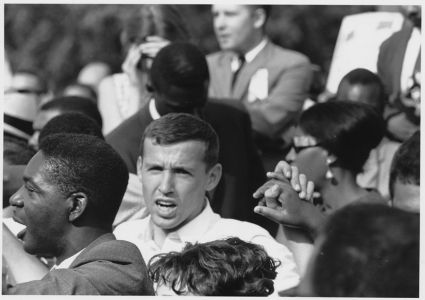
Nearly 250,000 people marched, including 60,000 white participants.

Leaders arrive late and link arms in front of marchers on Constitution Avenue.
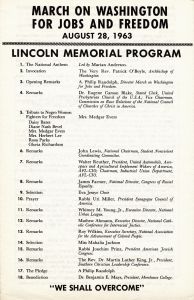
March on Washington for Jobs and Freedom program.

Martin Luther King, Jr. delivering his "I Have a Dream" speech.


_-_NARA_-_542056.jpg)
_-_NARA_-_542070.jpg)


After 1965: division of the black movement[modifier | modifier le wikicode]

The fight for civil rights in the United States has been characterised by a variety of philosophies and strategies. The Civil Rights Act of 1964 represented a major legislative victory against segregation and marked a significant advance in the fight for equal civil rights. However, it did not mean the end of the struggle for many activists. Martin Luther King Jr. and other advocates of integration and non-violence saw the legislation as an important step towards equal opportunity and full integration, but they recognised that the law alone could not eliminate socio-economic disparities or deep-rooted prejudices in society. They continued to campaign for deeper changes, including economic rights and the elimination of all forms of racial discrimination. On the other hand, there were those in the civil rights movement who were more sceptical about integration into white society, if not outright at odds with it. These individuals and groups, sometimes referred to as Black separatists or Black nationalists, advocated Black self-determination, economic autonomy and, in some cases, the creation of a separate nation for people of African descent. Figures such as Malcolm X and groups such as the Nation of Islam, and later the Black Panther Party, were associated with this philosophy. This period saw an intensification of debate about the best strategies for achieving real equality and social justice. The following years saw the emergence of more radical movements that moved away from the non-violent strategy advocated by Martin Luther King Jr, reflecting growing frustration with slow improvements in living conditions and persistent racism.
The rise of the Black Power movement in the 1960s represented a significant evolution in the struggle for civil rights in the United States, marking a shift towards more assertive and sometimes militant forms of expression and advocacy. This movement emphasised racial pride and self-determination, with figures such as Stokely Carmichael at the forefront and groups such as the Black Panther Party embodying this new phase with an approach that combined armed self-defence with social programmes to support black communities. However, this period also saw a slowdown in federal support for civil rights initiatives, despite legislative victories such as the Civil Rights Act and the Voting Rights Act. With the escalation of the Vietnam War, political priorities were redirected to international issues, shifting resources and attention away from civil rights issues. At the same time, there was a conservative backlash, with some segments of the white population perceiving advances in civil rights as a threat to their status. Moreover, after the passage of major legislation, there was a widespread perception that the legislative objectives had been achieved, despite the persistence of systemic inequalities. This legislative saturation, combined with a lack of ongoing commitment from some government officials and political opposition, contributed to a decline in federal support for the movement. The growth of the movement and the emergence of more radical groups also raised concerns within government, where issues of radicalism and violence sometimes hampered federal support. Thus, the late 1960s and early 1970s were characterised by a shift in the dynamics of the civil rights movement. From the struggle for integration and equality before the law, the focus broadened to include power, autonomy and responding to the systemic and structural inequalities that continued to affect black communities across the United States.

.jpg)
Distinguishing between the experiences of black Americans in different parts of the country is crucial to understanding the dynamics of the civil rights movement and the impact of the legislation that was passed during this period. The Voting Rights Act of 1965 marked a major advance by targeting the discriminatory practices that had historically prevented blacks in the South from exercising their right to vote. However, for the millions of blacks living in the urban ghettos of the North and West, the challenges were often different and less linked to official segregation laws than those in the South. In the North and West, discrimination was more rooted in systemic practices of economic racism, residential segregation and inequalities in education and employment. These problems could not be directly addressed by laws protecting voting rights. In the major cities of the North and West, ghettos were formed largely as a result of unofficial and official redlining policies, restrictive deed covenants, and employment discrimination that limited economic and social opportunities for blacks. These policies resulted in the creation of deprived urban environments that perpetuated poverty and social isolation. While the Civil Rights Act of 1964 and the Voting Rights Act of 1965 marked significant legal victories against institutionalized racism, these laws did not directly address systemic racism or deep-rooted economic inequalities. As a result, despite legislative progress in the South, many blacks in other regions continued to live in conditions of extreme poverty and marginalisation. The civil rights movement therefore gradually turned its attention to these issues of economic and social justice, leading to campaigns such as the Poor People's Campaign, which emphasised the need to broaden the struggle to include economic and housing issues. It also led to the emergence of other movements that sought to address conditions in the ghettos more directly and to strengthen the black community from within, including community economic development initiatives and black self-determination movements.
The assassinations of emblematic civil rights figures had a profound effect on the nation and the movement as a whole. The death of Malcolm X in February 1965, followed by those of Martin Luther King Jr. and Robert F. Kennedy in 1968, represented devastating losses for millions of Americans fighting for social justice and an end to racial discrimination. Malcolm X, known for his more militant outlook and calls for black self-determination, had begun to influence the more radical thinking of the civil rights movement, especially after his move away from the Nation of Islam and his trip to Mecca changed his vision of interracial collaboration and unity. His assassination therefore came as a shock to black communities and meant the loss of a voice that advocated both autonomy and a move towards more direct engagement in social change. The assassination of Martin Luther King Jr, the best-known face of the non-violent civil rights struggle, had an even deeper impact. He was seen as America's moralizer, using civil disobedience and powerful rhetoric to bring about peaceful change. His death left a huge void and prompted revolts in over 100 American cities, known as the Holy Week Uprising. Robert Kennedy, another civil rights activist and presidential candidate, was assassinated shortly after Martin Luther King Jr. His commitment to the cause of civil rights and his call for national unity raised hopes for a fairer America. With his death, many felt the loss of an opportunity to make that hope a reality. The assassinations, coupled with the endemic violence and riots that erupted in the ghettos of the North and California, projected the image of a nation in the grip of deep internal conflict. The riots were often triggered by incidents of police brutality, persistent inequality and frustrations built up over generations. These revolts have been met with intense repression, sometimes involving the National Guard and military forces. The combination of killings and riots contributed to a sense of urgency and national crisis. It not only exposed deep-rooted racial divisions but also underlined the considerable resistance to moving towards a truly egalitarian society. The chaos and instability of this period marked a turning point in American history, posing fundamental challenges to national consciousness and identity.
The explosive violence and unrest that shook the northern ghettos and other urban areas across the United States in the 1960s can be attributed in part to the great economic and social divide between these neighbourhoods and the more affluent suburban residential areas. Residents of urban ghettos often faced high unemployment, substandard housing, inferior education, and de facto segregation that persisted even after the legal abolition of de jure segregation. These conditions, combined with police brutality and systemic economic exclusion, created fertile ground for frustration and anger. The proposal for a solution similar to the Marshall Plan is a reference to the ambitious programme of financial aid put in place by the United States after the Second World War to help rebuild European countries devastated by war. Such a plan, when applied to American ghettos, suggests the need for a deep and sustained commitment in terms of investment in infrastructure, education, housing and economic opportunity to repair the damage caused by decades of neglect and discrimination. The idea would be to pursue a policy of internal reconstruction that tackles the roots of social and economic inequality in a holistic way. This would include not only substantial funding but also policy change to ensure that marginalised communities have access to the resources they need to thrive, including fair access to employment opportunities, quality education, affordable housing, adequate healthcare and political representation. This kind of radical intervention would have the potential to transform troubled communities and address some of the systemic issues that lead to violence and unrest. However, such an initiative would require significant political will and public support, as well as collaboration between local and federal governments, private businesses and the communities themselves.
The presidency of Lyndon B. Johnson's presidency was marked by two ambitious efforts that ultimately collided: on the one hand, his 'Great Society' and the War on Poverty, which sought to transform the American social and economic landscape, and on the other, his escalation of US military involvement in the Vietnam War. Johnson launched ambitious national programmes, which included major initiatives such as Medicare, Medicaid, education reforms and grants for urban development projects. These programmes aimed to eradicate poverty and hunger and improve education and healthcare for all Americans. However, the Vietnam War was beginning to consume an increasing proportion of American resources, both financial and human. Conscription for the Vietnam conflict affected all sectors of American society, but the burden fell disproportionately on young men from disadvantaged backgrounds, including many African-Americans. This exacerbated frustration in communities that benefited least from the Great Society's programmes, while paying a high price in a distant and increasingly unpopular conflict. Discontent was not limited to the black community. In 1968, young people around the world were rising up against what they perceived as injustices, social rigidities and authoritarian policies. In the United States, this took the form of anti-war demonstrations, uprisings in urban ghettos, and a culture of protest that permeated the music, art and literature of the time. The social and political chaos of 1968 helped to create a climate that favoured the election of Richard Nixon. Nixon campaigned on a promise to restore order and to support the "silent majority" of Americans who, he argued, wanted a return to stability without the social upheaval that had characterised the late 1960s. This promise of stability, combined with a strategy that sought to capitalise on racial divisions and the backlash against the civil rights movement, ultimately contributed to his electoral success.
The 1968 presidential election revealed the deep divisions that persisted in American society, particularly on the issue of civil rights and racial segregation. George Wallace, former Governor of Alabama, had become known for his unwavering support for segregation, symbolised by his infamous proclamation of "segregation now, segregation tomorrow, segregation forever". His bid for the presidency as a candidate of the American Independent Party attracted a significant base of voters who were resistant, even hostile, to the changes brought about by the civil rights movement. Wallace's campaign resonated particularly strongly in the Southern states, but he also attracted votes in other parts of the country, revealing a resistance to civil rights progress that went beyond the traditional geographical boundaries of the Deep South. By promoting overtly segregationist policies and playing on the fears and prejudices of his electorate, Wallace sought to capitalise on the racial and social tensions of the time. Although his candidacy was not successful in terms of electoral victory, it nevertheless shook up the American political landscape. The voices he gathered proved that segregationist and discriminatory attitudes remained deeply rooted among some Americans. Wallace's campaign highlighted the need for a continuing commitment to the fight for equal rights and social justice, emphasising that the passage of laws such as the Civil Rights Act and the Voting Rights Act was only one step in the long process of changing attitudes and social structures. Wallace's failure also demonstrated that, despite resistance, America was slowly moving towards greater acceptance of the principles of equality and justice for all. It encouraged civil rights activists to continue their hard work, knowing that every action, every march and every speech contributed to building a more inclusive and just nation.
Annexes[modifier | modifier le wikicode]
- Weiss, Jana (2017). "Remember, Celebrate, and Forget? The Martin Luther King Day and the Pitfalls of Civil Religion", Journal of American Studies
- Martin Luther King Jr. Day of Service official government site
- [King Holiday and Service Act of 1994] at THOMAS
- Remarks on Signing the King Holiday and Service Act of 1994, President William J. Clinton, The American Presidency Project, August 23, 1994
- I Have a Dream: Martin Luther King Jr. and the Future of Multicultural America, James Echols – 2004
- Alexandra Alvarez, "Martin Luther King's 'I Have a Dream': The Speech Event as Metaphor", Journal of Black Studies 18(3); doi:10.1177/002193478801800306.
- Hansen, D, D. (2003). The Dream: Martin Luther King Jr. and the Speech that Inspired a Nation. New York, NY: Harper Collins. p. 58.
- "Jones, Clarence Benjamin (1931– )". Martin Luther King Jr. and the Global Freedom Struggle (Stanford University).
- Horwitz, Morton J. (Winter 1993). "The Warren Court And The Pursuit Of Justice". Washington and Lee Law Review. 50.
- Powe, Jr., Lucas A. (2002). The Warren Court and American Politics. Harvard University Press.
- Swindler, William F. (1970). "The Warren Court: Completion of a Constitutional Revolution" (PDF). Vanderbilt Law Review. 23.
- Driver, Justin (October 2012). "The Constitutional Conservatism of the Warren Court". California Law Review. 100 (5): 1101–1167. JSTOR 23408735.
- Myrdal, Gunnar (1944). An American dilemma: The negro problem and modern democracy. New York: Harper & Bros.
- Inbody, Donald S. The Soldier Vote War, Politics, and the Ballot in America. Palgrave Macmillan US :Imprint: Palgrave Macmillan, 2016.
- Schønheyder, Caroline Therese. “U.S. Policy Debates Concerning the Absentee Voting Rights of Uniformed and Overseas Citizens, 1942-2011.” Thesis / Dissertation ETD, 2011.
- Coleman, Kevin. (2010). The Uniformed and Overseas Citizens Absentee Voting Act: Overview and Issues.
- US Policy Debates Concerning the Absentee Voting Rights, United States. Congress, U.S. Government Printing Office, 1944
- Krenn, Michael L. The African American Voice in U.S. Foreign Policy since World War II. Garland Pub., 1999.
- Maxwell, William J. F.B. Eyes: How J. Edgar Hoover's Ghostreaders Framed African American Literature. Princeton Univ. Press, 2017.
- Executive Order 9981 - On July 26, 1948, President Truman issued Executive Order 9981 establishing equality of treatment and opportunity in the Armed Services. This historic document can be viewed here.
- Jon E. Taylor, Freedom to Serve: Truman, Civil Rights, and Executive Order 9981 (Routledge, 2013)
- Patterson, James T. (2001). Brown v. Board of Education: A Civil Rights Milestone and Its Troubled Legacy. Oxford University Press. ISBN 978-0195156324.
- Abraham, Henry J. (1992). Justices and Presidents: A Political History of Appointments to the Supreme Court (3rd ed.). New York: Oxford University Press. ISBN 978-0-19-506557-2.
- Belknap, Michael (2005). The Supreme Court Under Earl Warren, 1953–1969. The University of South Carolina Press. ISBN 978-1-57003-563-0.
- Cray, Ed (1997). Chief Justice: A Biography of Earl Warren. ISBN 978-0-684-80852-9.
- Powe, Lucas A. (2000). The Warren Court and American Politics. Belknap Press. ISBN 978-0674006836.
- Schwartz, Bernard (1983). Super Chief: Earl Warren and His Supreme Court, A Judicial Biography. New York University Press. ISBN 9780814778265.
- Urofsky, Melvin I. (2001). The Warren Court: Justices, Rulings, and Legacy. ABC-CLIO. ISBN 9781576071601.
- See, e.g., Cumming v. Richmond County Board of Education, Berea College v. Kentucky, Gong Lum v. Rice, Missouri ex rel. Gaines v. Canada, and Sweatt v. Painter
- Aguiar, Marian; Gates, Henry Louis (1999). "Southern Christian Leadership Conference". Africana: the encyclopedia of the African and African American experience. New York: Basic Civitas Books. ISBN 0-465-00071-1.
- Cooksey, Elizabeth B. (December 23, 2004). "Southern Christian Leadership Conference (SCLC)". The new Georgia encyclopedia. Athens, GA: Georgia Humanities Council. OCLC 54400935. Retrieved February 12, 2008.
- Fairclough, Adam. To Redeem the Soul of America: The Southern Christian Leadership Conference and Martin Luther King, Jr. (University of Georgia Press, 2001)
- Garrow, David. Bearing the Cross: Martin Luther King, Jr., and the Southern Christian Leadership Conference (1986); Pulitzer Prize
- Meier, August; Rudwick, Elliott M. (1975). CORE: A Study in the Civil Rights Movement, 1942-1968. University of Illinois Press. ISBN 9780252005671.
- Frazier, Nishani (2017). Harambee City: Congress of Racial Equality in Cleveland and the Rise of Black Power Populism. University of Arkansas Press. ISBN 1682260186.<
- Congress of Racial Equality Official website
- Harambee City: Archival site incorporating documents, maps, audio/visual materials related to CORE's work in black power and black economic development.
- Catsam, Derek (2009). Freedom's Main Line: The Journey of Reconciliation and the Freedom Rides. University Press of Kentucky. ISBN 9780813173108.
- Niven, David (2003). The Politics of Injustice: The Kennedys, the Freedom Rides, and the Electoral Consequences of a Moral Compromise. University of Tennessee Press. ISBN 9781572332126.
- PEDAGOGÍA INTERNACIONAL: CUANDO LA INSTRUCCIÓN CÍVICA SE CONVIERTE EN UN PELIGRO PARA LA VIDA..., R. UEBERSCHLAG - The student, international student magazine.
- Whitby, Kenny J. The Color of Representation: Congressional Behavior and Black Interests. University of Michigan Press, 1997. JSTOR, www.jstor.org/stable/10.3998/mpub.14985.
- The Voter Education Project, King Research & Education Institute ~ Stanford University.
- Voter Education Project, Civil Rights Movement Veterans
- Tyson, Timothy B. (2017). The Blood of Emmett Till, Simon & Schuster. ISBN 978-1-4767-1484-4
- Anderson, Devery S. (2015). Emmett Till: The Murder That Shocked the World and Propelled the Civil Rights Movement. Jackson, MS: University Press of Mississippi, 2015.
- Houck, Davis; Grindy, Matthew (2008). Emmett Till and the Mississippi Press, University Press of Mississippi. ISBN 978-1-934110-15-7
- Whitaker, Hugh Stephen (1963). A Case Study in Southern Justice: The Emmett Till Case. M.A. thesis, Florida State University.
- The original 1955 Jet magazine with Emmett Till's murder story pp. 6–9, and Emmett Till's Legacy 50 Years Later" in Jet, 2005.
- Documents regarding the Emmett Till Case. Dwight D. Eisenhower Presidential Library
- Federal Bureau of Investigation. Prosecutive Report of Investigation Concerning (Emmett Till) Part 1 & Part 2 (PDF).
- Hogan, Wesley C. How Democracy travels: SNCC, Swarthmore students, and the growth of the student movement in the North, 1961–1964.
- Hogan, Wesley C. Many Minds, One Heart: SNCC's Dream for a New America, University of North Carolina Press. 2007.
- Carson, Clayborne (1981). In Struggle, SNCC and the Black Awakening of the 1960s. Harvard University Press.
- Student Nonviolent Coordinating Committee Founded ~ Civil Rights Movement Veterans.
- The Voter Education Project, King Research & Education Institute ~ Stanford University.
- Faubus, Orval Eugene. Down from the Hills. Little Rock: Democrat Printing & Lithographing, 1980. 510 pp. autobiography.
- Anderson, Karen. Little Rock: Race and Resistance at Central High School (2013)
- Baer, Frances Lisa. Resistance to Public School Desegregation: Little Rock, Arkansas, and Beyond (2008) 328 pp. ISBN 978-1-59332-260-1
- Kirk, John A. "Not Quite Black and White: School Desegregation in Arkansas, 1954-1966," Arkansas Historical Quarterly (2011) 70#3 pp 225–257 in JSTOR
- "Civil rights rider keeps fight alive" . Star-News. 30 June 1983. pp. 4A
- Civil Rights Act of 1964 (Pub.L. 88–352 , 78 Stat. 241 , enacted July 2, 1964)*Civil Rights Act Passes in the House ~ Civil Rights Movement Veterans
- "A Case History: The 1964 Civil Rights Act". The Dirksen Congressional Center.
- The Voting Rights Act of 1965: Background and Overview (PDF), Congressional Research Service
- Brown v. Board of Education 347 U.S. 493 (1954)
- Brown v. Board of Education 349 U.S. 294 (1955)
- Bolling v. Sharpe 347 U.S. 497 (1955)
Références[modifier | modifier le wikicode]
- ↑ Aline Helg - UNIGE
- ↑ Aline Helg - Academia.edu
- ↑ Aline Helg - Wikipedia
- ↑ Aline Helg - Afrocubaweb.com
- ↑ Aline Helg - Researchgate.net
- ↑ Aline Helg - Cairn.info
- ↑ Aline Helg - Google Scholar
- ↑ Stephen Lucas et Martin Medhurst, « "I Have a Dream" Speech Leads Top 100 Speeches of the Century », University of Wisconsin News, University of Wisconsin–Madison, 15 décembre 1999 (lire en ligne).
- ↑ A "Dream" Remembered, NewsHour, 28 août 2003.
- ↑ Goduti Jr., Philip A. (2012). Robert F. Kennedy and the Shaping of Civil Rights, 1960-1964. McFarland. ISBN 9781476600871.
- ↑ Goldzwig, Steven R.; Dionisopolous, George N. (1989). "John F. Kennedy's civil rights discourse: The evolution from "principled bystander" to public advocate". Communication Monographs. Speech Communication Association. 56 (3): 179–198. doi:10.1080/03637758909390259. ISSN 0363-7751.
- ↑ Loevy, Robert D. (1997). The Civil Rights Act of 1964: The Passage of the Law That Ended Racial Segregation (illustrated ed.). SUNY Press. ISBN 9780791433614.