Coups d'état and Latin American populisms
| Faculté | Lettres |
|---|---|
| Département | Département d’histoire générale |
| Professeur(s) | Aline Helg[1][2][3][4][5][6][7] |
| Cours | The United States and Latin America: late 18th and 20th centuries |
Lectures
- The Americas on the eve of independence
- The independence of the United States
- The U.S. Constitution and Early 19th Century Society
- The Haitian Revolution and its Impact in the Americas
- The independence of Latin American nations
- Latin America around 1850: societies, economies, policies
- The Northern and Southern United States circa 1850: immigration and slavery
- The American Civil War and Reconstruction: 1861 - 1877
- The (re)United States: 1877 - 1900
- Regimes of Order and Progress in Latin America: 1875 - 1910
- The Mexican Revolution: 1910 - 1940
- American society in the 1920s
- The Great Depression and the New Deal: 1929 - 1940
- From Big Stick Policy to Good Neighbor Policy
- Coups d'état and Latin American populisms
- The United States and World War II
- Latin America during the Second World War
- US Post-War Society: Cold War and the Society of Plenty
- The Cold War in Latin America and the Cuban Revolution
- The Civil Rights Movement in the United States
The rise of populist ideologies in Latin America after WWI was due to a number of factors, including the failure of liberal democratic governments to address the economic and social needs of the masses, widespread poverty and inequality, and widespread political instability. The Great Depression of 1929 had a devastating effect on the region, exacerbating these existing problems and leading to widespread unrest and political violence.
In Colombia, the period was marked by the rise of Jorge Eliécer Gaitán and his populist movement, which promised to address the needs of the poor and working-class. However, Gaitán's assassination in 1948 sparked a period of political violence known as "La Violencia," which lasted for over a decade.
In Cuba, the 1930s saw the rise of the populist leader Fulgencio Batista, who promised to address the needs of the poor and working-class. However, his regime was marked by widespread corruption and political violence, and he was eventually overthrown by Fidel Castro and the communist movement in 1959.
In Brazil, Getúlio Vargas came to power in 1930, promising to address the needs of the working-class and the poor. Despite initially implementing a number of reforms, including a minimum wage and labor laws, Vargas's regime became increasingly authoritarian and was eventually overthrown in 1945.
This article will provide a comprehensive examination of the political, economic and social changes in Latin America between the First World War and the Great Depression of 1929 that led to the emergence of populist ideologies. It aims to examine the effects of the Great Depression on Latin America as a whole, while subsequently focusing on three specific case studies - Colombia, Cuba, and Brazil.
The great changes of the 1920s
In the 1920s, Latin America saw significant economic, political, and social changes. The region's economies experienced a boom after World War I that lasted until the late 1920s. The prosperity was driven by factors such as increased demand for Latin American goods and favorable global economic conditions.
This period in Latin American history is referred to as the "dance of the millions" due to the rapid growth of the gross national product in many countries and the influx of foreign investment, particularly from the United States, into South American countries. The term reflects the apparent prosperity and optimism of the time, as the region's economies boomed and many saw an opportunity for wealth and success.
During the "dance of the millions," foreign investments into Latin America increased significantly, and the region's economies continued to rely heavily on the export of agricultural products and minerals to acquire the foreign currency needed for importing manufactured goods. The decline in European imports due to the Great War created an opportunity for industrialization in many Latin American countries. Sectors such as textiles, food and beverage production, building materials, and instrument manufacturing saw significant growth during this period. This marked a turning point in the region's economic development and signaled a shift towards a more diversified and industrialized economy.
The Great War in Europe also marked the beginning of US imperialism in Central America, the Caribbean, and South America. The United States saw the conflict as an opportunity to extend its influence and control over the region, particularly in sectors previously dominated by the British. This marked a shift in the balance of power and the emergence of the United States as a dominant player in the politics and economics of Latin America. The US intervention in the region brought about significant changes, including the establishment of US-friendly governments, the introduction of American-style democracy, and the expansion of US economic interests. This period marked the beginning of US hegemony in the region, which would have lasting effects on Latin America's political and economic landscape.
These changes in Latin America's political and economic landscape during the "dance of the millions" profoundly impacted society. They continued the trends that had begun in the 1850s, with the decline of small peasantry in favour of large haciendas, and the concentration of the labor force in certain sectors, such as plantations, mines, factories, transport, administration, civil service, and services. The progressive mechanization of agriculture, along with the massive immigration of Europeans to countries like Argentina and Brazil, led to the displacement of many small farmers and sharecroppers, who were forced to migrate to cities in search of new opportunities. This migration from rural to urban areas is known as the "rural exodus." These social changes contributed to the growing poverty and inequality in the region. They set the stage for the rise of populist ideologies that would offer solutions to the challenges faced by the working-class and poor.
The rapid industrialization and urbanization of the region led to a significant shift in the population structure of Latin America. The percentage of the population living in rural areas declined dramatically, from 75% in Argentina to 90% in Peru and Central America, as rural migrants flocked to the cities in search of new opportunities. The growing populations of the cities presented new challenges for the traditional elites, as it became increasingly difficult to maintain social order in the face of poverty and inequality. The shift from rural to urban societies was a defining feature of the period, and would have lasting effects on the political and economic landscape of the region.
The changes brought about by the "dance of the millions" and the shift towards urban societies were further compounded by the development of trade and communication networks. This allowed for the exchange of ideas and ideologies across borders and the arrival of new groups of immigrants. From Mexico, new political and social ideologies were introduced, as well as from socialist and fascist Europe and Bolshevik Russia. The arrival of Jewish immigrants also brought new perspectives and ideas to the region. All of these factors contributed to a growing sense of social and political ferment, as the traditional elites struggled to maintain control in the face of these new challenges. The intersection of these forces set the stage for the rise of populist ideologies that would define Latin America's political landscape in the years to come.
The influx of new ideologies and perspectives challenged the dominant control of the traditional elites and the Catholic Church. The arrival of these new ideas threatened the existing order, and the regimes of order and progress that had been in place for decades could no longer maintain their grip on power. The impact of these developments was felt throughout Latin America, as the political and social landscape of the region was transformed. The rise of new ideologies, combined with the growing poverty and inequality brought about by industrialization and urbanization, set the stage for the populist movements that would come to define the region in the years to come.
The massive influx of rural migrants transformed Latin America's cities and urban culture. In every country, people from different cultural regions were brought together in the capitals and large cities, creating a melting pot of diverse backgrounds and traditions. The impact of this migration was felt in all aspects of urban life, from the growth of slums and shantytowns, to the transformation of cultural norms and values. The arrival of these rural migrants brought new challenges and opportunities, as they struggled to adapt to the unfamiliar urban environment and find a place in the region's rapidly changing social and economic landscape.
Despite often facing rejection and discrimination, these rural migrants played a significant role in national integration. Their presence in the cities brought their regional traditions and cultural heritage with them, enriching the urban fabric. The need for literacy in urban life led to a growth in education, with schools becoming more widely available, resulting in a more literate population. Additionally, the advent of radio and cinema in the cities during the 1920s added a new dimension to urban life and provided new avenues for communication, entertainment, and cultural expression. These developments brought new challenges and opportunities, and helped shape the emerging national identity of Latin America in the years to come.
During the 1910s and 1920s, other significant social changes took place in Latin America. A new middle class emerged: intellectuals, small business owners, entrepreneurs, teachers, and civil servants from the capitals and large cities. This group sought stability and a place in society, but they no longer wished to be controlled by the traditional elites or foreign capital. The rise of this new middle class brought new perspectives, ideas, and aspirations, and helped shape the region's political, social, and cultural landscape. This group played an important role in the growing sense of national identity and developing a more democratic and inclusive society.
During this time, the number of university students was also growing, primarily consisting of young men from the upper middle class. These students brought new energy, ideas, and ambitions to the universities, and helped shape the region's intellectual and cultural life. The growth of the student population also reflected broader social and economic changes, as increasing numbers of families sought to provide their children with higher education and greater opportunities in the future. The growth of this intellectual elite helped to create new avenues for political and cultural engagement, and played an important role in shaping the future of Latin America.
In 1918, students emerged as a political force in Latin America. They called for university autonomy and were influenced by various ideologies, including socialism, anarchism, the Mexican Revolution, and indigenism. This awakening of student political activism reflected a growing interest in their respective countries' development and the working classes' education. The students saw themselves as agents of change and sought to use their newfound political voice to shape the future of Latin America. This period marked the beginning of a new era of regional political and intellectual engagement. The students would continue to play an important role in shaping its future.
In the 1920s, workers in various industrial sectors began to organize themselves into unions and showed interest in socialist, anarchist, and communist ideologies. This trend was largely influenced by European immigrants who brought these ideologies with them to Latin America. Sectors such as state mines, factories, oil, and cigarette factories were particularly affected by this trend as workers in these industries sought to improve their working conditions and wages through collective action. This was a significant development as it marked the beginning of organized labor in Latin America and signaled a growing awareness among workers of their rights and the importance of collective action in achieving their goals.
The military, an important source of employment and political influence, became a major actor in Latin America's political and social evolution during this time. With increasing frequency, military coups d'état occurred, often led by young officers who sought to modernize their countries, but also to assert their own power. The rise of populist ideologies, such as those of the military regimes of Mexico and the populist government of Getulio Vargas in Brazil, reflected the growing discontent of the urban working classes and rural populations with the existing political and economic systems. These changes would have a profound impact on Latin America in the years to come, including the devastating effects of the Great Depression of 1929.
In response to the changing social and economic landscape, the army increasingly positioned itself as a political force, breaking free from the control of traditional parties and the Catholic Church. This shift marked the emergence of the military as a potential alternative to the status quo in Latin America.
This leads to the emergence of a new political force, the military, which aims to present itself as an alternative to traditional political parties and the Catholic Church. The officers, primarily from the middle class and from provincial towns, seek to have the army play a more active role in the country's economic development.
This leads to a shift towards a more democratic political system and the participation of previously marginalized groups, including women and working-class individuals, in the political sphere.
The influence of extreme right-wing ideologies is growing among Latin American politicians and military personnel. With the advent of new technologies such as cinema and radio, these politicians can now extend their reach and spread their discourse to a wider audience, shaping the nation's political landscape.
Latin American populisms
Latin American populisms, characterized by a charismatic leader, a mass base, and a focus on the needs of the common people, emerged in the 1920s and dominated politics in the region from the 1930s to the 1950s. This period saw numerous coups d'état, as military leaders sought to overthrow populist governments. Despite the challenges, Latin American populisms left a lasting legacy, shaping the political and social landscape of the region.
Juan Domingo Perón in Argentina is often associated with populism in Latin America, but he rose to power in the 1940s and surfed on the wave of populism that had already been established in the region since the 1920s and 1930s.
During the 1920s and 1930s in Latin America, populism was a political movement that aimed to integrate the working class into national politics without fundamentally changing the social order. It targeted urban masses, workers, petty bourgeoisie, rentiers, rural migrants, students, intellectuals, and soldiers, and focused on addressing their needs and concerns through government intervention and social programs. This type of populism sought to reconcile the interests of different social groups while maintaining the existing power structures.
The urban classes in Latin America were seen as a threat to the existing social order due to their potential for radicalization. To prevent this, populism aimed to reject the class struggle and instead promote class solidarity by advocating for a corporatist state. This state was seen as a way to hierarchically rule the national family through vertical coalitions of patronages, thus maintaining the existing power structures and avoiding social revolution. Populism aimed to reconcile the interests of different social groups in order to preserve the social order.

Populism in Latin America was often characterized by a charismatic leader who had a strong emotional connection with the people. This leader was often seen as a macho figure, characterized by strength, authoritarianism, and a sympathy for the needs of the people. The charismatic leader was seen as the embodiment of the popular will, and their personal appeal and emotional connection with the masses were key elements of the populist movement.
The populist leader in Latin America was often seen as a benevolent and paternalistic figure who was seen as understanding and protecting the people. At the same time, he was not tolerant of opposition and could be authoritarian in his approach. He used mass media to gain popular support and build his personal brand, but the movement itself did not have a complex ideology. Instead, it was centered around nationalism and a vague promise of development with social justice. The leader was seen as the embodiment of the popular will, and the emotional connection with the masses was key to the success of the movement.
The strong state intervention in economic and social affairs was a key aspect of Latin American populism. To distract from internal social conflicts, the populist leader often sought to unify the masses against a common foreign enemy, such as US imperialism, Chinese immigrants, Afro-Caribbean immigrants, or Jewish immigrants (in the case of Argentina). This helped to build a sense of national unity and solidarity, but also served to distract from the underlying social and economic tensions within the country.
Rafael Trujillo's rule in the Dominican Republic is considered one of the most extreme examples of Latin American populism. Trujillo was trained in the National Guard by the US Marines and remained in power for many years, ruling with an iron fist. In 1937, he ordered the massacre of 15,000 to 20,000 Haitian peasants by the army on the border, which is considered one of the worst human rights atrocities in Latin American history. Despite this, Trujillo maintained popular support among certain sectors of the population, due in part to his use of mass media to build a cult of personality and his claims to be a strong and benevolent leader who was working to protect the nation from foreign threats.
Impact of the Great Depression in Latin America
Economic
The Great Depression had a significant impact on Latin American economies, especially for countries that were heavily reliant on exports to the US or Europe. The drop in demand for their goods, combined with declining commodity prices, led to a sharp contraction in their economies and a decrease in their standard of living. The effects of the depression were felt for several decades and played a role in shaping the political and economic landscape of the region.
The fall in consumption in the US had a cascading effect on Latin American economies, leading to a decrease in demand for their exports and a decline in their income. This, combined with the decrease in commodity prices, resulted in a sharp contraction of their economies and a decline in their standard of living. The economic instability caused by the Great Depression had long-lasting effects on the region and contributed to political and social unrest in many countries.
Social
The economic downturn caused by the Great Depression resulted in widespread job loss and unemployment, particularly in the rural areas where many people were employed in agriculture and mining. The workers who lost their jobs migrated to cities in search of work, leading to an increase in urban poverty and overcrowding. The rise in unemployment and underemployment also had a significant impact on families and communities, causing dislocation and social unrest. The Great Depression had far-reaching social consequences, contributing to the widening of the income gap and the decline in living standards for many people.
The effects of the Great Depression were felt differently in different countries depending on their level of economic development and existing poverty levels. In Latin America, where poverty was already widespread, the increase in poverty and unemployment caused by the depression was severe, although it may not have been as noticeable as in the US, where the contrast between pre- and post-depression prosperity was more stark.
Politics
The economic crisis caused by the Great Depression had significant political repercussions in Latin America. In the period between 1930 and 1935, many countries in the region experienced regime changes, some of which were peaceful and others that were violent. The widespread poverty, unemployment, and social unrest fueled by the depression created a politically unstable environment that was ripe for the emergence of authoritarian leaders who promised to restore order and stability. These political upheavals contributed to the decline of democratic institutions and the rise of authoritarian or military regimes, which had long-lasting consequences for the region.
The United States, which was facing its own economic crisis during the Great Depression, was unable to provide the financial support and intervention it had previously offered to Latin American countries. The policy of "good neighborliness," which aimed to foster friendly relations and avoid intervention in the affairs of other countries, was not sufficient to prevent political upheavals and coups d'état in the region. The political instability caused by the depression, combined with the absence of US support, created a conducive environment for the rise of authoritarian leaders who promised to restore order and stability. This period marked a turning point in the relationship between the US and Latin America and had far-reaching consequences for the region.
The case of Colombia: crisis absorbed by coffee growers
Economic
Colombia was one of the countries in Latin America that was heavily impacted by the Great Depression, as its economy was largely dependent on coffee exports, with 75% of its coffee exports going to the United States. Despite the severe economic crisis brought on by the fall in demand for its exports, Colombia did not experience a sudden change in power, unlike many other countries in the region. Instead, the crisis was absorbed largely by the coffee growers, who faced declining prices and income as a result of the depression. The economic and social impact of the depression was felt acutely in the coffee-growing regions of Colombia and had far-reaching consequences for the country.
After the onset of the Great Depression in 1929, the world price of coffee plummeted, leading to a significant decline in income for coffee growers in Colombia. This resulted in a decrease in imports and a contraction of the economy, but compared to other Latin American countries, Colombia was relatively better off. The volume of exports fell by only 13%, and the Gross National Product (GNP) declined by only 2.4%. Unlike many other countries in the region, Colombia did not experience a coup d'état or revolution during this period. Instead, there was a historic transfer of power from the Conservative party to the Liberal party, as a result of a political system that marginalized the Liberal party and allowed the Conservatives to maintain control for more than 50 years. This transfer of power occurred after the division of the Conservative party and the election of a Liberal president in 1930.
The experience of Colombia during the Great Depression can provide valuable insights and lessons for understanding similar events and reactions that may occur in the present or future. Studying the historical experiences of countries during times of economic crisis can help shed light on how different countries and regions respond to similar challenges and can inform decision-making in the present.
The transition in Colombia's economy during the Great Depression was influenced by the way coffee was produced. The shift towards small-scale coffee farming and the transfer of ownership from large landowners to small farmers helped the country to absorb the economic shock of the Great Depression to some extent. By decentralizing the coffee industry and spreading the risk among many small farmers, the country was able to mitigate the impact of declining coffee prices and export income on the overall economy. This shows how a diversified economy can be more resilient in times of crisis.
During the Great Depression, the small coffee farmers in Colombia were hit hard by the fall in prices. The former large landowners, who had shifted to buying and exporting coffee, were able to weather the crisis better because they did not have to bear the direct costs of producing coffee. The small farmers, on the other hand, had to continue working hard to produce coffee despite the low prices, which resulted in their exploitation and further economic hardship. This shows how economic shocks can have a disproportionate impact on vulnerable communities, perpetuating cycles of poverty and inequality.
This semi-autarky helped small coffee farmers in Colombia to some extent during the Great Depression. By having their own vegetable garden, they were able to produce some of their own food, which reduced their dependence on the market and allowed them to survive despite the low prices for coffee. This shows how local communities and households can adopt self-sufficient strategies to cope with economic shocks and external pressures, but it also highlights the limitations of these strategies and the need for broader systemic solutions to address the root causes of economic instability.
Politics

This division of the Conservatives led to the transfer of power to the Liberal party in 1930 and marked a shift in Colombian politics. Despite the economic hardships faced by the country during the Great Depression, there was no major political unrest or coups, which was in contrast to the experiences of many other Latin American countries.
Alfonso Lopez's populist program and reforms addressed the social and economic impacts of the Great Depression in Colombia. He introduced measures such as universal suffrage for men, education programs, unionisation, and recognition of indigenous communities to improve the standard of living and reduce inequality in the country. This marked a shift towards more progressive policies and reforms aimed at addressing the widespread social and economic difficulties faced by the people in Colombia due to the Great Depression.
It wasn't until 1934 that Alfonso Lopez was elected and initiated a populist program known as "revolución en marcha". This program was inspired by the Mexican revolution and included a small constitution reform, universal suffrage for men, and education and unionization programs. There was also a small recognition of the indigenous communities in Colombia.
Lopez's "Marching Revolution" was an attempt to address some of the social and economic issues that had arisen in the wake of the Great Depression, including poverty, inequality, and unemployment. While his reforms were limited, they represented a significant step forward for the country and marked a shift towards a more progressive political landscape.
In 1938, Lopez was removed from power in a military coup, ending his populist and reformist agenda. The extreme right-wing military regime that took over would go on to suppress political opposition and labour unions and reverse much of the progress made under Lopez's administration.
Under President Alfonso Lopez, liberalism garnered support from a portion of the urban and working-class populations. Despite this success, however, rural areas, particularly the small coffee-growing communities, were largely unaffected by Lopez's efforts. These small farmers had been suffering from self-exploitation for an extended period, and the pressure from their circumstances eventually culminated in a civil war during World War II, referred to as the "violencia," which resulted in the deaths of over 250,000 peasants and a mass rural migration.
The case of Cuba: Revolution and military coup d'état
Cuba is an economy that has depended on sugar since the end of the 18th century, first cultivated by slaves until its abolition in 1886, then by rural workers, often seasonal workers from Jamaica or Haiti, who were brought to work on the large, underpaid plantations in the United States.
In 1930, half of the cultivated land belonged to American citizens in Cuba, they also owned almost all the mines, transport, communications, a large part of the banks and trade.
Between 1929 and 1933, the price of sugar fell by more than 60% and Cuban sugar exports plunged by more than 80%. The large landowners responded by cutting production, lowering agricultural wages by 75%, massively laying off and deporting thousands of seasonal workers from Haiti and Jamaica. Hundreds of small factories and stores went bankrupt; by 1933 a quarter of the working population was unemployed and 60% of the population lived below the subsistence minimum.
In power since 1924 has been President Gerardo Machado, a nationalist liberal turned dictator.
During the crisis, the opposition radicalizes against him through strikes, attacks, sabotage, communist, socialist and anarchist movements very strong already in the 1920s in Cuba; repression becomes more and more bloody.
Washington tries to intervene by sending a negotiator, but without a solution; in August 1933 a general strike paralyses the country, the army releases the dictator who goes into exile and a very heterogeneous coalition takes power, but is unable to control the general anarchy.

It was a period of riots, strikes, and the taking of sugar plantations by workers who set themselves up as a kind of Bolshevik conglomerate; soon afterwards soldiers and officers of a barracks in Havana led by Sergeant Batista mutinied.
Unexpectedly, they received the support of civilians who transformed their mutiny into a military putsch, resulting in a 100-day revolutionary government governed by decree to "return Cuba to Cuba" and free it from US control.
It was then that women in Cuba gained universal suffrage, university autonomy, workers, including cane cutters, a minimum wage and other social benefits, and a start was made on agrarian reform.
These reforms are too radical for the right and far right, too timid for the Marxist left and unacceptable to Roosevelt's United States.
The United States does not intervene militarily, but convinces Batista to take the power he assumes through civilian presidents and then directly as dictator until the Castro revolution of 1959.
The Case of Brazil: Military Coup and Fascist Regime
There's a military coup and a fascist regime.
Economics
Brazil's economy is fairly diversified, but exports are mainly coffee; unlike Colombia, coffee is grown by seasonal workers, European immigrants, but above all Brazilian migrants, who are subject to large landowners who continue to dominate their strongholds without sharing.
In 1930, the government of the first Brazilian republic of order and progress, this government did not take coherent measures in the face of the crisis that provoked a conflict over the presidential election, because only a small section of society had the vote and could elect the president.
Three states out of seventeen refuse to accept the result of the election causing uprisings, the military will overthrow the civilian government giving power to Vargas, a cattle breeder and governor of the state of Rio Grande do Sul.
Politics
We can see that all the power in Brazil as history moves from the sugar northeast to Rio de Janeiro to the south where economic interests, power and cattle breeding like coffee production are concentrated.
Once in power, Vargas began by eliminating the socialist and communist left and then turned to the fascist right, then called "integralist" and secretly financed by Mussolini's Italy.
In 1937, Vargas banned all political parties launching a second coup directly supported by the army imposing the Estado Novo on the Brazilians; it was a corporatist state inspired by Mussolini's Italy and Salazar's Portugal.
This dictatorship is characterised by nationalism, the development of the army, state intervention in the economy, state control of trade unions, censorship and political repression.
This Estado Novo lasted until 1954, throughout the Second World War, when the army provoked another coup d'état and forced Vargas into exile.

Integralist propaganda poster - 1937.
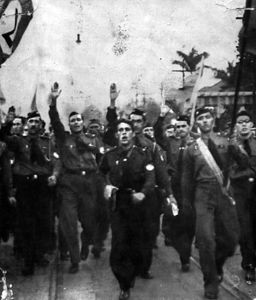
Fundamentalist greeting, "Anauê", of indigenous origin meaning "You are my brother" and ancient indigenous war cry.

New State propaganda.
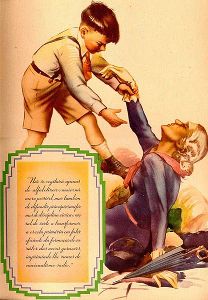
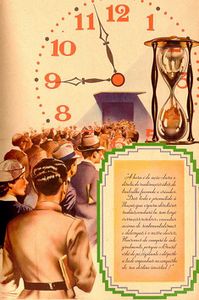

Edda Mussolini, daughter of Benito Mussolini, was received by Ademar de Barros during his visit to São Paulo in 1939. The Estado Novo was sympathetic to Nazi fascism.


.jpg)


Conclusions
The crisis of 1929 brought all American companies, not only from the United States but also from Latin America, to the brink of the abyss.
It shows the weaknesses of economic liberalism, a relative liberalism, since it is a liberalism in which the State basically helps the hacendados, industrialists, corporations, banks and at the same time represses the workers.
This crisis reveals the deep inequalities of all these societies and all of them need a charismatic leader who unites and reassures the population; all of them also resort to nationalism, including the United States under Roosevelt.
Populism allows the ruling classes to avoid or suppress revolutions, as in Cuba in 1933, but they often have to put in place social legislation to protect the workers and the poor.
Everywhere, the big losers are in the countryside the small peasants and in the cities the big losers are the socialist and communist parties and trade unions which are suppressed or integrated into a large national party with certain social benevolence.
Social tensions are suppressed, but they have not disappeared and will erupt again after the Second World War.
Annexes
References
- ↑ Aline Helg - UNIGE
- ↑ Aline Helg - Academia.edu
- ↑ Aline Helg - Wikipedia
- ↑ Aline Helg - Afrocubaweb.com
- ↑ Aline Helg - Researchgate.net
- ↑ Aline Helg - Cairn.info
- ↑ Aline Helg - Google Scholar