Coups d'état and Latin American populisms
| Faculté | Lettres |
|---|---|
| Département | Département d’histoire générale |
| Professeur(s) | Aline Helg |
| Cours | The United States and Latin America: late 18th and 20th centuries |
Lectures
- The Americas on the eve of independence
- The independence of the United States
- The U.S. Constitution and Early 19th Century Society
- The Haitian Revolution and its Impact in the Americas
- The independence of Latin American nations
- Latin America around 1850: societies, economies, policies
- The Northern and Southern United States circa 1850: immigration and slavery
- The American Civil War and Reconstruction: 1861 - 1877
- The (re)United States: 1877 - 1900
- Regimes of Order and Progress in Latin America: 1875 - 1910
- The Mexican Revolution: 1910 - 1940
- American society in the 1920s
- The Great Depression and the New Deal: 1929 - 1940
- From Big Stick Policy to Good Neighbor Policy
- Coups d'état and Latin American populisms
- The United States and World War II
- Latin America during the Second World War
- US Post-War Society: Cold War and the Society of Plenty
- The Cold War in Latin America and the Cuban Revolution
- The Civil Rights Movement in the United States
We will look at the general changes throughout Latin America between the First World War and the Great Depression of 1929 that led to the rise of populist ideologies and then we will talk about the devastating effects of the Great Depression in Latin America as a whole before looking at Colombia, Cuba and Brazil.
The great changes of the 1920s
During the war of 1914 - 1918, the economies of Latin America experienced an upturn that continued until the 1920s.
This period is called the "dance of the millions" because the gross national product of most countries grew rapidly and foreign investment, especially from the United States, was attracted to South American countries.
These investments are increasing rapidly and Latin American economies are still based on the development of exports of agricultural products and minerals in order to acquire the foreign exchange needed for imports of manufactured goods. As imports from Europe are falling sharply, we are seeing the beginning of industrialisation in most countries, namely in textiles, food, drinks, building materials and also instruments.
The war in Europe also means the beginning of US imperialism not only in Central America and the Caribbean, but also in South America, where they control the sectors hitherto held by the British.
These changes are reflected in society and continue the process begun in the 1850s. The small peasantry continues to decline in favour of the large haciendas, the labour force is concentrated in certain sectors, plantations, mines, factories, transport, administration, civil service and services; but due to the progressive mechanization and in the case of Argentina and Brazil the massive immigration of Europeans, many small farmers and sharecroppers are left behind and are forced to leave to try their luck in the cities, this is the rural exodus.
There is a shift from a 75 per cent rural society in Argentina 80 per cent to 90 per cent in Peru and Central America to increasingly urban societies because these rural migrants have virtually no other place to go than the increasingly populated cities and it is becoming difficult for the traditional elites to maintain social order.
This is all the more so because with the development of trade and communications, new ideologies are arriving from Mexico, but also from socialist or fascist Europe, but also from Bolshevik Russia, as well as by the arrival of Jewish immigrants.
These new ideologies undermine the control of the elites and the Catholic Church, it is the end of the regimes of order and progress.
The massive arrival of displaced peasants transforms cities and urban culture. In every country, people from different cultural regions find themselves mixed together in the capitals and large provincial cities.
Even if they are often rejected or despised, these rural migrants contribute to a certain national integration since they bring their regional particularities to the cities. Moreover, urban life often requires literacy and schools are often concentrated there; urban populations are increasingly literate and at the same time in these cities in the 1920s radio and cinema made their entrance.
Other social changes mark these years 1910 - 1920. The middle class, composed of intellectuals, small businessmen, entrepreneurs, teachers, and civil servants from either the capital or large provincial cities, began to form the middle class that wanted its place in a stable society, but no longer necessarily controlled by elites or foreign capital.
The category of university students is growing, even if they are young men from the upper middle class.
As early as 1918, students were a political force to be reckoned with; they demanded university autonomy, at the same time they were influenced by socialism, anarchism, the Mexican revolution and indigenism; they were now interested in the development of their country and the education of the working classes.
Workers in certain industrial sectors, especially those related to exports such as state mines, factories, oil, cigarette factory workers for example, are also beginning to unionize and become interested in socialism, anarchism and communism partly imported by European immigrants.
From 1910 and especially from 1918, strikes began to develop, while at the same time another sector became more important, the army.
The army developed in the towns and cities and freed itself from the tutelage of the traditional parties and the Catholic Church in order to present itself as a political alternative.
It is mainly middle-class officers, often from provincial towns, who are calling for a more active role for the army in the country's economic development.
At the same time in politics, left-wing parties are emerging as suffrage develops first for men and then for women.
At the same time, extreme right-wing ideologies are being emulated among Latin American politicians and army men. It is thanks to cinema and radio that these politicians will be able to reach more and more audiences, there is really a discourse that is beginning to spread throughout the nation.
Latin American populisms
It is in this context that Latin American populisms took shape in the 1920s. These populisms would dominate politics from the 1930s to the 1950s.
Populism is often associated with Perón, but it is later, as it surfs on a wave from the 1920s and 1930s.
Latin American populism of this period is a movement that attempts to integrate the working classes into national politics without changing the social order; it is aimed primarily at the urban masses, workers, the petty bourgeoisie, rentiers, rural migrants, students, intellectuals, and soldiers.
These are the urban classes whose radicalization threatens to bring about social revolution for fear of losing the social order. Populism rejects the class struggle for class solidarity, defending the idea of a corporatist state that would hierarchically rule the national family between vertical coalitions of patronages.

Populism is usually led by a charismatic leader who often responds to the macho type, i.e. a strong, authoritarian, but sympathetic man with whom the people can identify emotionally.
He is a benevolent, paternalistic, great leader of populism who is there because he understands and protects the people, but at the same time he is a leader who does not tolerate provocation and opposition. He uses the mass media to gain popular support, but at the same time he is a movement that does not really have a complex ideology, at the heart of his ideology is nationalism and a vague promise of development with social justice.
This means a strong state that intervenes in economic and social affairs, moreover in order to hide internal social conflicts populism often unites the masses against a common foreign enemy which can be US imperialism, the Chinese emigrant or the Afro-Caribbean immigrant or the Jewish immigrant in the case of Argentina.
The most terrible case of populism is that of Trujillo, who was trained in the National Guard by the Marines and who remained in power for a long time. In 1937 he had between 15,000 and 20,000 Haitian peasants massacred by the army on the border.
Impact of the Great Depression in Latin America
Economic
The Great Depression in the United States is producing enormous shock waves in Latin American nations and an economic slump from which they will only emerge after the Second World War; the more the country depends on exports of raw materials or agricultural products to the United States, the more shocking and terrible it is, but those who also export to European countries are also seriously affected by the crisis.
The fall in consumption in the United States leads to a sharp drop in demand and Latin American countries are therefore deprived of a large part of their income, in addition to the fall in the prices of these products on the world market and on average the total value of Latin American exports between 1930 and 1934 is half of what it was between 1925 and 1929.
Social
The mines and plantations are laying off many of their workers, who are going to swell the population of the cities in search of work; there is the rise in unemployment, the rise in underemployment, the dislocation of families which is increasing dramatically.
In countries where people live in poverty, misery and distress are terrible, but somewhere they are less spectacular and less publicized than in the United States. Misery was already there before, so the increase in misery is less dramatic than in the United States, but it is no less severe.
Politics
The Latin American economic slump is reflected in politics; from 1930 to 1935, almost all Latin American countries experienced more or less violent regime changes.
The United States, which was itself mired in the economic crisis, no longer intervened, and in fact its policy of good neighbouring was not going to succeed in preventing coups d'état and violent seizures of power.
The case of Colombia: crisis absorbed by coffee growers
Economic
Colombia does not see a sudden change in power, Colombia's economy in 1929 was largely dependent on its coffee exports, 75% of which went to the United States.
After 1929, the world price of coffee plummeted, income from coffee fell, Colombia's import volumes fell by 63%, but in all other economic indicators Colombia fared better than the rest of Latin America. The volume of exports falls by only 13%, GNP falls by only 2.4%, and there is no coup d'état or revolution, only a historic transfer of government from the Conservative party to the government for more than 50 years thanks to a system of politics that completely marginalized the Liberal party, which passed to the Liberals in 1930 after the division of the Conservatives and the election of a Liberal president.
The lesson from Colombia is helpful in understanding some of the reactions today.
Economically, the reason for this transition is the way coffee is produced. Since the 1920s, large landowners who are also major exporting merchants have sold most of their coffee-growing land to small farmers.
This allows the former large landowners to concentrate on buying the coffee crops and exporting the coffee. When the crisis hits, it is mainly the small coffee farmers who are bearing the brunt of the fall in prices; they sell coffee at very low prices without reducing production, in fact they exploit themselves, they force themselves, their women and children to work just as hard in order to earn almost nothing.
This is possible, because many of them live in semi-autarky and have their own vegetable garden, they can survive without buying almost anything until they get out of this very difficult time.
Politics

At the political level, the transfer of power was done because in 1930 the Conservatives had the bad idea of dividing themselves between two presidential candidates, which allowed the Liberals to win with a candidate from the elite with traditional views.
It is only in 1934 that there is a new election that sees Alfonso Lopez elected who launches a populist program called "revolución en marcha" inspired by the Mexican revolution with a small reform of the constitution, universal suffrage for men, he launches education programs, unionization, there is also a small recognition of the Indian communities in Colombia.
At the political level, the transfer of power was done because in 1930 the Conservatives had the bad idea of dividing themselves between two presidential candidates, which allowed the Liberals to win with a candidate from the elite with traditional views.
It is only in 1934 that there is a new election that sees Alfonso Lopez elected who launches a populist program called "revolución en marcha" inspired by the Mexican revolution with a small reform of the constitution, universal suffrage for men, he launches education programs, unionization, there is also a small recognition of the Indian communities in Colombia.
From 1937 onwards, Lopez was attacked by a fascinating extreme right inspired by the model of General Franco in Spain who had to give up part of his reform programme and in particular a timid land reform.
Lopez succeeded in integrating part of the urban and working classes behind liberalism, he also succeeded in limiting the damage of the Great Depression, but the countryside was not really affected by these reforms; the small coffee producers who had been self-exploiting for all these years were on the verge of an explosion that would occur in a civil war during the Second World War called the "violencia" that would cause the death of more than 250,000 peasants and a huge rural exodus.
Le cas de Cuba : Révolution et coup d’État militaire
Cuba est une économie qui dépend du sucre depuis la fin du XVIIIème siècle d’abord cultivé par les esclaves jusqu’à l’abolition en 1886 puis par des travailleurs ruraux souvent des saisonniers de Jamaïque ou d’Haïti qui sont amenés afin de travailler dans les grandes plantations étasuniennes et sous-payés.
En 1930, la moitié des terres cultivées appartient à des citoyens étatsuniens à Cuba, ils détiennent aussi presque toutes les mines, les transports, les communications, une grande partie des banques et du commerce.
Entre 1929 et 1933, le prix du sucre chute de plus de 60 % et les exportations de sucre cubain plongent de plus de 80 %. Les grands propriétaires répondent en diminuant la production, en baissant les salaires agricoles de 75 %, en licenciant massivement et en déportant des milliers de travailleurs saisonniers de Haïti et de la Jamaïque. Des centaines de petites usines et de magasins font faillite ; en 1933 un quart de la population active est au chômage et 60 % de la population vie en dessous du minimum vital.
Au pouvoir, on trouve depuis 1924 le président Gerardo Machado, libéral nationaliste devenu dictateur.
Pendant la crise, l’opposition se radicalise contre lui à travers des grèves, des attentats, des sabotages, des mouvements communistes, socialistes et anarchistes très fort déjà dans les années 1920 à Cuba ; la répression devient de plus en plus sanguinaire.
Washington tente d’intervenir en envoyant un négociateur, mais sans solution ; en août 1933 une grève générale paralyse le pays, l’armée lâche le dictateur qui s’exile et une coalition très hétérogène prend le pouvoir, mais n’arrive pas à contrôler l’anarchie générale.

C’est une période où il y a des émeutes, des grèves, des prises de plantations sucrières par des travailleurs qui s’érigent en sorte de conglomérats bolcheviques ; peu après des soldats et des officiers d’une caserne de La Havane avec à leur tête le sergent Batista se mutinent.
De manière très inattendue, ils reçoivent l’appui des civils qui transforment leur mutinerie en un putsch militaire ; il en sort un gouvernement révolutionnaire qui va durer 100 jours gouverné par décret afin de « rendre Cuba à Cuba » et de la libérer de la tutelle des États-Unis.
C’est à ce moment-là que les femmes à Cuba acquièrent le suffrage universel, l’université leur autonomie, les travailleurs y compris les coupeurs de canne un salaire minimum et d’autres bénéfices sociaux et on lance un début de réforme agraire.
Ces réformes sont trop radicales pour la droite et l’extrême droite, trop timides pour la gauche marxiste et inacceptable pour les États-Unis de Roosevelt.
Les États-Unis n’interviennent pas militairement, mais convainquent Batista de prendre le pouvoir qu’il assume à travers des présidents civils puis directement comme dictateur jusqu’à la révolution castriste de 1959.
Le cas du Brésil : coup d’État militaire et régime fascisant
Il y a un coup d’État militaire et un régime fascisant.
Économie
L’économie du Brésil est assez diversifiée, mais les exportations sont principalement du café ; contrairement à la Colombie, le café est cultivé par des travailleurs saisonniers, des immigrants européens, mais surtout des migrants brésiliens, ce sont des travailleurs soumis à de grands propriétaires terriens qui continuent à dominer sans partage sur leurs fiefs.
En 1930, c’est le gouvernement de la première république brésilienne d’ordre et de progrès, ce gouvernement ne prend pas de mesures cohérentes face à la crise provoquant un conflit autour de l’élection présidentielle, car c’est seulement une petite portion de la société qui avait le suffrage et pouvait élire le président.
Trois États sur dix-sept refusent le résultat de l’élection provoquant des soulèvements, les militaires vont renverser le gouvernement civil donnant le pourvoir à Vargas, éleveur de bétail et gouverneur de l’État de Rio Grande do Sul.
Politique
On voit que tout le pouvoir au Brésil à mesure que l’histoire passe du Nord-Est sucrier à Rio de Janeiro au Sud où se concentrent les intérêts économiques le pouvoir et l’élevage de bétail comme la production de café.
Une fois au pouvoir Vargas commence par éliminer la gauche socialiste et communiste puis il se tourne vers la droite fasciste appelée alors « integraliste » et secrètement financée par l’Italie de Mussolini.
En 1837, Vargas interdit tous les partis politiques lançant un deuxième coup d’État directement appuyé par l’armée imposant l’Estado Novo aux Brésiliens ; c’est un État corporatiste inspiré de l’Italie de Mussolini et du Portugal de Salazar.
Cette dictature est caractérisée par le nationalisme, le développement de l’armée, l’intervention de l’État dans l’économie, le contrôle étatique des syndicats, la censure et la répression politique.
Cet Estado Novo dure jusqu’en 1954 traversant toute la Deuxième Guerre mondiale quand l’armée provoque un nouveau coup d’État et force Vargas à s’exiler.

Affiche de propagande Intégraliste - 1937.
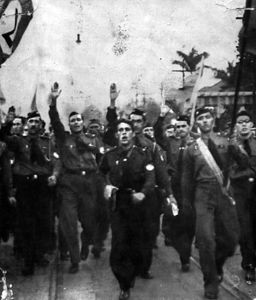
Salut intégraliste, « Anauê », d’origine indigène signifiant « Tu es mon frère » et ancien cri de guerre indigène.

La propagande de l’État Nouveau.
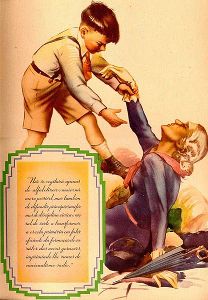
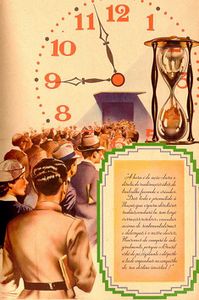

Edda Mussolini, fille de Benito Mussolini, fut reçue par Ademar de Barros lors de sa visite à São Paulo en 1939. L'Estado Novo entretenait une sympathie avec le fascisme nazi.


.jpg)


Conclusions
La crise de 1929 place toutes les sociétés américaines, c’est-à-dire des États-Unis, mais aussi d’Amérique latine, au bord du gouffre.
Elle montre les faiblesses du libéralisme économique, un libéralisme relatif puisque c’est un libéralisme dans lequel au fond l’État aide les hacendados, les industriels, les corporations, les banques et en même temps réprime les travailleurs.
Cette crise révèle les profondes inégalités de toutes ces sociétés et toutes ont besoin d’un leader charismatique qui uni et qui rassure la population ; toutes aussi on recourt au nationalisme y compris les États-Unis sous Roosevelt.
Le populisme permet aux classes dirigeantes d’éviter ou de supprimer les révolutions comme à Cuba en 1933, mais ils doivent souvent mettre en place une législation sociale afin de protéger les travailleurs et les plus démunis.
Partout, les grands perdants sont dans les campagnes les petits paysans et dans les villes les grands perdants sont les partis et les syndicats socialistes et communistes qui sont réprimés ou intégrés dans un grand parti national avec certaines bienveillances sociales.
Les tensions sociales sont étouffées, mais n’ont pas disparu et elles éclateront de nouveau après la Deuxième Guerre mondiale.